Phew! That's a bit of a mouthful; but the other title I came up with was probably too jokey: "Diversity isn't where a Welsh poet lives" (Dai Verse city.)
Anyway, the purpose of this post is to look at my local elected Council and see how it measures up in regards to gender mix and ethnic diversity. It's only because Labour have for years attempted to 'weaponise' these topics – as we have all witnessed when they fling labels around such as 'sexist!' and 'racist!' (the exclamation marks have in effect part of the word) – so I wondered how the party groups were doing in these two respects, partly as a break from all the current General Election activity. In particular: have Labour put their money where their mouth is, so to speak?
Because we have had so many changes over the years, including several party defections and a few by-elections – even since the last local elections just two years ago – the only sensible way to tackle this is to look at the state of the party groups as they are today (there are no Independents) which means just Conservatives, Labour and UKIP. I found this council web-page useful for reference.
First, the gender mix: here are the numbers of male (M) and female (F) councillors in each party group, followed in each case by the percentage female…
Conservatives (38) – 28 (M); 10 (F); 26% F
Labour (15) – 9 (M); 6 (F); 40% F
UKIP (2) – 2 (M); 0 (F); 0% F
Overall (55) – 39 (M); 16 (F); 29% F
Okay: that's not bad for Labour, actually, and okay for the Conservatives – though those who are avid 'equality' freaks will no doubt be less pleased. Personally, I have never been concerned about these matters – which is probably why it has taken me so many years to post about this! It was actually inspired by something I read about Emmanuel Macron's mostly-white campaign team just minutes before I started writing this; also because of the 'diversity' theme of tonight's Eurovision Song Contest – which was presented by three white males, by the way…
Right: on to ethnic mix now. It's the same style of tabulation for this, with (W) meaning 'white' and (E) standing for 'ethnic', as these are the preferred terms, as I understand the thinking to be this week. No doubt it will change soon enough(!)
Conservatives (38) – 33 (W); 5 (E); 13% E
Labour (15) – 14 (W); 1 (E); 7% E
UKIP (2) – 2 (W); 0 (E); 0% E
Overall (55) – 49 (W); 6 (E); 11% E
Poor UKIP really don't have enough members to do much about their participation in this diversity exercise – and to be fair to them, when they did have three members (up until several months ago) the third was at least female. Labour, though, are sadly lacking here – and they are the ones who kick up a fuss about these things. Next time they do so, feel free to fling this back at them!
Though there isn't any completely up-to-date census data on this, I think the overall figure is roughly proportional to the mix in our local population of some quarter of a million souls, perhaps a fraction high if anything.
Whether this exercise will prove to have been of any value or not remains to be seen – but at least we have the information on record in a form that might come in handy for future reference purposes.

Showing posts with label conservatives. Show all posts
Showing posts with label conservatives. Show all posts
Sunday, 14 May 2017

Friday, 12 May 2017
Wolf in Sheep's Clothing
As many of those folk who have known me for a long time, and especially in close-up, will already know, I am a very strong believer in a healthy democracy. This needs at least two (but hopefully not too many) political parties with credible policies and a reasonable hope of being elected to government.
We have increasingly lacked that proper structure here in Britain, which is why I have (as many readers will be aware) been playing a small part in trying to fix the issue. For the past nearly seven years this has meant trying to find a replacement main opposition party to the Conservatives – whose ongoing tenure in government seemed to me assured for many years to come – in the knowledge that Labour were going to more or less destroy themselves in about half a dozen years.
As I told people in the second half of 2010 and later, I knew that Labour had set themselves upon an irreversible path to their own demise once they had installed Ed[ward] Miliband as their party leader – though I doubt any of them believed me back then. The party was turning to the left, and then some. Now, of course, those people perhaps understand at least something of why I made that bold claim, and with such conviction.
Fast-forward to today and what do we find?
Labour continued to turn leftward, eventually and inevitably installing the real party-killer (Ed-M was just the catalyst that made it not only possible, but just about unavoidable) Jeremy Corbyn. It had to happen. Equally predictably, this move allowed the ever-lurking out-and-out Communists to infiltrate and dominate the party, using the movement they created called Momentum. Their long-awaited day had come!
Thus today's Labour party has become the wolf in sheep's clothing, and is busy transforming the party from within. The parliamentary party has, as they'd have expected, become a serious problem, because of all those pesky 'moderate', 'Blairite' or 'blue Labour' MPs as the current leadership (and especially Momentum) brands them.
Thus we are seeing a number of more 'suitable' candidates for the upcoming General Election being parachuted in to safe Labour seats, while the less safe seats are becoming more marginal in the present political climate so will probably be voted out of office anyway – not a significant issue, then.
The Labour party manifesto for this election reads like something that wouldn't have gone amiss in former Communist East Germany – and its supposedly draft version was leaked to two news outlets so that it became in effect de facto policy. As I posted on social media less than a day ago, the idea was to make it effectively impossible for the party to materially change anything – and indeed at the meeting to discuss any such changes that was held later in the day, it was reported as just 'tinkering' and making no substantive alterations.
Thus the Corbynite faction have what they have sought all along: the leader they wanted, the now-official policies they wanted, and their own/preferred people forming a majority of their parliamentary party a month from now.
This was the real reason they embraced the 'snap' election so readily: not to win it (they knew that wasn't possible) but to transform Labour into a genuine Communist Party disguised as something else, even if the camouflage isn't exactly fooling most people. Still, they have enough supporters for their needs, considerable evidence of which I continually find in various places.
Such a wolf can never again be a suitable alternative party to the Conservatives. As I said seven years ago, Labour had set itself upon a one-way street to destruction: there can be no way back. Perhaps, as some have surmised, they will split as they once did when the SDP was formed by 'the Gang of Four' more than a generation ago. If so, though, it will be for the same actual reason (i.e. not the public face) which will be currently-elected members seeking to avoid losing their seats – self-interest, in other words, so this would not make a breakaway party trustworthy.
With UKIP now losing support hugely, the party falling apart internally (which has been going on for some time now) and rapidly becoming a 'dead end', as I labelled them a few years back; the Greens continuing to fool nobody so with barely three percent support; and a slowly resurgent Liberal Democrat party as the only other even vaguely realistic alternatives; it is the last of these that – for all its faults – looks like being the only conceivable future opposition party out of those currently in existence.
What about possible new parties, though?
The wealthy UKIP financial supporter Arron Banks has been rumoured to be creating a new party, a kind of UKIP Mk 2 that is provisionally being called "The Patriotic Alliance" – but all has gone very quiet on that front for the past two months; i.e. from well before the snap election was called, so the current hiatus wasn't caused by that.
So, in conclusion, what we expect to happen in the next few months? Theresa May's Conservatives look set for a landslide win in next month's General Election. After that, Labour might or might not split, Arron Banks' new party might or might not be launched, and the Lib Dems might or might not continue to climb up the pecking order. It looks like interesting times ahead!
We have increasingly lacked that proper structure here in Britain, which is why I have (as many readers will be aware) been playing a small part in trying to fix the issue. For the past nearly seven years this has meant trying to find a replacement main opposition party to the Conservatives – whose ongoing tenure in government seemed to me assured for many years to come – in the knowledge that Labour were going to more or less destroy themselves in about half a dozen years.
As I told people in the second half of 2010 and later, I knew that Labour had set themselves upon an irreversible path to their own demise once they had installed Ed[ward] Miliband as their party leader – though I doubt any of them believed me back then. The party was turning to the left, and then some. Now, of course, those people perhaps understand at least something of why I made that bold claim, and with such conviction.
Fast-forward to today and what do we find?
Labour continued to turn leftward, eventually and inevitably installing the real party-killer (Ed-M was just the catalyst that made it not only possible, but just about unavoidable) Jeremy Corbyn. It had to happen. Equally predictably, this move allowed the ever-lurking out-and-out Communists to infiltrate and dominate the party, using the movement they created called Momentum. Their long-awaited day had come!
Thus today's Labour party has become the wolf in sheep's clothing, and is busy transforming the party from within. The parliamentary party has, as they'd have expected, become a serious problem, because of all those pesky 'moderate', 'Blairite' or 'blue Labour' MPs as the current leadership (and especially Momentum) brands them.
Thus we are seeing a number of more 'suitable' candidates for the upcoming General Election being parachuted in to safe Labour seats, while the less safe seats are becoming more marginal in the present political climate so will probably be voted out of office anyway – not a significant issue, then.
The Labour party manifesto for this election reads like something that wouldn't have gone amiss in former Communist East Germany – and its supposedly draft version was leaked to two news outlets so that it became in effect de facto policy. As I posted on social media less than a day ago, the idea was to make it effectively impossible for the party to materially change anything – and indeed at the meeting to discuss any such changes that was held later in the day, it was reported as just 'tinkering' and making no substantive alterations.
Thus the Corbynite faction have what they have sought all along: the leader they wanted, the now-official policies they wanted, and their own/preferred people forming a majority of their parliamentary party a month from now.
This was the real reason they embraced the 'snap' election so readily: not to win it (they knew that wasn't possible) but to transform Labour into a genuine Communist Party disguised as something else, even if the camouflage isn't exactly fooling most people. Still, they have enough supporters for their needs, considerable evidence of which I continually find in various places.
Such a wolf can never again be a suitable alternative party to the Conservatives. As I said seven years ago, Labour had set itself upon a one-way street to destruction: there can be no way back. Perhaps, as some have surmised, they will split as they once did when the SDP was formed by 'the Gang of Four' more than a generation ago. If so, though, it will be for the same actual reason (i.e. not the public face) which will be currently-elected members seeking to avoid losing their seats – self-interest, in other words, so this would not make a breakaway party trustworthy.
With UKIP now losing support hugely, the party falling apart internally (which has been going on for some time now) and rapidly becoming a 'dead end', as I labelled them a few years back; the Greens continuing to fool nobody so with barely three percent support; and a slowly resurgent Liberal Democrat party as the only other even vaguely realistic alternatives; it is the last of these that – for all its faults – looks like being the only conceivable future opposition party out of those currently in existence.
What about possible new parties, though?
The wealthy UKIP financial supporter Arron Banks has been rumoured to be creating a new party, a kind of UKIP Mk 2 that is provisionally being called "The Patriotic Alliance" – but all has gone very quiet on that front for the past two months; i.e. from well before the snap election was called, so the current hiatus wasn't caused by that.
So, in conclusion, what we expect to happen in the next few months? Theresa May's Conservatives look set for a landslide win in next month's General Election. After that, Labour might or might not split, Arron Banks' new party might or might not be launched, and the Lib Dems might or might not continue to climb up the pecking order. It looks like interesting times ahead!
Thursday, 6 April 2017
Reckless Abandon
The news today is that Mark Reckless – once upon a time Conservative MP for near-to-me Rochester & Strood constituency, who then switched party to UKIP – has now resigned from that party too. Just like his friend of many years, Douglas Carswell MP, he is now sitting as an Independent, though he is no longer an MP but a member of the Welsh Assembly.
Somewhat like the European Parliament, Assembly Members (AMs) can sit with a particular political grouping if they wish, and if they are accepted, and it appears that Mark R. will be sitting with the Conservative Group in that structure. As far as I am aware, he has not re-joined his original party, and I don't think they would want him – at least not unless and until he has demonstrated true loyalty to them this time, I can well imagine.
This is quite possibly what this 'grouping' move is intended to demonstrate over time, in the hope that he will be invited back in a year or two. It could be that he wants to be an MP again, and sees no chance of that happening if he had stayed within UKIP. Not only was he unlikely to be selected as a candidate (because he was not much liked within that party) but recent election results – including the by-election a few weeks ago where their leader Paul Nuttall stood and failed to take the seat, carrying on the tradition of his predecessor – show that the party is unable to win seats.
With opinion poll figures for UKIP showing a downward trend for a long time now, and vote share in by-elections dropping hugely, the writing was on the wall: there is seemingly no electoral future in UKIP. This surely at least partly explains why both Douglas and Mark have now left the party, and at this specific time. The official line is that with the triggering of Article 50, their work within UKIP is now complete. It's plausible, though I am sceptical.
That event did provide a convenient excuse on the occasion of this second resignation – but it does not account for the timing of the Carswell departure, which was a little before that date, in a kind of 'no man's land' on the political calendar – and the two departures must be viewed together, just as their both joining UKIP was staggered just weeks apart, and of course because of their long friendship.
Overall, I don't see today's change making much difference to anyone outside Wales, and probably very little change there either. I shall keep a weather eye on what develops over time; but that, I think, is all it warrants.
Somewhat like the European Parliament, Assembly Members (AMs) can sit with a particular political grouping if they wish, and if they are accepted, and it appears that Mark R. will be sitting with the Conservative Group in that structure. As far as I am aware, he has not re-joined his original party, and I don't think they would want him – at least not unless and until he has demonstrated true loyalty to them this time, I can well imagine.
This is quite possibly what this 'grouping' move is intended to demonstrate over time, in the hope that he will be invited back in a year or two. It could be that he wants to be an MP again, and sees no chance of that happening if he had stayed within UKIP. Not only was he unlikely to be selected as a candidate (because he was not much liked within that party) but recent election results – including the by-election a few weeks ago where their leader Paul Nuttall stood and failed to take the seat, carrying on the tradition of his predecessor – show that the party is unable to win seats.
With opinion poll figures for UKIP showing a downward trend for a long time now, and vote share in by-elections dropping hugely, the writing was on the wall: there is seemingly no electoral future in UKIP. This surely at least partly explains why both Douglas and Mark have now left the party, and at this specific time. The official line is that with the triggering of Article 50, their work within UKIP is now complete. It's plausible, though I am sceptical.
That event did provide a convenient excuse on the occasion of this second resignation – but it does not account for the timing of the Carswell departure, which was a little before that date, in a kind of 'no man's land' on the political calendar – and the two departures must be viewed together, just as their both joining UKIP was staggered just weeks apart, and of course because of their long friendship.
Overall, I don't see today's change making much difference to anyone outside Wales, and probably very little change there either. I shall keep a weather eye on what develops over time; but that, I think, is all it warrants.
Saturday, 25 March 2017
All's Well That's Carswell – or is it?
News today that Douglas Carswell – the original Conservative sitting-MP defector to UKIP – has left that party comes as little surprise: pundits and commentators have been expecting it for some time. He will now sit as an Independent.
Thus UKIP, which has never has had one of its own people elected to the House of Commons, has gone from no MPs to one (defector), and then to two with the second defection by Mark Reckless shortly after, then back to one a mere six months later, and now zero again, less than two years after the last General Election.
The timing of this move is interesting, coming as it does at a slightly odd time. Douglas states his reason as being the completion of the mission to leave the EU – but we haven't yet done so. Article 50 is to be triggered just four days from now, so if that was the reason why didn't he at least wait until then? The Referendum was held months ago, so that wasn't the cause either.
Apparently he has been liaising with senior Conservatives with the apparent aiming of rejoining his former party. I don't think that would go down well among the party's rank and file membership, and is something that I'd recommend be seriously pursued.
ANother ingredient in the mix is the possible imminent launch of UKIP big sponsor Arron Banks' new party, provisionally called the Patriotic Alliance. The feeling I get with that, though, is that he might be even less welcome there than back in the Conservative fold. I could be wrong.
In recent days, though, yet another movement has surfaced: this appears to be some kind of 'New UKIP'. While that is probably a dead-end route (the analogy of stopping digging when you're already in a hole of your own making springs to mind) it might provide a new home for Douglas C. I have no idea if that is even on his radar, but as mere speculation it is worth airing as one of the possibilities.
Behind all of this, though, I suspect is the realisation that UKIP – which I have long stated is a dead end – is dying, as polls and by-elections have been clearly showing. Here's Britain Elects' poll-of-polls graph covering the period since the May 2015 General Election…
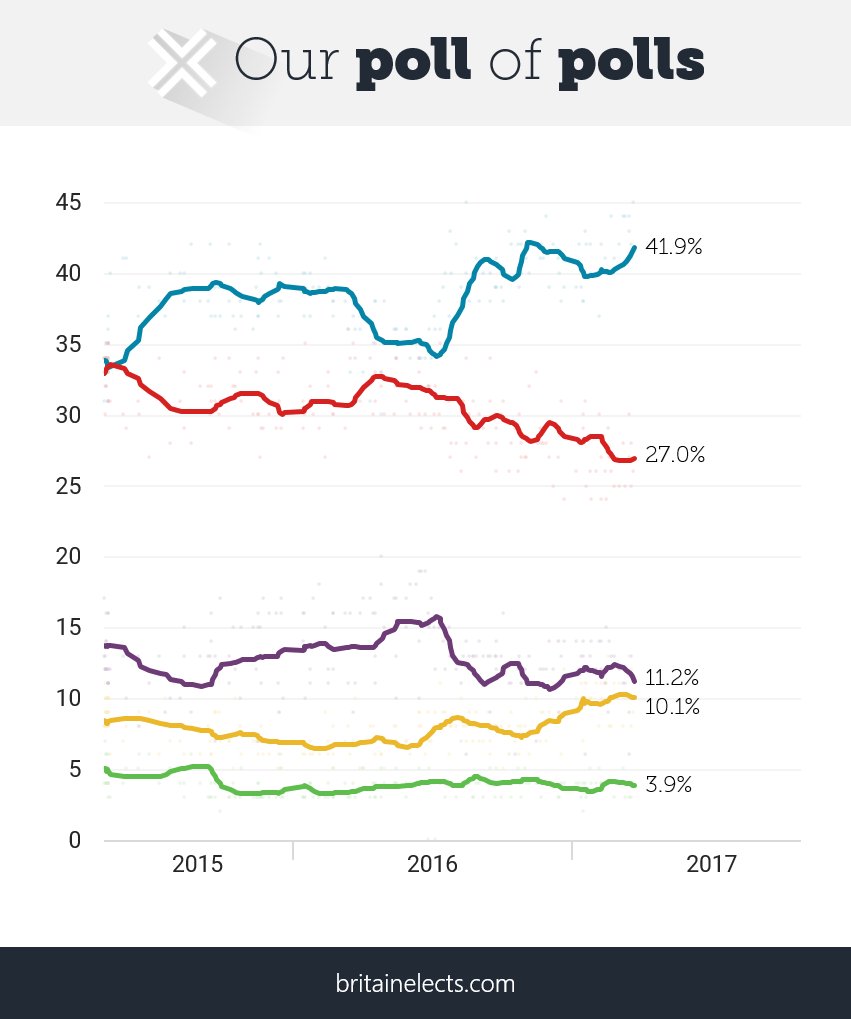
The UKIP polling support is clearly moribund, with the resurgent Liberal Democrats looking set to overtake them shortly. This has been borne out in a large number of by-election results in recent months, mostly council seats but still telling a strong story. UKIP votes have been slashed from the previous election in many of the contested seats, down to between a third and a half of their former vote share.
I watch these closely, and every week (Thursday night & Friday morning) you'll find the results with my comments re-tweeted on my Twitter timeline. The writing is now very clearly on the wall – and perhaps this is indeed the best time to get out and make oneself nominally available to any suitably-positioned new movement that could do with having on board an established political figure to give it some weight.
That could well be the calculation at work here.
Thus UKIP, which has never has had one of its own people elected to the House of Commons, has gone from no MPs to one (defector), and then to two with the second defection by Mark Reckless shortly after, then back to one a mere six months later, and now zero again, less than two years after the last General Election.
The timing of this move is interesting, coming as it does at a slightly odd time. Douglas states his reason as being the completion of the mission to leave the EU – but we haven't yet done so. Article 50 is to be triggered just four days from now, so if that was the reason why didn't he at least wait until then? The Referendum was held months ago, so that wasn't the cause either.
Apparently he has been liaising with senior Conservatives with the apparent aiming of rejoining his former party. I don't think that would go down well among the party's rank and file membership, and is something that I'd recommend be seriously pursued.
ANother ingredient in the mix is the possible imminent launch of UKIP big sponsor Arron Banks' new party, provisionally called the Patriotic Alliance. The feeling I get with that, though, is that he might be even less welcome there than back in the Conservative fold. I could be wrong.
In recent days, though, yet another movement has surfaced: this appears to be some kind of 'New UKIP'. While that is probably a dead-end route (the analogy of stopping digging when you're already in a hole of your own making springs to mind) it might provide a new home for Douglas C. I have no idea if that is even on his radar, but as mere speculation it is worth airing as one of the possibilities.
Behind all of this, though, I suspect is the realisation that UKIP – which I have long stated is a dead end – is dying, as polls and by-elections have been clearly showing. Here's Britain Elects' poll-of-polls graph covering the period since the May 2015 General Election…
The UKIP polling support is clearly moribund, with the resurgent Liberal Democrats looking set to overtake them shortly. This has been borne out in a large number of by-election results in recent months, mostly council seats but still telling a strong story. UKIP votes have been slashed from the previous election in many of the contested seats, down to between a third and a half of their former vote share.
I watch these closely, and every week (Thursday night & Friday morning) you'll find the results with my comments re-tweeted on my Twitter timeline. The writing is now very clearly on the wall – and perhaps this is indeed the best time to get out and make oneself nominally available to any suitably-positioned new movement that could do with having on board an established political figure to give it some weight.
That could well be the calculation at work here.
Friday, 4 November 2016
Rainham Central By-Election
The Rainham Central by-election was held yesterday (3 November 2016), caused by the sad loss of Mike O'Brien to cancer, and the insistence of at least one opposition party to stand where perhaps (as some have said) it should have been uncontested. In the event, a total of six candidates stood, representing the six enduring parties that we have around Medway. Others have come and gone, but these six can be relied upon for fielding candidates in Medway – though not necessarily in all seats or all cases.
Anyway, the by-election result is now in. The solid Conservative win is no surprise, with no less than 61% of the total vote; but perhaps Labour's third-place position will have been unexpected by some – though I had a strong feeling that it might go that way.
Indeed, I well recall rubbing my hands with glee at seeing the Statement of Persons Nominated – i.e. list of candidates – when it was published. That is always the moment when I know more or less what is going to be the outcome, and when I make my (sometimes public) predictions. It is always a delight when the ever-arrogant Medway Labour end up in third place or lower, as has happened a few times in recent elections, both local and national (e.g. Rochester & Strood last year).
Here are the vote numbers, in descending order as usual...
Even more noticeable is the sheer size of the winner's majority – over a thousand votes more than the runner-up, and in fact a good three and a half times the votes of UKIP and more than four times the Labour candidate's vote.
There's a real message for some of the parties in there somewhere...
Anyway, the by-election result is now in. The solid Conservative win is no surprise, with no less than 61% of the total vote; but perhaps Labour's third-place position will have been unexpected by some – though I had a strong feeling that it might go that way.
Indeed, I well recall rubbing my hands with glee at seeing the Statement of Persons Nominated – i.e. list of candidates – when it was published. That is always the moment when I know more or less what is going to be the outcome, and when I make my (sometimes public) predictions. It is always a delight when the ever-arrogant Medway Labour end up in third place or lower, as has happened a few times in recent elections, both local and national (e.g. Rochester & Strood last year).
Here are the vote numbers, in descending order as usual...
- Jan Aldous (Con) – 1,448
- Mark Mencattelli (UKIP) – 389
- Simon Allen (Lab) – 320
- Paul Chaplin (Lib Dem) – 137
- George Meegan (Green) – 61
- Mike Russell (Eng Dem) – 14
- Con: 61.1% (+9.9)
- UKIP: 16.4% (-5.2)
- Lab: 13.5% (-2.9)
- Lib Dem: 5.8% (+5.8)
- Green: 2.6% (-5.2)
- Eng Dem: 0.6% (+0.6)
Even more noticeable is the sheer size of the winner's majority – over a thousand votes more than the runner-up, and in fact a good three and a half times the votes of UKIP and more than four times the Labour candidate's vote.
There's a real message for some of the parties in there somewhere...
Monday, 24 October 2016
Strood South By-election
Edited to correct a misleading part taken from a Medway Labour tweet and scans
It is no secret that I have considerable affection for the Strood South ward of Medway Council, so it will come as no surprise that I took an interest in last Thursday's by-election. That event was caused by the resignation of UKIP councillor Catriona Reckless-Brown who will soon be moving to Wales where her husband (former Rochester & Strood MP Mark Reckless) has been selected to stand for the Welsh Assembly, also for UKIP.
The three Council seats in Strood South were at that time held by UKIP, Conservative (John Avey) and an Independent (Mark Joy, who had been elected as UKIP but then left the party) so very mixed – in fact the only ward of Medway Council's 22 to be a three-way split. There were six candidates in the by-election, including the two (one Conservative, Josie Iles, and one Labour, Isaac Igwe) who had lost their seats to the then two UKIP candidates.
The results of the by-election were thus, in descending order of number of votes cast:
Also note the wide gulf between them and the winner – more than 200 votes. It is to be noted that I predicted this outcome, and told a couple of people my forecast, though forgot to make it public until the morning of last Thursday, i.e. polling day! My exact prediction was "a comfortable Conservative win, with Labour and UKIP close together in second and third place, either way round." (It's on my Facebook page.)
The turnout was low, sadly, at 16·74% – just one in six eligible voters participated. By-elections tend to have significantly lower turnouts than full elections, and last year's council elections here were boosted by coinciding with the General Election. Indeed, back in May 2000, at the full council elections that year Luton (a Labour safe ward) had a turnout of just 17·37% – hardly any higher than this mere by-election.
EDIT: The Council leader, Alan Jarrett (Conservative), has today been reported in the local newspaper (not online, unfortunately) as saying that UKIP lost the seat because their councillors had been "ineffectual" since being elected some 17 months ago; and UKIP group leader Roy Freshwater is also quoted as saying they lost the seat (a) because of the weather and (b) because they don't have the 'party machine' that the two traditional big parties have. Medway Labour has selectively scanned parts of the relevant page from the 'paper. This they misrepresented, but this edit corrects what I wrote here before, having taken the Medway Labour claim as correct. I really must learn that they can NEVER be trusted!
I certainly agree that the UKIP councillors have been, frankly, a waste of space, and have done as little work as their counterparts in (say) the European Parliament, who are known to be 'the laziest party group' throughout the entire Parliament – though very good at taking as much (public) money as they can, including the occasional 'fiddle' that comes to light (Janice Atkinson's restaurant bill that was in the news around a year ago) – and who knows how much there might be as yet unrevealed?
Anyway, keeping to their usual practice, and as their own fellow has now publicly stated, the 'Kippers on our Council really do seem to have done nothing of any consequence to represent those who elected them in what was, after all, just a national 'anti-establishment' mood swing at the time – May 2015. That of course has faded since then, as I predicted it would, and UKIP Cllr Roy Freshwater's own claim of a lack of a big 'machine' would indeed have hampered their chances of holding the seat at this time. The weather affects all parties equally, and no doubt contributed toward the low turn-out.
Even so, the best they could have done would have been to come second, and I think just 150 votes or so behind the winner: it could have been a slightly closer contest, and they'd have been the runners-up rather than Labour. However, the bigger issue for voters was the lack of activity by UKIP in the ward and elsewhere in Medway for that matter. These things are noticed and the word gets around. It was no doubt what lost the three we had before May 2015 their seats (Messrs Irvine, Mason and Rodberg, all of whom re-stood but lost.)
To me it seems obvious that another of my (longer-standing this time) predictions – that there will be no UKIP councillors at Medway after the next all-out elections – will also come to pass.
And whose fault will that be? Theirs alone!
It is no secret that I have considerable affection for the Strood South ward of Medway Council, so it will come as no surprise that I took an interest in last Thursday's by-election. That event was caused by the resignation of UKIP councillor Catriona Reckless-Brown who will soon be moving to Wales where her husband (former Rochester & Strood MP Mark Reckless) has been selected to stand for the Welsh Assembly, also for UKIP.
The three Council seats in Strood South were at that time held by UKIP, Conservative (John Avey) and an Independent (Mark Joy, who had been elected as UKIP but then left the party) so very mixed – in fact the only ward of Medway Council's 22 to be a three-way split. There were six candidates in the by-election, including the two (one Conservative, Josie Iles, and one Labour, Isaac Igwe) who had lost their seats to the then two UKIP candidates.
The results of the by-election were thus, in descending order of number of votes cast:
- Josie Iles (Con) – 724
- Isaac Igwe (Lab) – 521
- Karl Weller (UKIP – 480
- Steve Dyke (Green) – 74
- Isabelle Cherry (LD) – 62
- Mike Russell (Eng Dem) – 23
Also note the wide gulf between them and the winner – more than 200 votes. It is to be noted that I predicted this outcome, and told a couple of people my forecast, though forgot to make it public until the morning of last Thursday, i.e. polling day! My exact prediction was "a comfortable Conservative win, with Labour and UKIP close together in second and third place, either way round." (It's on my Facebook page.)
The turnout was low, sadly, at 16·74% – just one in six eligible voters participated. By-elections tend to have significantly lower turnouts than full elections, and last year's council elections here were boosted by coinciding with the General Election. Indeed, back in May 2000, at the full council elections that year Luton (a Labour safe ward) had a turnout of just 17·37% – hardly any higher than this mere by-election.
EDIT: The Council leader, Alan Jarrett (Conservative), has today been reported in the local newspaper (not online, unfortunately) as saying that UKIP lost the seat because their councillors had been "ineffectual" since being elected some 17 months ago; and UKIP group leader Roy Freshwater is also quoted as saying they lost the seat (a) because of the weather and (b) because they don't have the 'party machine' that the two traditional big parties have. Medway Labour has selectively scanned parts of the relevant page from the 'paper. This they misrepresented, but this edit corrects what I wrote here before, having taken the Medway Labour claim as correct. I really must learn that they can NEVER be trusted!
I certainly agree that the UKIP councillors have been, frankly, a waste of space, and have done as little work as their counterparts in (say) the European Parliament, who are known to be 'the laziest party group' throughout the entire Parliament – though very good at taking as much (public) money as they can, including the occasional 'fiddle' that comes to light (Janice Atkinson's restaurant bill that was in the news around a year ago) – and who knows how much there might be as yet unrevealed?
Anyway, keeping to their usual practice, and as their own fellow has now publicly stated, the 'Kippers on our Council really do seem to have done nothing of any consequence to represent those who elected them in what was, after all, just a national 'anti-establishment' mood swing at the time – May 2015. That of course has faded since then, as I predicted it would, and UKIP Cllr Roy Freshwater's own claim of a lack of a big 'machine' would indeed have hampered their chances of holding the seat at this time. The weather affects all parties equally, and no doubt contributed toward the low turn-out.
Even so, the best they could have done would have been to come second, and I think just 150 votes or so behind the winner: it could have been a slightly closer contest, and they'd have been the runners-up rather than Labour. However, the bigger issue for voters was the lack of activity by UKIP in the ward and elsewhere in Medway for that matter. These things are noticed and the word gets around. It was no doubt what lost the three we had before May 2015 their seats (Messrs Irvine, Mason and Rodberg, all of whom re-stood but lost.)
To me it seems obvious that another of my (longer-standing this time) predictions – that there will be no UKIP councillors at Medway after the next all-out elections – will also come to pass.
And whose fault will that be? Theirs alone!
Sunday, 7 February 2016
Socially Engineered
In London, Zac Goldsmith has an uphill battle ahead of him to win the London Mayoralty this coming May. Labour's Sadiq Khan is widely tipped to win instead, a few think by quite a margin.
Why? Is it because Sadiq is better for the job than Zac would be? No: the exact opposite is the case – though Zac doesn't have the charisma of the incumbent, Boris Johnson. He'd still be vastly better for London, especially in the upcoming years, but it will take a lot for him to win. It is definitely possible, but far from easy.
Why should this be? It's down to the social engineering of London during the Labour years in government, especially the vast influx of immigrants from what were known would be Labour-favourable (one way or another) origins. The scale of that situation has been reported in a few places in recent months, and there are a number of associated aspects of all of that which show just bad that purely politically-motivated policy has been – most notably for the newcomers themselves.
We here in Medway have also witnessed social engineering at work in places such as Troy Town, which is an area within Rochester. Back in the 'eighties, the then Labour-run predecessor council to today's Unitary Authority arranged for a lot of social housing to be built in Troy Town. If you were to wander around that area, you'd no doubt be surprised at just how much of this ill-fitting 'square peg in round hole' accommodation there is there. It isn't vast, but there is a fair amount of it, and of course it's generally high-density – so there are a lot of votes embedded in those quarters.
A former mayor, who has lived here much longer than I have, gave me the low-down on this, including names and dates. It explains why that ward (when it was a separate ward) was the only part of Rochester to have Labour councillors even after the Unitary Authority came into being, and even after the following local elections when Labour lost its other Rochester seats. They are still there today, though not very well liked – and that is a whole 'nother story, which is very interesting in itself but doesn't concern us today.
Interestingly, because there was already a fair amount of social housing and similar in neighbouring Strood, and Labour seemed to think they had those seats by default, perhaps too much of their effort went into the 'Troy Town project' – and there are still signs of that going on today, I notice whenever I pass through there. The consequence seems to have been that the good folks of urban Strood (the rural part is a separate entity) saw what was going on in other places that had Conservative representation and grew ever more marginal in their voting at each successive local election.
By the year 2003 they had switched over (grown up?) and elected five out of six Conservative councillors, with Fred Bacon holding on in what was by then called Strood South ward only because of his strong personal vote. Since then, Labour has held only one or none of the three seats in each of Strood North and Strood South wards, and now has no seats there at all.
Other Labour 'safe' territory on our council also had the odd seat lost to Conservatives last May: Twydall, and Luton &Wayfield. No longer do they have any safe seats on Medway Council, despite all they have done to try to wangle things (including their ward boundary changes that were accepted by the Local Government Commission, taking effect in 2003).
The overall lesson in all of this is to at least be aware of any such political manipulations in the local community and nearby. Even if there is little if anything any of us as ordinary citizens can do about such social engineering, at least we ought to know of it and realise what is really going on.
Of course, this could equally well be done the other way around by Conservatives or other elected representatives on the political right, but my experience has been that this is rarely done for political reasons and in most instances is done just to improve the quality of an area – which is surely what those they are representing would wish them to do. I have seen this from the inside: different motivation, different goal in view; so let us not be misled on that.
Meanwhile, Labour here are fighting a losing battle – and I have seen a number of signs that, behind the public face, they do realise this – especially since the advent of the Corbyn & company party leadership, which makes an already bad situation for them even worse. The rest of us here in Medway, though, have to live with the fallout from their manipulations from years past – just as Londoners are having to cope with a raft of acute and in some cases severe consequences of the last Labour government's self-serving policies that ripped apart our Capital's core being and transformed it entirely.
At least it never got anywhere near that extent here...
Why? Is it because Sadiq is better for the job than Zac would be? No: the exact opposite is the case – though Zac doesn't have the charisma of the incumbent, Boris Johnson. He'd still be vastly better for London, especially in the upcoming years, but it will take a lot for him to win. It is definitely possible, but far from easy.
Why should this be? It's down to the social engineering of London during the Labour years in government, especially the vast influx of immigrants from what were known would be Labour-favourable (one way or another) origins. The scale of that situation has been reported in a few places in recent months, and there are a number of associated aspects of all of that which show just bad that purely politically-motivated policy has been – most notably for the newcomers themselves.
We here in Medway have also witnessed social engineering at work in places such as Troy Town, which is an area within Rochester. Back in the 'eighties, the then Labour-run predecessor council to today's Unitary Authority arranged for a lot of social housing to be built in Troy Town. If you were to wander around that area, you'd no doubt be surprised at just how much of this ill-fitting 'square peg in round hole' accommodation there is there. It isn't vast, but there is a fair amount of it, and of course it's generally high-density – so there are a lot of votes embedded in those quarters.
A former mayor, who has lived here much longer than I have, gave me the low-down on this, including names and dates. It explains why that ward (when it was a separate ward) was the only part of Rochester to have Labour councillors even after the Unitary Authority came into being, and even after the following local elections when Labour lost its other Rochester seats. They are still there today, though not very well liked – and that is a whole 'nother story, which is very interesting in itself but doesn't concern us today.
Interestingly, because there was already a fair amount of social housing and similar in neighbouring Strood, and Labour seemed to think they had those seats by default, perhaps too much of their effort went into the 'Troy Town project' – and there are still signs of that going on today, I notice whenever I pass through there. The consequence seems to have been that the good folks of urban Strood (the rural part is a separate entity) saw what was going on in other places that had Conservative representation and grew ever more marginal in their voting at each successive local election.
By the year 2003 they had switched over (grown up?) and elected five out of six Conservative councillors, with Fred Bacon holding on in what was by then called Strood South ward only because of his strong personal vote. Since then, Labour has held only one or none of the three seats in each of Strood North and Strood South wards, and now has no seats there at all.
Other Labour 'safe' territory on our council also had the odd seat lost to Conservatives last May: Twydall, and Luton &Wayfield. No longer do they have any safe seats on Medway Council, despite all they have done to try to wangle things (including their ward boundary changes that were accepted by the Local Government Commission, taking effect in 2003).
The overall lesson in all of this is to at least be aware of any such political manipulations in the local community and nearby. Even if there is little if anything any of us as ordinary citizens can do about such social engineering, at least we ought to know of it and realise what is really going on.
Of course, this could equally well be done the other way around by Conservatives or other elected representatives on the political right, but my experience has been that this is rarely done for political reasons and in most instances is done just to improve the quality of an area – which is surely what those they are representing would wish them to do. I have seen this from the inside: different motivation, different goal in view; so let us not be misled on that.
Meanwhile, Labour here are fighting a losing battle – and I have seen a number of signs that, behind the public face, they do realise this – especially since the advent of the Corbyn & company party leadership, which makes an already bad situation for them even worse. The rest of us here in Medway, though, have to live with the fallout from their manipulations from years past – just as Londoners are having to cope with a raft of acute and in some cases severe consequences of the last Labour government's self-serving policies that ripped apart our Capital's core being and transformed it entirely.
At least it never got anywhere near that extent here...
Friday, 8 May 2015
That Was The Election, That Was!
Well, that was one for the history books!
The General Election saw a small Conservative overall majority (something I had been privately saying was now a distinct possibility) and the loss of most Liberal Democrat seats – fifty of their 58 now gone.
My scientifically-modelled (such as it is: I don't really go in for making nationwide predictions) expectations were cautious to the point of pessimism, though still better for the Conservatives than any poll or betting market at some 295 seats, with only Harry Cole of Guido Fawkes fame making the same prediction.
In Scotland, the SNP took 56 of the 59 seats, interestingly leaving one seat each there continuing to be held by the Conservatives, Labour and the Lib Dems. The expectation (mine and many others') that they would largely wipe out Labour north of the border has been even more devastatingly accurate than anticipated! The Conservatives had virtually no seats in Scotland to lose, which turned out to be a significant contributor to the asymmetric shifts during this election
Another such shift was in the target seats 'battleground', where the Conservatives took a fair number of their target Labour seats, whereas Labour failed to take more than a handful of their targets. Even the two most marginal such seats remained with the Blues, as did many more of their 106 targets. The Conservatives had concentrated on just forty target seats, and that focus aided their greater success, despite having significantly fewer activists and helpers on the ground.
Locally, the results have been exactly as I predicted – but only because, by now, the Conservative candidate for Rochester & Strood constituency – Kelly Tolhurst – had been able to make herself known more fully around the other eight wards in the 'patch' – rather than just her Rochester West presence as a councillor for the past four years.
This, as I said at the time of the by-election some six months ago, was the biggest ingredient in the equation at that time, as the by-election had, then, just been dropped on everyone with no time to work toward it. As I urged back then, the time to start working toward the General Election was immediately, right then – and to her credit and that of her team, they did just that. I then knew that the seat would be hers, and indeed it became so, and by a very healthy margin of 24k votes to UKIP Mark Reckless' circa 16k votes.
That was a good win, on so many levels!
Obviously, Tracey Crouch and Rehman Chishti held their seats easily, which was hardly a surprise. Poor Tristan Osborne, having door-knocked in Chatham & Aylesford for some weeks and getting the same response, reportedly had in effect resigned himself to abject defeat and has been reported as conceding that 'Tracey is doing an OK job as MP'.
The upshot of all of this is that the country now has a truly Conservative national government (despite what some try to claim) and all the drag of the past five years is now lifted away. Some will try to portray that as uncaring, a 'government without a heart' – but those who are both honest and intelligent enough to see past the Lefty spin will know that this is not so.
The breaking of the 'client State' will release the true potential of all our citizens who have true value, while protecting those who genuinely cannot contribute. These days, I fall into the latter category owing to age and health issues – though I still do not claim any benefits.
This election has done what I had been hoping for so long: it has made the next phase of our country's ascendancy back into the top echelon of the world's nations possible, and indeed highly probable, within just a few years.
Indications are strong that the international community has been waiting (dare I say eagerly?) for this, if anything even more strongly than they did five years ago, when the high probability of a Conservative-led government was the only prospect staying the hands of the big credit rating agencies who would otherwise have severely marked-down Britain's credit rating back in the Spring of 2010.
Now all we have in that respect (by the way) is a sliver shaved off our rating, purely symbolically (it was the minimum possible downgrade) to keep other affected nations happy, and only because of the Eurozone's woes that have impacted a chunk of our trading. In other words, none of that, slight though it was, has been because of any real deficiency here in Britain.
Thus the scene is set for what promises to be a very interesting few years immediately up ahead!
The General Election saw a small Conservative overall majority (something I had been privately saying was now a distinct possibility) and the loss of most Liberal Democrat seats – fifty of their 58 now gone.
My scientifically-modelled (such as it is: I don't really go in for making nationwide predictions) expectations were cautious to the point of pessimism, though still better for the Conservatives than any poll or betting market at some 295 seats, with only Harry Cole of Guido Fawkes fame making the same prediction.
In Scotland, the SNP took 56 of the 59 seats, interestingly leaving one seat each there continuing to be held by the Conservatives, Labour and the Lib Dems. The expectation (mine and many others') that they would largely wipe out Labour north of the border has been even more devastatingly accurate than anticipated! The Conservatives had virtually no seats in Scotland to lose, which turned out to be a significant contributor to the asymmetric shifts during this election
Another such shift was in the target seats 'battleground', where the Conservatives took a fair number of their target Labour seats, whereas Labour failed to take more than a handful of their targets. Even the two most marginal such seats remained with the Blues, as did many more of their 106 targets. The Conservatives had concentrated on just forty target seats, and that focus aided their greater success, despite having significantly fewer activists and helpers on the ground.
Locally, the results have been exactly as I predicted – but only because, by now, the Conservative candidate for Rochester & Strood constituency – Kelly Tolhurst – had been able to make herself known more fully around the other eight wards in the 'patch' – rather than just her Rochester West presence as a councillor for the past four years.
This, as I said at the time of the by-election some six months ago, was the biggest ingredient in the equation at that time, as the by-election had, then, just been dropped on everyone with no time to work toward it. As I urged back then, the time to start working toward the General Election was immediately, right then – and to her credit and that of her team, they did just that. I then knew that the seat would be hers, and indeed it became so, and by a very healthy margin of 24k votes to UKIP Mark Reckless' circa 16k votes.
That was a good win, on so many levels!
Obviously, Tracey Crouch and Rehman Chishti held their seats easily, which was hardly a surprise. Poor Tristan Osborne, having door-knocked in Chatham & Aylesford for some weeks and getting the same response, reportedly had in effect resigned himself to abject defeat and has been reported as conceding that 'Tracey is doing an OK job as MP'.
The upshot of all of this is that the country now has a truly Conservative national government (despite what some try to claim) and all the drag of the past five years is now lifted away. Some will try to portray that as uncaring, a 'government without a heart' – but those who are both honest and intelligent enough to see past the Lefty spin will know that this is not so.
The breaking of the 'client State' will release the true potential of all our citizens who have true value, while protecting those who genuinely cannot contribute. These days, I fall into the latter category owing to age and health issues – though I still do not claim any benefits.
This election has done what I had been hoping for so long: it has made the next phase of our country's ascendancy back into the top echelon of the world's nations possible, and indeed highly probable, within just a few years.
Indications are strong that the international community has been waiting (dare I say eagerly?) for this, if anything even more strongly than they did five years ago, when the high probability of a Conservative-led government was the only prospect staying the hands of the big credit rating agencies who would otherwise have severely marked-down Britain's credit rating back in the Spring of 2010.
Now all we have in that respect (by the way) is a sliver shaved off our rating, purely symbolically (it was the minimum possible downgrade) to keep other affected nations happy, and only because of the Eurozone's woes that have impacted a chunk of our trading. In other words, none of that, slight though it was, has been because of any real deficiency here in Britain.
Thus the scene is set for what promises to be a very interesting few years immediately up ahead!
Friday, 10 April 2015
Throwing Money Around
As expected, the upcoming General Election has brought out the perennial policy approaches.
Basically, the right-wing is careful with other people's money, but know when and where to spend for beneficial results to our society, whereas the left-wing are profligate with the population's money that they take in ever-increasing taxes (many of them invisible to the man-in-the-street).
Now, any idiot can use his or her elected position to steal off everyone else and then fling that money at causes that suit their own ambitions, their cronies or their future electoral success. I could list numerous examples of this, from the Police and Crime Commissioner to the former Government's Ministers, and various points in between – and beyond (e.g. the EU).
A perhaps surprisingly useful 'litmus test' – surprising, that is, in what it ends up revealing – is spending on the National Health Service (NHS).
Now, there's a whole debate to be had on whether we should even have an NHS in its current form, and many with knowledge of medicine's current needs might say with justification that – given the choice – they wouldn't start from here, but we do have to work with what we've got today.
On this topic, there are those rabid Lefties and the like who are obsessed with public ownership of the entire NHS, and are – erroneously – critical of the present government for 'privatising' the NHS. In fact, only six percent (and a bit) is in private or charity (third sector) hands, and of that around five percent was transferred by the preceding Labour government. Only one percent or so has followed that during the past nearly five years. Oops...
In the present election campaign, though, it is the Liberal Democrats who are repeatedly pushing their policy of throwing money at the NHS as if that is the way to improve the service.
It isn't.
Money is only one of the means to an end, and the present Conservative-driven methodology of modestly increasing spending year-on-year – to remove the excuse of 'under-funding' or 'cuts' as the supposed cause of inadequate performance – while improving ways of working.and cutting out waste, is the right way to go. I have witnessed so much of both sides and their vastly different philosophies over the decades, including the 22 years I worked in the Civil Service, that I have become well aware of the virtues and demerits of each side of the argument.
Interestingly, it was Labour who had backed themselves into a corner through their vast overspending during their time in office that resulted in their cluelessness necessitating actual cuts in NHS spending. As I indicated above, this would provide an oh-so-convenient excuse for the dropping of standards within the (heavily-Unionised) NHS and, in effect, a form of blackmail to the government of the day to up spending on the NHS hugely. It would backfire and people would be harmed in the process.
It might sound somewhat Buddhist in nature, but 'the middle path' is the right way to deal with this whole topic – and there are others that are similar, for that matter. Apply intelligence and insight, not dogma, laziness or vested interests, and the NHS can continue well into the future, adapting and improving, staying relevant and valuable.
Take any other path and its future becomes highly uncertain...
Basically, the right-wing is careful with other people's money, but know when and where to spend for beneficial results to our society, whereas the left-wing are profligate with the population's money that they take in ever-increasing taxes (many of them invisible to the man-in-the-street).
Now, any idiot can use his or her elected position to steal off everyone else and then fling that money at causes that suit their own ambitions, their cronies or their future electoral success. I could list numerous examples of this, from the Police and Crime Commissioner to the former Government's Ministers, and various points in between – and beyond (e.g. the EU).
A perhaps surprisingly useful 'litmus test' – surprising, that is, in what it ends up revealing – is spending on the National Health Service (NHS).
Now, there's a whole debate to be had on whether we should even have an NHS in its current form, and many with knowledge of medicine's current needs might say with justification that – given the choice – they wouldn't start from here, but we do have to work with what we've got today.
On this topic, there are those rabid Lefties and the like who are obsessed with public ownership of the entire NHS, and are – erroneously – critical of the present government for 'privatising' the NHS. In fact, only six percent (and a bit) is in private or charity (third sector) hands, and of that around five percent was transferred by the preceding Labour government. Only one percent or so has followed that during the past nearly five years. Oops...
In the present election campaign, though, it is the Liberal Democrats who are repeatedly pushing their policy of throwing money at the NHS as if that is the way to improve the service.
It isn't.
Money is only one of the means to an end, and the present Conservative-driven methodology of modestly increasing spending year-on-year – to remove the excuse of 'under-funding' or 'cuts' as the supposed cause of inadequate performance – while improving ways of working.and cutting out waste, is the right way to go. I have witnessed so much of both sides and their vastly different philosophies over the decades, including the 22 years I worked in the Civil Service, that I have become well aware of the virtues and demerits of each side of the argument.
Interestingly, it was Labour who had backed themselves into a corner through their vast overspending during their time in office that resulted in their cluelessness necessitating actual cuts in NHS spending. As I indicated above, this would provide an oh-so-convenient excuse for the dropping of standards within the (heavily-Unionised) NHS and, in effect, a form of blackmail to the government of the day to up spending on the NHS hugely. It would backfire and people would be harmed in the process.
It might sound somewhat Buddhist in nature, but 'the middle path' is the right way to deal with this whole topic – and there are others that are similar, for that matter. Apply intelligence and insight, not dogma, laziness or vested interests, and the NHS can continue well into the future, adapting and improving, staying relevant and valuable.
Take any other path and its future becomes highly uncertain...
Tuesday, 31 March 2015
Too Dull
So far, the pre-election campaign has been rather dull. I hope that, now the campaign is officially under way, it will liven up and becoming more likely to grab the electorate's attention.
Although all parties (well, most of them anyway) have some value and validity, realistically it is only the two parties who have any realistic possibility of forming or (in coalition) leading the next national government are Labour and the Conservatives.
Labour have at least got an actor to participate in this evening's election broadcast – something they've tried before, as have others. Getting a celebrity's endorsement of – and, even better, participation in – a party's campaign is often thought by party campaign managers and other senior members of a party as welcome and helpful.
It probably is, but is it justified? Only if the end can somehow be said to justify the means – but not for an honest party, for the reasons that Daniel Hannan warned about four years ago, among others I could mention, and indeed have touched on two or three times in recent years. For today, though, Dan's piece will more than suffice.
Apart from that, Labour has so far shown little really aspirational stuff, just anti-Conservatism and anti-Coalition stances as usual. Boring and tedious! There is also little appearance of their party leader – who, most notably, has been conspicuously left off many of their candidate's materials completely. That in itself is very telling indeed...
As for the Conservatives, their workmanlike approach is adequate, if not exactly innovative, and mostly looking back at past successes. The trouble with that is that it is repetitive with no new material coming through (unless some news suddenly appears, so is reactive), and gives no real look to the future apart from a nebulous 'we shall do such-and-such in the next five years' and no more.
Now, looking to past success is a good, solid foundation, and reinforcement through repetition is the second biggest reason we have political soundbite slogans' (the first is for headlines in the media). Nevertheless, one doesn't make a house by merely laying the foundation. It needs more – something more 'concrete' for the future than mere, well, concrete!
If I were the Conservative strategist, I'd be preparing two very specific election broadcasts. One would be a carefully-crafted, non-exaggerated and as factual as possible, year-by-year account of how a typical family would be faring under a majority Conservative government, from now, so six brief episodes in all.
The other would feature (a) another, somewhat similar but clearly different family; (b) a pensioner; and (c) a University student living away from home. The story (again portrayed as accurately as possibly and without hyperbole) would be a 'fork in the road', and would show each of these players five years hence under a Labour or Labour-led government, and then under a Conservative government (that way around, to end on a high note).
For all I know, perhaps such works are being prepared right now – but indications so far, including attitudes and near-robotic sharing/re-tweeting the party's national output out in the country (including in my broad area of west and north Kent), suggest that they are content to keep to the old, traditional ways, with momentary flashes of innovation that will make (at most) small differences in safe seats and excite no-one 'floating' in any of the marginals.
I could of course be wrong – and of course I realise that all the donkey work still has to be done come what may, and rightly so, so no complaint or otherwise on that score – but the way the party is 'selling' itself, its candidates and its plans for all our futures, deserves to be re-thought and raised several notches.
It also needs to be geared more to drawing people in, rather than just spouting lines and statistics at them like some kind of lecturer. That approach no longer really works in today's society. David Cameron's occasional brief summary at Prime Minister's Questions does that with much greater impact in just a few seconds: "Growth up, employment up, unemployment down, the deficit halved" – that kind of approach, but make it secondary and brief like that!
UPDATE @ 1700 hrs: This by Peter Bingle at Total Politics today not only fits well with what I have written here, it goes further with some additional ideas and is also well worth reading.
Just for information: I am not attempting to get myself recruited as a party strategist, just trying to be helpful!
Although all parties (well, most of them anyway) have some value and validity, realistically it is only the two parties who have any realistic possibility of forming or (in coalition) leading the next national government are Labour and the Conservatives.
Labour have at least got an actor to participate in this evening's election broadcast – something they've tried before, as have others. Getting a celebrity's endorsement of – and, even better, participation in – a party's campaign is often thought by party campaign managers and other senior members of a party as welcome and helpful.
It probably is, but is it justified? Only if the end can somehow be said to justify the means – but not for an honest party, for the reasons that Daniel Hannan warned about four years ago, among others I could mention, and indeed have touched on two or three times in recent years. For today, though, Dan's piece will more than suffice.
Apart from that, Labour has so far shown little really aspirational stuff, just anti-Conservatism and anti-Coalition stances as usual. Boring and tedious! There is also little appearance of their party leader – who, most notably, has been conspicuously left off many of their candidate's materials completely. That in itself is very telling indeed...
As for the Conservatives, their workmanlike approach is adequate, if not exactly innovative, and mostly looking back at past successes. The trouble with that is that it is repetitive with no new material coming through (unless some news suddenly appears, so is reactive), and gives no real look to the future apart from a nebulous 'we shall do such-and-such in the next five years' and no more.
Now, looking to past success is a good, solid foundation, and reinforcement through repetition is the second biggest reason we have political soundbite slogans' (the first is for headlines in the media). Nevertheless, one doesn't make a house by merely laying the foundation. It needs more – something more 'concrete' for the future than mere, well, concrete!
If I were the Conservative strategist, I'd be preparing two very specific election broadcasts. One would be a carefully-crafted, non-exaggerated and as factual as possible, year-by-year account of how a typical family would be faring under a majority Conservative government, from now, so six brief episodes in all.
The other would feature (a) another, somewhat similar but clearly different family; (b) a pensioner; and (c) a University student living away from home. The story (again portrayed as accurately as possibly and without hyperbole) would be a 'fork in the road', and would show each of these players five years hence under a Labour or Labour-led government, and then under a Conservative government (that way around, to end on a high note).
For all I know, perhaps such works are being prepared right now – but indications so far, including attitudes and near-robotic sharing/re-tweeting the party's national output out in the country (including in my broad area of west and north Kent), suggest that they are content to keep to the old, traditional ways, with momentary flashes of innovation that will make (at most) small differences in safe seats and excite no-one 'floating' in any of the marginals.
I could of course be wrong – and of course I realise that all the donkey work still has to be done come what may, and rightly so, so no complaint or otherwise on that score – but the way the party is 'selling' itself, its candidates and its plans for all our futures, deserves to be re-thought and raised several notches.
It also needs to be geared more to drawing people in, rather than just spouting lines and statistics at them like some kind of lecturer. That approach no longer really works in today's society. David Cameron's occasional brief summary at Prime Minister's Questions does that with much greater impact in just a few seconds: "Growth up, employment up, unemployment down, the deficit halved" – that kind of approach, but make it secondary and brief like that!
UPDATE @ 1700 hrs: This by Peter Bingle at Total Politics today not only fits well with what I have written here, it goes further with some additional ideas and is also well worth reading.
Just for information: I am not attempting to get myself recruited as a party strategist, just trying to be helpful!
Thursday, 26 February 2015
Medway Budget Council Meeting 2015 – Actuals
Well, that was it. I didn't stay until the end, only until the Budget item was dealt with (including convolutions caused by amendments) and voted upon, with the usual (and expected) result: it passed and the amendments were defeated.
So, was the process the same as in previous years? Essentially, yes – just as I outlined in my previous post, but a little shriller, with three Labour members shouting during their speaking times, quite apart from the usual heckling and hectoring for which the Labour group is notorious. It was obvious that elections were coming...
The matters I mentioned in my previous post did come up; and the alert observer would have sussed out very easily what was really going on, especially with the local media present. Tonight's claque was primarily the Trades Union and Socialist Coalition (TUSC) who are probably even more Communist-alike than the Socialist Workers Party – though I suspect it is close to being a tie!
As I always do at these annual events, because one member of each party gets unlimited speaking time, I time each of them, so here are this year's figures, for the record...
There was little of particular note this time, policies-wise, really just the FUSE Festival, which (it transpired) had been cancelled because the Arts Council, who had previously provided match-funding, had this year withdrawn that funding as this particular festival was considered 'poor value' to be subsidised from the public purse.
That echoes my own feelings, and I have long considered that the only way to be sure of its ongoing viability would be for it to become essentially self-financing and the council become merely a facilitator and promoter through its 'What's On?' print and on-line facilities.
In the end, what seems to have been some unspecified nifty footwork behind the scenes has resulted in the Arts Council re-opening the file and partially relenting. Thus the festival will go ahead after all, but in a slimmed-down form as its funding will, in total, be a little less than half its customary level.
There were other 'political footballs' including the canard that is the mythos regarding Rochester Airport. I have dealt with this topic elsewhere, and might even upload a video where I discuss the topic in moderate depth (it's already recorded, I am just thinking about whether to make it public) so don't need to go into it again now.
This was, however, a handy opportunity for Cllr Jarrett to give a little history lesson about Labour and the Lib Dems and their pursuance of the closure of the airport for a good fifteen years. A number of truths I know only too well came out in that one-minute summary, but I could have added even more, given the chance!
Another valuable history lesson was given by the Leader of the Council in response to Labour's claim that they were 'expressing the views of the people of Medway' whereas the ruling Conservative group didn't reflect public opinion. The leader did what I have done on this 'blog and elsewhere in the past: point out the always-increasing Conservative presence on the elected Medway Council, from May 2000 (when I was first elected, incidentally) to the present day. The full Medway public obviously differ in viewpoint from the claque and their Labour buddies, who between them counted as well under a twentieth of a percent of that number...
Labour's 'surveys' (to which they made several references) are selective and slanted in how they are done – I know: I've had them here – and they use scaremongering techniques when surveying by door-knocking – several of my 'eyes and ears' have reported their own first-hand experiences of this, including from three former (Labour) mayors. Therefore, do not fall into the trap of thinking these rather convenient outcomes are valid.
Overall, the budget debate – along with the distractions of the Labour and Lib Dem amendments – went on a little too long, but wasn't quite as bad as I had predicted. It was close, though.
UPDATE 1: For a (very much) Left-dominated view of the proceedings, in tweeted form, check this out.
UPDATE 2: Here is a breakdown of where much of the money is set to go.
UPDATE 3: This is the audio recording of the entire meeting, lasting 3 hours and 41 minutes (though the first 3 mins 20 secs are blank).
So, was the process the same as in previous years? Essentially, yes – just as I outlined in my previous post, but a little shriller, with three Labour members shouting during their speaking times, quite apart from the usual heckling and hectoring for which the Labour group is notorious. It was obvious that elections were coming...
The matters I mentioned in my previous post did come up; and the alert observer would have sussed out very easily what was really going on, especially with the local media present. Tonight's claque was primarily the Trades Union and Socialist Coalition (TUSC) who are probably even more Communist-alike than the Socialist Workers Party – though I suspect it is close to being a tie!
As I always do at these annual events, because one member of each party gets unlimited speaking time, I time each of them, so here are this year's figures, for the record...
- Cllr Alan Jarrett (Con) – 50 mins 45 secs
- Cllr Vince Maple (Lab) – 28 mins 48 secs
- Cllr Geoff Juby (Lib Dem) – 6 mins 40 secs
- Cllr Chris Irvine (UKIP) – 3 mins 38 secs
There was little of particular note this time, policies-wise, really just the FUSE Festival, which (it transpired) had been cancelled because the Arts Council, who had previously provided match-funding, had this year withdrawn that funding as this particular festival was considered 'poor value' to be subsidised from the public purse.
That echoes my own feelings, and I have long considered that the only way to be sure of its ongoing viability would be for it to become essentially self-financing and the council become merely a facilitator and promoter through its 'What's On?' print and on-line facilities.
In the end, what seems to have been some unspecified nifty footwork behind the scenes has resulted in the Arts Council re-opening the file and partially relenting. Thus the festival will go ahead after all, but in a slimmed-down form as its funding will, in total, be a little less than half its customary level.
There were other 'political footballs' including the canard that is the mythos regarding Rochester Airport. I have dealt with this topic elsewhere, and might even upload a video where I discuss the topic in moderate depth (it's already recorded, I am just thinking about whether to make it public) so don't need to go into it again now.
This was, however, a handy opportunity for Cllr Jarrett to give a little history lesson about Labour and the Lib Dems and their pursuance of the closure of the airport for a good fifteen years. A number of truths I know only too well came out in that one-minute summary, but I could have added even more, given the chance!
Another valuable history lesson was given by the Leader of the Council in response to Labour's claim that they were 'expressing the views of the people of Medway' whereas the ruling Conservative group didn't reflect public opinion. The leader did what I have done on this 'blog and elsewhere in the past: point out the always-increasing Conservative presence on the elected Medway Council, from May 2000 (when I was first elected, incidentally) to the present day. The full Medway public obviously differ in viewpoint from the claque and their Labour buddies, who between them counted as well under a twentieth of a percent of that number...
Labour's 'surveys' (to which they made several references) are selective and slanted in how they are done – I know: I've had them here – and they use scaremongering techniques when surveying by door-knocking – several of my 'eyes and ears' have reported their own first-hand experiences of this, including from three former (Labour) mayors. Therefore, do not fall into the trap of thinking these rather convenient outcomes are valid.
Overall, the budget debate – along with the distractions of the Labour and Lib Dem amendments – went on a little too long, but wasn't quite as bad as I had predicted. It was close, though.
UPDATE 1: For a (very much) Left-dominated view of the proceedings, in tweeted form, check this out.
UPDATE 2: Here is a breakdown of where much of the money is set to go.
UPDATE 3: This is the audio recording of the entire meeting, lasting 3 hours and 41 minutes (though the first 3 mins 20 secs are blank).
Medway Budget Council Meeting 2015 – Predictions
In this dual-election year, I thought it might be worth placing on the public record my expectations in advance of this evening's budget-setting meeting of the full Medway Council. It's not because it will be momentous, but just worth having 'on file', so to speak, so that one can see after the event whether I was anywhere near accurate.
Of course it will follow the pattern of recent years in particular; and beyond that also, to some degree. The ruling group will present their well-structured budget, bemoaning the reductions in Government grant yet again that mean they are having to 'take difficult decisions. They will gloss over or ignore the mistakes that have been made in the last two or three years that have cost a lot of money, much of which would be said by most to have been wasted – though some of it was, in practice, unavoidable, but by no means all.
It is true that the Conservatives have been able to produce what are known as 'balanced budgets' for many years, though often using a number of wheezes in order to achieve that desired outcome each time. They have, to their credit, been more pragmatic than dogmatic, and that approach has consistently produced the proper 'bottom line', if only by the skin of their teeth on a few occasions!
On the official opposition side, the big difference this decade has been that the only Labour councillor here at Medway who has any idea about council finance, the estimable Cllr Glyn Griffiths, was removed from the position that made him their finance spokesman – deputy leader of the Labour group on the Council.
His replacement as deputy leader hasn't a clue (but is very 'mouthy') so their current group leader has taken it upon himself to double-up on the job of finance spokesman, even though he doesn't have all that much more of an idea than their deputy leader.
As I expected would happen once this structural change within Labour's councillors had occurred, their budget meeting speech in response to the budget proposals turned into an almost entirely irrelevant rant about national politics, point-scoring being the sole driver of most of what was said in these more recent years. The only exceptions were when they had a (Union-dictated) agenda to pursue at local level.
This year's such matters will be (predictably) the so-called 'living wage' and reduction in numbers of (Unionised, subscription-paying!) council staff. They will quote (especially on that first matter) what 'so many other councils, of all political persuasions, are already signed up to' – or similar wording, as if that has a direct bearing on what should happen here.
Incomes have gone up in the country in recent years, not by putting increased pressure on employers – which means fewer jobs affordable from the same-sized salaries pot – but through reduction in Income Tax and raised personal allowances. Note that an increased hourly rate for council staff would mean even more job reductions, directly contradicting Labour's other big policy plank this evening(!)
Purely locally, there is also the anticipated loss of the Fuse festival as an issue that Medway Labour have taken up – again, somewhat predictably..
I have sat through these events for years, and although Glynn's interminable rambling rants were tedious and a lot of what he said was irrelevant, at least some of it was applicable and he did inject some (usually fairly dry) humour into his budget speeches. All that mitigation has now gone, and the whole thing is orchestrated.
Each year a good-sized claque occupies the public gallery, and one can hear in the way Cllr Maple (the Labour group leader these days) uses tone of voice and significant pauses to try to get this (somewhat dim, it has to be said) group to cheer and appluad at the 'right' moments. They have been known to miss their cues several times, and it is a picture to watch Cllr Maple try to signal to them, in order to get the reaction he wanted the journalists in attendance to notice and report on.
Yes, it's all 'manufactured' – and will be more intense this year, as it is both a General Election year and also coincides with the Council's all-out local elections for the 55 seats on Medway Council.
Will the local media fall for it? Are they merely complicit and will go along with it anyway, even knowing the extent of the fakery and deceptions, the slants, selective statistics and the rest of it?
We shall know only when we read what they report after tonight's meeting. I shall be there, though, and I'll know exactly what was really going on!
Of course it will follow the pattern of recent years in particular; and beyond that also, to some degree. The ruling group will present their well-structured budget, bemoaning the reductions in Government grant yet again that mean they are having to 'take difficult decisions. They will gloss over or ignore the mistakes that have been made in the last two or three years that have cost a lot of money, much of which would be said by most to have been wasted – though some of it was, in practice, unavoidable, but by no means all.
It is true that the Conservatives have been able to produce what are known as 'balanced budgets' for many years, though often using a number of wheezes in order to achieve that desired outcome each time. They have, to their credit, been more pragmatic than dogmatic, and that approach has consistently produced the proper 'bottom line', if only by the skin of their teeth on a few occasions!
On the official opposition side, the big difference this decade has been that the only Labour councillor here at Medway who has any idea about council finance, the estimable Cllr Glyn Griffiths, was removed from the position that made him their finance spokesman – deputy leader of the Labour group on the Council.
His replacement as deputy leader hasn't a clue (but is very 'mouthy') so their current group leader has taken it upon himself to double-up on the job of finance spokesman, even though he doesn't have all that much more of an idea than their deputy leader.
As I expected would happen once this structural change within Labour's councillors had occurred, their budget meeting speech in response to the budget proposals turned into an almost entirely irrelevant rant about national politics, point-scoring being the sole driver of most of what was said in these more recent years. The only exceptions were when they had a (Union-dictated) agenda to pursue at local level.
This year's such matters will be (predictably) the so-called 'living wage' and reduction in numbers of (Unionised, subscription-paying!) council staff. They will quote (especially on that first matter) what 'so many other councils, of all political persuasions, are already signed up to' – or similar wording, as if that has a direct bearing on what should happen here.
Incomes have gone up in the country in recent years, not by putting increased pressure on employers – which means fewer jobs affordable from the same-sized salaries pot – but through reduction in Income Tax and raised personal allowances. Note that an increased hourly rate for council staff would mean even more job reductions, directly contradicting Labour's other big policy plank this evening(!)
Purely locally, there is also the anticipated loss of the Fuse festival as an issue that Medway Labour have taken up – again, somewhat predictably..
I have sat through these events for years, and although Glynn's interminable rambling rants were tedious and a lot of what he said was irrelevant, at least some of it was applicable and he did inject some (usually fairly dry) humour into his budget speeches. All that mitigation has now gone, and the whole thing is orchestrated.
Each year a good-sized claque occupies the public gallery, and one can hear in the way Cllr Maple (the Labour group leader these days) uses tone of voice and significant pauses to try to get this (somewhat dim, it has to be said) group to cheer and appluad at the 'right' moments. They have been known to miss their cues several times, and it is a picture to watch Cllr Maple try to signal to them, in order to get the reaction he wanted the journalists in attendance to notice and report on.
Yes, it's all 'manufactured' – and will be more intense this year, as it is both a General Election year and also coincides with the Council's all-out local elections for the 55 seats on Medway Council.
Will the local media fall for it? Are they merely complicit and will go along with it anyway, even knowing the extent of the fakery and deceptions, the slants, selective statistics and the rest of it?
We shall know only when we read what they report after tonight's meeting. I shall be there, though, and I'll know exactly what was really going on!
Tuesday, 20 January 2015
The Debates Debate
I know it sounds silly, but we've had it before: the way the pre-General Election party leaders' televised debates are to be conducted and who is to be invited to participate.
Last time, five years ago, it was comparatively clear-cut – and there were three parties that could reasonably be thought of as being part or all of the new post-May 2010 UK government. They were, unsurprisingly, the Conservatives, Labour, and the Liberal Democrats.
Thus when those three parties' leaders were to be the invited participants, it all made sense and was no great surprise. Indeed, two of those leaders subsequently became Prime Minister (David Cameron) and Deputy PM (Nick Clegg).
This time around, the national situation has changed markedly and the waters are distinctly (or should that be indistinctly?) muddy, with no fewer than five parties now of sufficient significance to warrant consideration.
Realistically, there are only two approaches that the organising broadcasters can take without justifiable accusations of political bias...
However, the Green Party has a larger membership that either UKIP or the Lib Dems, they also have a new MP who took that seat from another party by standing on a Green party platform. UKIP has never done this, merely holding two seats by deploying the same candidates whose positions were essentially secured by a different party, and their holding them primarily as 'the devil we know' in this time of anti-political sentiment.
Of course, the Lefties don't want the Green party leader in the debate(s), as that would tend to level the playing field again – and one thing upon which all Lefty organisations depend heavily is skewing things their way, playing as dirty as they feel is necessary to achieve that goal. They know they cannot win in any fair contest (hence all that postal vote rigging that we have read about in recent years, for example) as their most respected writers have frequently admitted, and as worldwide history during the past century or so clearly illustrates.
The Left's diversionary tactic has been to put it about that David Cameron is scared of facing Nigel Farage.
I am sure he'd face such an encounter with trepidation, but he knows he has little to fear. UKIP has lots of internal problems, many of which reach the public awareness; their policies are often incoherent and nonsensical and get changed on the hoof (as our Mark Reckless recently found) or even scrapped in their entirety; they are essentially one-dimensional in nature so can be easily outflanked by Cameron's broader and more inclusive approach, and insider knowledge, especially on the world stage.
He can handle the gig!
On the opposite side of the political divide, the Lefties know that the Greens are on an upward trend these days, after a couple of years more-or-less in the political wilderness. Their change of party leader seems to be bearing fruit – watermelons in this case, of course: green on the outside but raw Communist red when one looks below the surface.
This means they can 'out-left' Labour easily, and could even (after an all-five debate) lead to the Lib Dems petering out completely within the next couple of years. Thus neither of those parties wants the Greens involved in any of the debates, especially while that party is in the ascendancy. Both are running scared of them.
Thus it is easy to see that it is actually the Miliband and Clegg camps that are 'frit', and David Cameron who is correct in insisting that the Greens be included. Overall, they are now the most significant (especially potentially) of the three 'lesser' parties – and without them, neither of the others (Lib Dems, UKIP) should be included either.
That, folks, is the bottom line!
Last time, five years ago, it was comparatively clear-cut – and there were three parties that could reasonably be thought of as being part or all of the new post-May 2010 UK government. They were, unsurprisingly, the Conservatives, Labour, and the Liberal Democrats.
Thus when those three parties' leaders were to be the invited participants, it all made sense and was no great surprise. Indeed, two of those leaders subsequently became Prime Minister (David Cameron) and Deputy PM (Nick Clegg).
This time around, the national situation has changed markedly and the waters are distinctly (or should that be indistinctly?) muddy, with no fewer than five parties now of sufficient significance to warrant consideration.
Realistically, there are only two approaches that the organising broadcasters can take without justifiable accusations of political bias...
- Have only those party leaders that can sensibly be expected to have a chance of being the next Prime Minister. That means David Cameron and Ed[ward] Miliband – no-one else; or
- All five significant parties. This is the only acceptable way to include the Liberal Democrats again this time, as their support in the country has consistently been so low as to have them in either equal fourth place or even fifth place, behind UKIP and the Green Party.
However, the Green Party has a larger membership that either UKIP or the Lib Dems, they also have a new MP who took that seat from another party by standing on a Green party platform. UKIP has never done this, merely holding two seats by deploying the same candidates whose positions were essentially secured by a different party, and their holding them primarily as 'the devil we know' in this time of anti-political sentiment.
Of course, the Lefties don't want the Green party leader in the debate(s), as that would tend to level the playing field again – and one thing upon which all Lefty organisations depend heavily is skewing things their way, playing as dirty as they feel is necessary to achieve that goal. They know they cannot win in any fair contest (hence all that postal vote rigging that we have read about in recent years, for example) as their most respected writers have frequently admitted, and as worldwide history during the past century or so clearly illustrates.
The Left's diversionary tactic has been to put it about that David Cameron is scared of facing Nigel Farage.
I am sure he'd face such an encounter with trepidation, but he knows he has little to fear. UKIP has lots of internal problems, many of which reach the public awareness; their policies are often incoherent and nonsensical and get changed on the hoof (as our Mark Reckless recently found) or even scrapped in their entirety; they are essentially one-dimensional in nature so can be easily outflanked by Cameron's broader and more inclusive approach, and insider knowledge, especially on the world stage.
He can handle the gig!
On the opposite side of the political divide, the Lefties know that the Greens are on an upward trend these days, after a couple of years more-or-less in the political wilderness. Their change of party leader seems to be bearing fruit – watermelons in this case, of course: green on the outside but raw Communist red when one looks below the surface.
This means they can 'out-left' Labour easily, and could even (after an all-five debate) lead to the Lib Dems petering out completely within the next couple of years. Thus neither of those parties wants the Greens involved in any of the debates, especially while that party is in the ascendancy. Both are running scared of them.
Thus it is easy to see that it is actually the Miliband and Clegg camps that are 'frit', and David Cameron who is correct in insisting that the Greens be included. Overall, they are now the most significant (especially potentially) of the three 'lesser' parties – and without them, neither of the others (Lib Dems, UKIP) should be included either.
That, folks, is the bottom line!
Monday, 29 December 2014
Pre-Election Coalition Divide
As I (and a few others) have been saying for a year or more, once the autumn party conference season was over,the coalition partners have been going their own ways in the run-up to next May's General Election. Thus it comes as no surprise to find 'big name' Liberal Democrats putting out their party's lines, and indeed it is what I'd expect them to do.
There are, however, difficulties inherent in this approach if it isn't handled well – and it seems to be being poorly managed, at least in places. There is one glaring example of this that has come to media notice and which could be very damaging for the party's chances in the election – and their hopes aren't exactly high as it is.
This is the case of David Laws, the former Chief Secretary to the Treasury who was compelled to resign from that position owing to what might be termed 'expenses.irregularities'. It is not a good idea to deploy him so publicly in the first place, as his past will be brought up in hostile reporting, but even worse when he has to trot out his party's lefty-at-heart lines about 'the cuts' to public expenditure.
What he has apparently been saying completely contradicts his (very public) stance while he was in that former office and, then, in a position to know the reality. He isn't now, except second-hand from his replacement, Danny Alexander. He will now be perceived as two-faced, and putting party dogma above truth and the interests of the country. This will also most likely curtail his political career.
I'm sure Lib Dems reading this will try to find ways to disagree; but if the boot were on the other foot and they were aware of someone in another party doing exactly the same, their attitude would suddenly be very different. That, I believe, is more-or-less the dictionary definition of hypocrisy.
However, apart from David and Danny, they have no authoritative-seeming voices on economic matters; and if they tried to push this topic onto another member of their senior team it'd come across as odd and with less 'clout' – so they are rather stuck!
Of course, if they were to grow up as a party and throw out the Lefty dogma, then this issue vanishes – and they can still maintain their essential differences from other parties on a number of important issues, which is healthier for British politics as well. I can't see this happening, sadly, so again they are going to come across as a party of deceivers and will fare badly next May, probably losing a number of parliamentary seats in the process.
The national approach is also likely to harm the chances of local council candidates who are standing this year, including in my own home borough of Medway. They are already down to three members here, out of the 55 councillors we have – easily their lowest proportion (below six percent) of the available seats since the current council was created (and first elected for) in 1997.
They could be wiped out by their party's national perception caused by their campaign methodology for the General Election, doing a disservice to their local members, candidates and supporters. We already saw very recently, in the Rochester & Strood by-election, just how few votes they are now get, even when fielding a long-experienced candidate who has been the leader of their council group for years.
Once they gofrom the Council, if that does indeed happen, it will be very difficult to come back in future: it is essentially a one-way street to oblivion. Only they can do something about that, by I don't think they will.
There are, however, difficulties inherent in this approach if it isn't handled well – and it seems to be being poorly managed, at least in places. There is one glaring example of this that has come to media notice and which could be very damaging for the party's chances in the election – and their hopes aren't exactly high as it is.
This is the case of David Laws, the former Chief Secretary to the Treasury who was compelled to resign from that position owing to what might be termed 'expenses.irregularities'. It is not a good idea to deploy him so publicly in the first place, as his past will be brought up in hostile reporting, but even worse when he has to trot out his party's lefty-at-heart lines about 'the cuts' to public expenditure.
What he has apparently been saying completely contradicts his (very public) stance while he was in that former office and, then, in a position to know the reality. He isn't now, except second-hand from his replacement, Danny Alexander. He will now be perceived as two-faced, and putting party dogma above truth and the interests of the country. This will also most likely curtail his political career.
I'm sure Lib Dems reading this will try to find ways to disagree; but if the boot were on the other foot and they were aware of someone in another party doing exactly the same, their attitude would suddenly be very different. That, I believe, is more-or-less the dictionary definition of hypocrisy.
However, apart from David and Danny, they have no authoritative-seeming voices on economic matters; and if they tried to push this topic onto another member of their senior team it'd come across as odd and with less 'clout' – so they are rather stuck!
Of course, if they were to grow up as a party and throw out the Lefty dogma, then this issue vanishes – and they can still maintain their essential differences from other parties on a number of important issues, which is healthier for British politics as well. I can't see this happening, sadly, so again they are going to come across as a party of deceivers and will fare badly next May, probably losing a number of parliamentary seats in the process.
The national approach is also likely to harm the chances of local council candidates who are standing this year, including in my own home borough of Medway. They are already down to three members here, out of the 55 councillors we have – easily their lowest proportion (below six percent) of the available seats since the current council was created (and first elected for) in 1997.
They could be wiped out by their party's national perception caused by their campaign methodology for the General Election, doing a disservice to their local members, candidates and supporters. We already saw very recently, in the Rochester & Strood by-election, just how few votes they are now get, even when fielding a long-experienced candidate who has been the leader of their council group for years.
Once they gofrom the Council, if that does indeed happen, it will be very difficult to come back in future: it is essentially a one-way street to oblivion. Only they can do something about that, by I don't think they will.
Saturday, 20 December 2014
Learning the Lesson
As I am fond of saying, there are essentially two ways to learn something: the easy way, and the hard way. I prefer the latter, as it hurts more so gets learned good and hard, rather than lasting only a short time and then the same mistake is repeated.
Despite that, I'd still save people all of that if they'd learn to accept what I write and say (as the majority do), even if it takes them outside their 'comfort zone' and causes them to re-appraise their own thinking. Those with fixed personal and corporate agendas usually cannot do this, or at best are so unwilling to do so that there is no point in pressing the matter, whatever it might be.
If I wanted to show how 'clever' I have seemed to be in recent years, I could easily list a whole range of statements, predictions and other pracle-like pronouncements I have been making consistently, and we could now easily see just how many of them have already panned out and others are obviously heading toward doing the same. Undoubtedly there are a few that didn't (such as the Lib Dem polling recovery after the 2014 Party Conference season – though there are signs, if too late to be very useful, of that now starting to happen) but it all goes to show that anyone with sme insight and a decent brain can work out what is likely to happen next, and why.
But no: the people always know best, and even I have been labelled as 'biased' (waits for everyone to stop laughing) if I dare to suggest anything that doesn't fit their worldview.
Thus I have been working mostly on getting people to think more for themselves, rather than (one might think) spoon-feeding them on this 'blog. What I have done here over the years was necessary, in order to lay down the proper foundation ahead of the period that is so soon to come.
That I did in considerable detail, but – as long-term readers will recall – wasn't with slanted, manipulated or fake materials to push a preferred view, but as openly as I could, so that readers were in a position to evaluate a situation for themselves. I might have guided the style of thinking, but it wasn't my way, by and large, to steer people's thinking in a specific, fixed direction. Occasionally there was a single, important issue that needed to dominate, but not often.
It was thus that, for unrelated reasons, I considered taking down older material. The world had moved on anyway, and some of what was in that huge number of political posts was no doubt by then out of date in some specifics. Ultimately, though, the time had come for my readership to move on too – and, to be fair to them, they have done so. If they ever truly needed me at all, they certainly don't now – not in the way I had been posting. They've grown up...
So, where does that leave us? Should I still post the occasional political post here? I think so; and it is important to keep that option open. Others in this area, and elsewhere, are continuing to provide their own insights and experiences, and that has improved noticeably in my home area over the past two years – which is one reason why I have been happy to take more of a back seat approach over that period.
Folk are going to have to learn their own lessons, as in practice they always have when it comes right down to it, and it is as I have predicted: that those who have tried to fool us with easy and convenient 'sales pitches', when Police and Crime Commissioner candidates or upcoming political parties, these and others are coming unstuck and greater public/media exposure is revealing to the masses what some of us have known all along.
In the final analysis, all will be well...
Despite that, I'd still save people all of that if they'd learn to accept what I write and say (as the majority do), even if it takes them outside their 'comfort zone' and causes them to re-appraise their own thinking. Those with fixed personal and corporate agendas usually cannot do this, or at best are so unwilling to do so that there is no point in pressing the matter, whatever it might be.
If I wanted to show how 'clever' I have seemed to be in recent years, I could easily list a whole range of statements, predictions and other pracle-like pronouncements I have been making consistently, and we could now easily see just how many of them have already panned out and others are obviously heading toward doing the same. Undoubtedly there are a few that didn't (such as the Lib Dem polling recovery after the 2014 Party Conference season – though there are signs, if too late to be very useful, of that now starting to happen) but it all goes to show that anyone with sme insight and a decent brain can work out what is likely to happen next, and why.
But no: the people always know best, and even I have been labelled as 'biased' (waits for everyone to stop laughing) if I dare to suggest anything that doesn't fit their worldview.
Thus I have been working mostly on getting people to think more for themselves, rather than (one might think) spoon-feeding them on this 'blog. What I have done here over the years was necessary, in order to lay down the proper foundation ahead of the period that is so soon to come.
That I did in considerable detail, but – as long-term readers will recall – wasn't with slanted, manipulated or fake materials to push a preferred view, but as openly as I could, so that readers were in a position to evaluate a situation for themselves. I might have guided the style of thinking, but it wasn't my way, by and large, to steer people's thinking in a specific, fixed direction. Occasionally there was a single, important issue that needed to dominate, but not often.
It was thus that, for unrelated reasons, I considered taking down older material. The world had moved on anyway, and some of what was in that huge number of political posts was no doubt by then out of date in some specifics. Ultimately, though, the time had come for my readership to move on too – and, to be fair to them, they have done so. If they ever truly needed me at all, they certainly don't now – not in the way I had been posting. They've grown up...
So, where does that leave us? Should I still post the occasional political post here? I think so; and it is important to keep that option open. Others in this area, and elsewhere, are continuing to provide their own insights and experiences, and that has improved noticeably in my home area over the past two years – which is one reason why I have been happy to take more of a back seat approach over that period.
Folk are going to have to learn their own lessons, as in practice they always have when it comes right down to it, and it is as I have predicted: that those who have tried to fool us with easy and convenient 'sales pitches', when Police and Crime Commissioner candidates or upcoming political parties, these and others are coming unstuck and greater public/media exposure is revealing to the masses what some of us have known all along.
In the final analysis, all will be well...
Wednesday, 12 November 2014
Reckless Abandon
I have deliberately been reserved (though not completely silent) on the matter of Mark Reckless's defection from the Conservatives to the United Kingdom Independence Party (UKIP). With what has happened since, and pressure from a few to put something on the record 'lest I be perceived as fudging it', here is the complete scenario in several parts. It will be quite long, but I hope will make for worthwhile reading. Let's start at the beginning...
Was it a surprise when Mark Reckless jumped ship?
Not really. Once his good buddy of many years, Douglas Carswell, made the jump, I immediately surmised that Mark would follow after Douglas had checked out 'the lie of the land', so to speak. Indeed, I suspect they had been planning all of this for some time.
Thus, when I was out that day to pay a courtesy visit to an event in the Lower Lines Park in Gillingham, and local Labour councillor Adam Price came up to me and announced that Mark's jump was just then being rumoured, I simply said to him 'So there goes another one!" as casually as you like. It was no great surprise to me.
Was he ever a true Conservative?
Probably not. The Spectator realised this back in 2005, when they supported all but one of the then Conservative candidates – the exception being Mark Reckless. They even wrote an open letter to the the Labour incumbent Bob Marsahall-Andrews, saying that he was 'more of a Conservative than Mark Reckless.'
I was never taken in either. Although I didn't know of that letter at the time (in fact, not until a few weeks ago!) when I was involved in the final three rounds of the candidate selection process for the 2010 General Election, I never once voted for him. Too shifty and calculating, his body language and voice spoke volumes to me...
Why was it timed thus?
The crucial factor was calling the by-election; and within six months of a General Election (either anticipated, or now – with fixed Parliamentary terms – a near-certain date) it is not required to hold a by-election, so it had to be at least a little over that time.
Fortunately for him, this fitted in well with the UKIP conference dates, so he was able to sneak off to Doncaster and make his announcement there, while still just over six months before the scheduled General Election date.
Why have a by-election at all?
It costs a six-figure sum and causes disruption and inconvenience.
There has been no real answer provided to this. There has certainly been no compelling reason offered to show why this suddenly became 'necessary' or even desirable. The correct way to have handled it would have been for Mark Reckless to resign the Conservative whip and sat as an Independent MP for the remaining six months, stating his intention to re-stand next May but for UKIP.
That would have been the honourable thing to do.
Failing that, he could have taken the same route as he has, but letting everyone who needed to know in advance. Instead, as several sources have reported (and it is easy to deduce from events) he lied to people's faces, and simply walked away from his constituency business, leaving those with enquiries and other matters with his office completely in the dark as to what was going to happen.
I had a few of those on to me, asking if I could intervene (a lot of people around here don't know that I am no longer active in the party or on the Council) in order that their business could be handled – but Tracey Crouch picked up the pieces and has taken over all that casework. With some advance warning, Tracey might have had a chance to recruit additional staff to help manage this doubled workload for the duration, but that obviously never came into the Reckless consciousness. He had simply abandoned them...
As far as the by-election per se is concerned, Mark could hardly avoid it once he had decided not to just resign the Whip, as Douglas had already gone the resignation/by-election route and it would have been really awkward for Mark not to do the same. The precedent had been set.
Why did he do it?
We might never know the true, full answer to that; but from what has happened, how it was done and his behaviour both before and after, we can deduce far and away the most likely reason. This also fits in with what Douglas Carswell did, and that was probably for exactly the same reason.
When you're out here in the constituency, you are the 'big fish in the pond'.
When you get to the House of Commons and are surrounded by hundreds of others in your own party, you feel much smaller. Now, many of those are getting promotions while you are being left behind.
As well-reputed 'rebels' Messrs Carswell and Reckless will obviously have realised that they were consigned to careers spent entirely on the backbenches while they remain in a party where they are considered to be 'malcontents' or similar, and where there is plenty of choice to fill vacancies on promotion.
As the same-size fish in a tiny pond, they will now have much greater prominence (assuming Mark gets re-elected, which might well happen, at least for this six-month spell) and will be their new party's official spokesmen on this, that and everything else. Even if there should be an influx of UKIP MPs next May (unlikely, but not impossible) they will be entrenched and established. They will keep their positions.
Thus we can see why they took this particular route. If they had not been specifically 'UKIP MPs' until next May, they'd be vying with any other new UKIP electees for position. Thus the bottom line is, and always was, personal ambition. Principles probably never really came into it, apparent from perhaps incidentally, despite the hype. I'd say this scenario is a near-certainty, and the way they handled it shows this very clearly, once one takes a few moments to analyse it all.
Will he get back in?
Possibly. The local electorate still haven't yet fully woken up to the error they made with the Police and Crime Commissioner – though, as I have mentioned before (and confided to several people for more a good two years) that is happening. I suspect they'll make exactly the same mistake again, falling for the easy and oh-so-convenient sales pitch and the (pseudo!) 'non-establishment' line in particular. Of course it's all nonsense, but the public-at-large don't get it – not yet...
So, why are UKIP doing so well in polls and various elections?
This one is easy, but it needs some recent historical knowledge within the punditry to fully understand.
Once Ed[ward] Miliband became the Labour party leader, everyone and his dog immediately realised that Labour were not going to be able to win the next General Election on their own mettle. It was therefore around that time, realising that the Liberal Democrats were now a spent force and seeing their ratings plummet, that those with a specifically anti-Conservative agenda started looking for an alternative approach.
Shortly after, some influential sources started pushing UKIP very, very hard – and some of us noticed this at the time and since. I could name names here, but will merely drop a hint to one such: 'PB'. It is obvious that these pundits and similar were building-up UKIP a long way beyond their actual standing at the time or their unaided future prospects.
The reasoning was simple: they were purportedly right-wing and anti-EU (yet they had, and have, plenty of MEPs blissfully taking all the allowances and expenses they can get their hands on, while putting in little if any effort – one of their MEPs has a 9% attendance record, and even Nigel Farage's figure is just 37%) though much of this is deception. As if to point that up, they are also almost exclusively anti-Conservative: they very rarely have a go at any other specific party.
Thus they were an ideal choice for those with a suitably meshing agenda, especially those sources purporting to be 'non-party supporting', and the rest has become history. It is all very easy to see in retrospect, of course, when one analyses what has been going on under our noses.
And there we have it: there is more (a lot more, in fact) but this is long enough, I think. No doubt I shall get 'Kipper trolls doing what they always do – but they are transparent. I have operated on facts that are in the news and on the record. They are going to have a hard time with this, as they will know that what I have written is either essentially or entirely correct. I shall not be passing any comments that are either diversionary or seek to demean the messenger (i..e. me) as they are the two most common methods of the dishonest. No-one honest ever uses either approach!
Was it a surprise when Mark Reckless jumped ship?
Not really. Once his good buddy of many years, Douglas Carswell, made the jump, I immediately surmised that Mark would follow after Douglas had checked out 'the lie of the land', so to speak. Indeed, I suspect they had been planning all of this for some time.
Thus, when I was out that day to pay a courtesy visit to an event in the Lower Lines Park in Gillingham, and local Labour councillor Adam Price came up to me and announced that Mark's jump was just then being rumoured, I simply said to him 'So there goes another one!" as casually as you like. It was no great surprise to me.
Was he ever a true Conservative?
Probably not. The Spectator realised this back in 2005, when they supported all but one of the then Conservative candidates – the exception being Mark Reckless. They even wrote an open letter to the the Labour incumbent Bob Marsahall-Andrews, saying that he was 'more of a Conservative than Mark Reckless.'
I was never taken in either. Although I didn't know of that letter at the time (in fact, not until a few weeks ago!) when I was involved in the final three rounds of the candidate selection process for the 2010 General Election, I never once voted for him. Too shifty and calculating, his body language and voice spoke volumes to me...
Why was it timed thus?
The crucial factor was calling the by-election; and within six months of a General Election (either anticipated, or now – with fixed Parliamentary terms – a near-certain date) it is not required to hold a by-election, so it had to be at least a little over that time.
Fortunately for him, this fitted in well with the UKIP conference dates, so he was able to sneak off to Doncaster and make his announcement there, while still just over six months before the scheduled General Election date.
Why have a by-election at all?
It costs a six-figure sum and causes disruption and inconvenience.
There has been no real answer provided to this. There has certainly been no compelling reason offered to show why this suddenly became 'necessary' or even desirable. The correct way to have handled it would have been for Mark Reckless to resign the Conservative whip and sat as an Independent MP for the remaining six months, stating his intention to re-stand next May but for UKIP.
That would have been the honourable thing to do.
Failing that, he could have taken the same route as he has, but letting everyone who needed to know in advance. Instead, as several sources have reported (and it is easy to deduce from events) he lied to people's faces, and simply walked away from his constituency business, leaving those with enquiries and other matters with his office completely in the dark as to what was going to happen.
I had a few of those on to me, asking if I could intervene (a lot of people around here don't know that I am no longer active in the party or on the Council) in order that their business could be handled – but Tracey Crouch picked up the pieces and has taken over all that casework. With some advance warning, Tracey might have had a chance to recruit additional staff to help manage this doubled workload for the duration, but that obviously never came into the Reckless consciousness. He had simply abandoned them...
As far as the by-election per se is concerned, Mark could hardly avoid it once he had decided not to just resign the Whip, as Douglas had already gone the resignation/by-election route and it would have been really awkward for Mark not to do the same. The precedent had been set.
Why did he do it?
We might never know the true, full answer to that; but from what has happened, how it was done and his behaviour both before and after, we can deduce far and away the most likely reason. This also fits in with what Douglas Carswell did, and that was probably for exactly the same reason.
When you're out here in the constituency, you are the 'big fish in the pond'.
When you get to the House of Commons and are surrounded by hundreds of others in your own party, you feel much smaller. Now, many of those are getting promotions while you are being left behind.
As well-reputed 'rebels' Messrs Carswell and Reckless will obviously have realised that they were consigned to careers spent entirely on the backbenches while they remain in a party where they are considered to be 'malcontents' or similar, and where there is plenty of choice to fill vacancies on promotion.
As the same-size fish in a tiny pond, they will now have much greater prominence (assuming Mark gets re-elected, which might well happen, at least for this six-month spell) and will be their new party's official spokesmen on this, that and everything else. Even if there should be an influx of UKIP MPs next May (unlikely, but not impossible) they will be entrenched and established. They will keep their positions.
Thus we can see why they took this particular route. If they had not been specifically 'UKIP MPs' until next May, they'd be vying with any other new UKIP electees for position. Thus the bottom line is, and always was, personal ambition. Principles probably never really came into it, apparent from perhaps incidentally, despite the hype. I'd say this scenario is a near-certainty, and the way they handled it shows this very clearly, once one takes a few moments to analyse it all.
Will he get back in?
Possibly. The local electorate still haven't yet fully woken up to the error they made with the Police and Crime Commissioner – though, as I have mentioned before (and confided to several people for more a good two years) that is happening. I suspect they'll make exactly the same mistake again, falling for the easy and oh-so-convenient sales pitch and the (pseudo!) 'non-establishment' line in particular. Of course it's all nonsense, but the public-at-large don't get it – not yet...
So, why are UKIP doing so well in polls and various elections?
This one is easy, but it needs some recent historical knowledge within the punditry to fully understand.
Once Ed[ward] Miliband became the Labour party leader, everyone and his dog immediately realised that Labour were not going to be able to win the next General Election on their own mettle. It was therefore around that time, realising that the Liberal Democrats were now a spent force and seeing their ratings plummet, that those with a specifically anti-Conservative agenda started looking for an alternative approach.
Shortly after, some influential sources started pushing UKIP very, very hard – and some of us noticed this at the time and since. I could name names here, but will merely drop a hint to one such: 'PB'. It is obvious that these pundits and similar were building-up UKIP a long way beyond their actual standing at the time or their unaided future prospects.
The reasoning was simple: they were purportedly right-wing and anti-EU (yet they had, and have, plenty of MEPs blissfully taking all the allowances and expenses they can get their hands on, while putting in little if any effort – one of their MEPs has a 9% attendance record, and even Nigel Farage's figure is just 37%) though much of this is deception. As if to point that up, they are also almost exclusively anti-Conservative: they very rarely have a go at any other specific party.
Thus they were an ideal choice for those with a suitably meshing agenda, especially those sources purporting to be 'non-party supporting', and the rest has become history. It is all very easy to see in retrospect, of course, when one analyses what has been going on under our noses.
And there we have it: there is more (a lot more, in fact) but this is long enough, I think. No doubt I shall get 'Kipper trolls doing what they always do – but they are transparent. I have operated on facts that are in the news and on the record. They are going to have a hard time with this, as they will know that what I have written is either essentially or entirely correct. I shall not be passing any comments that are either diversionary or seek to demean the messenger (i..e. me) as they are the two most common methods of the dishonest. No-one honest ever uses either approach!
Friday, 2 May 2014
Arnie on Boris and Cameron
This isn't acting. In under two minutes, 'The Governator' enthusiastically gives LBC his views on London Mayor Boris Johnson, and also some words about David Cameron when the question of the Prime Minister-ship arises. It's a delightful little clip, actually, and covers a lot of valid (as anyone who has ever been close to governance will recognise) points...
Friday, 25 October 2013
Weekly Political Digest – 25 October 2013
I didn't feel up to doing one of these digests last week, mainly because of my temporarily increased medication, and because it came hot on the heels of my Council meeting report, so some of what had been lined up for that week, but is still current, has been included this week...
Capitalism is Popular
Or so says Fraser Nelson – and I think he's right. People with a clue about how and why things work, and what makes our nation (and others) great and what makes them falter, tend toward the capitalist end of the political viewpoint vista. Fraser's point here, though, is to get the Prime Minister to more fully grasp this reality and act on it more strongly than has tended to happen under the Coalition Government.
It's an important discussion that needs to be held with Conservative party strategists; and indeed a manifesto structured primarily on such a tenet, along with truly radical Conservatism, could well bring as much second-term success for David Cameron and his team as it did for Margaret Thatcher and hers, back in the 'eighties. We're looking at an even more highly probable overall majority for the Blues than ever.
More Unhealthy News
As I promised last time, if something significant added to the NHS cover-up story I featured then were to appear, I'd link to it. This in the Mail concerns Furness (i.e. yet another area) and what seem to have been possibly avoidable baby deaths. That in itself is concerning.
The crucial point here, though, is that Labour's Health Secretary at the time, Andy Burnham, denies any awareness of the problems there, yet there are documents that show he was briefed on it, and then just a few months later the hospital was given a clean bill of health. This was just before the May 2010 General Election.
I leave readers to draw their own conclusions after reading the linked article and, if you choose, any other sources on this matter you might find elsewhere. It doesn't look good, though...
Polling Gap Continues to Close
The trend I have been touching upon a couple of times in recent months is confirmed by handy graphs at Guido's site. Labour's lead has almost bottomed-out for the time being, in the week or so since then, and seems to be about 3 or 4% when all results (not just the Ipsos MORI ones for those graphs) are taken into account.
With the very promising economic news of the past day or two, I suspect the decline in Labour's narrow lead might recommence, and it is even possible that the Conservatives will take the lead soon and consistently. Although this is good news for the country, it is coming a little early if anything, which means it might not last out in the polling by the time we reach the May 2015 election.
However, with what I believe is yet to come, during the next eighteen months, there should be plenty to give fresh boosts to the Conservatives, and also to take away from Labour's figures, in advance of Election Day.
Jumper-Gate
In a moment of perhaps surprising honesty and apparent support for David Cameron, the BBC has debunked the contrived and false story about David Cameron apparently advising people to wear jumpers rather than turn on their heating. Not that it would have been bad advice if it had been true, as health professionals and some charities advise us to wrap up well in the colder times of the year, to some extent even when indoors; and it is notable that even MPs themselves are often filmed at home wearing a jumper or a cardigan.
Anyway, it was an attempt to manufacture a story that would suit Labour's agenda – and indeed they are still putting it about as if it were true even today, a full week after this BBC piece that showed it wasn't true. It's another timely reminder that Labour aren't interested in truth, only in smears.
UKIPper Knocking
Now that sub-heading can be read at least three different ways (think about it). What I mean here, though, is that UKIP will be knocking the Conservatives out of their seats in a number of marginals if they campaign all-out in those seats, and the voting public do need to be aware of the danger. Windsor UKIP have wised-up to this fact themselves, as this very useful piece from Mark Wallace reports..
Unlike local Labour activist (and now councillor) Tristan Osborne, who bitterly resented the Left vote being split in the council elections here two years ago (it's on his 'blog), I have no problem with having a range of parties vying for the same batch of votes. Therefore I continue to have no objection to UKIP, the English Democrats, or any Right-wing Independent candidates in any election.
All I ask is that the voting public be informed of the consequences of supporting them. After that, it's up to them, the voters, to decide which way to go, properly informed.. I think that most will realise the dangers and won't risk handing the seat over to those they actually oppose; so I thinking the Conservative vote will hold up in the marginal seats. Disapproval can be registered in (say) Surrey or Tunbridge Wells, where a reduced majority will send a message without making a fatal error!
Left Shoe Shuffle
The fallout from Ed[ward] Miliband's latest reshuffle has generated some significant rumblings within the Parliamentary Labour Party (i.e. the Labour MPs including Whips and Shadow Ministers) as Labour Uncut reveals. Their headline regarding 'fear and loathing' within the PLP is very telling on several levels, and it gets ever more interesting as one reads through what is a slightly lengthy but quite detailed piece.
This is quite a powerful, and very public, disclosure from the 'inside track', so to speak, and reveals a lot of Ed-M's tactical and strategic thinking that seems to have been the driver of who went where – and who didn't, for that matter.
For example, the positioning of Tristam Hunt as what is termed in the linked piece the 'anti-Chuka', and the redefining of Yvette Cooper's portfolio (by shifting the equalities brief to someone else) are clear indicators of the Labour leader's desire to protect his own position and to ensure a 'suitable' (from his viewpoint) chain of potential succession. He's certainly thinking ahead, but only of his own interests it appears.
John Rentoul also has some useful stuff on Tristam Hunt as a possible replacement party leader, and how he has been performing, which is well worth a read.
Medway Maritime Hospital
The two big issues that have been in the news recently concerning my local hospital – over-stretched Accident and Emergency and failings within the Maternity Unit – are being tackled, as one would expect.
The former – caused by an ever-expanding population within its catchment area resulting in an annual intake considerably in excess of that for which it was designed – is being alleviated by an injection of significant funding by central Government. What is to be done makes for quite interesting reading, actually, and gives an impression that they will crack this one. Unfortunately that doesn't seem to be available on-line. Perhaps it'll appear later.
.As for the maternity issues: I do not know, and am not exactly the best-qualified to comment anyway. Project Reboot at the Medway is covered here in the Nursing Times, which publications paints a rosy picture but doesn't quite ring true somehow. When I checked out the comments I found that others seemed to agree with my assessment (okay, there are a load of Lefties in there, and it shows; but they still understand the job). Therefore do not accept that article at face value: we shall just have to see how it turns out in reality.
New Council Housing
Finally for this week, also in my home area of Medway, is the news that new council housing is to be built here for the first time in some fifteen years. Over sixty new council homes have been agreed, and there could well be more to follow.
There is an oddity in Medway, in that the two councils that merged to form the Unitary Authority, coincidentally also fifteen years ago, had different situations regarding council homes. On the Rochester and Chatham side of the borough, including the Hoo Peninsula, all their former stock was by then being administered by Housing Associations and the like. In Gillingham, Twydall and Rainham, their council still owned and looked after such properties.
That anomalous situation remains to this day, so the new properties are all to be located within the Gillingham etc part of the borough, as will be the potential additional units if they should come to pass.
This whole initiative has become possible only because of the national Government's exchange of an old, restrictive policy for something far more useful. It is notable that during the Labour years in government, virtually no new council homes were built. I once read a figure of just 300 such homes for their entire period in office, for the whole of England.
The way things are going, Medway alone might well be able to surppass that figure in a noticeably shorter time period...
Capitalism is Popular
Or so says Fraser Nelson – and I think he's right. People with a clue about how and why things work, and what makes our nation (and others) great and what makes them falter, tend toward the capitalist end of the political viewpoint vista. Fraser's point here, though, is to get the Prime Minister to more fully grasp this reality and act on it more strongly than has tended to happen under the Coalition Government.
It's an important discussion that needs to be held with Conservative party strategists; and indeed a manifesto structured primarily on such a tenet, along with truly radical Conservatism, could well bring as much second-term success for David Cameron and his team as it did for Margaret Thatcher and hers, back in the 'eighties. We're looking at an even more highly probable overall majority for the Blues than ever.
More Unhealthy News
As I promised last time, if something significant added to the NHS cover-up story I featured then were to appear, I'd link to it. This in the Mail concerns Furness (i.e. yet another area) and what seem to have been possibly avoidable baby deaths. That in itself is concerning.
The crucial point here, though, is that Labour's Health Secretary at the time, Andy Burnham, denies any awareness of the problems there, yet there are documents that show he was briefed on it, and then just a few months later the hospital was given a clean bill of health. This was just before the May 2010 General Election.
I leave readers to draw their own conclusions after reading the linked article and, if you choose, any other sources on this matter you might find elsewhere. It doesn't look good, though...
Polling Gap Continues to Close
The trend I have been touching upon a couple of times in recent months is confirmed by handy graphs at Guido's site. Labour's lead has almost bottomed-out for the time being, in the week or so since then, and seems to be about 3 or 4% when all results (not just the Ipsos MORI ones for those graphs) are taken into account.
With the very promising economic news of the past day or two, I suspect the decline in Labour's narrow lead might recommence, and it is even possible that the Conservatives will take the lead soon and consistently. Although this is good news for the country, it is coming a little early if anything, which means it might not last out in the polling by the time we reach the May 2015 election.
However, with what I believe is yet to come, during the next eighteen months, there should be plenty to give fresh boosts to the Conservatives, and also to take away from Labour's figures, in advance of Election Day.
Jumper-Gate
In a moment of perhaps surprising honesty and apparent support for David Cameron, the BBC has debunked the contrived and false story about David Cameron apparently advising people to wear jumpers rather than turn on their heating. Not that it would have been bad advice if it had been true, as health professionals and some charities advise us to wrap up well in the colder times of the year, to some extent even when indoors; and it is notable that even MPs themselves are often filmed at home wearing a jumper or a cardigan.
Anyway, it was an attempt to manufacture a story that would suit Labour's agenda – and indeed they are still putting it about as if it were true even today, a full week after this BBC piece that showed it wasn't true. It's another timely reminder that Labour aren't interested in truth, only in smears.
UKIPper Knocking
Now that sub-heading can be read at least three different ways (think about it). What I mean here, though, is that UKIP will be knocking the Conservatives out of their seats in a number of marginals if they campaign all-out in those seats, and the voting public do need to be aware of the danger. Windsor UKIP have wised-up to this fact themselves, as this very useful piece from Mark Wallace reports..
Unlike local Labour activist (and now councillor) Tristan Osborne, who bitterly resented the Left vote being split in the council elections here two years ago (it's on his 'blog), I have no problem with having a range of parties vying for the same batch of votes. Therefore I continue to have no objection to UKIP, the English Democrats, or any Right-wing Independent candidates in any election.
All I ask is that the voting public be informed of the consequences of supporting them. After that, it's up to them, the voters, to decide which way to go, properly informed.. I think that most will realise the dangers and won't risk handing the seat over to those they actually oppose; so I thinking the Conservative vote will hold up in the marginal seats. Disapproval can be registered in (say) Surrey or Tunbridge Wells, where a reduced majority will send a message without making a fatal error!
Left Shoe Shuffle
The fallout from Ed[ward] Miliband's latest reshuffle has generated some significant rumblings within the Parliamentary Labour Party (i.e. the Labour MPs including Whips and Shadow Ministers) as Labour Uncut reveals. Their headline regarding 'fear and loathing' within the PLP is very telling on several levels, and it gets ever more interesting as one reads through what is a slightly lengthy but quite detailed piece.
This is quite a powerful, and very public, disclosure from the 'inside track', so to speak, and reveals a lot of Ed-M's tactical and strategic thinking that seems to have been the driver of who went where – and who didn't, for that matter.
For example, the positioning of Tristam Hunt as what is termed in the linked piece the 'anti-Chuka', and the redefining of Yvette Cooper's portfolio (by shifting the equalities brief to someone else) are clear indicators of the Labour leader's desire to protect his own position and to ensure a 'suitable' (from his viewpoint) chain of potential succession. He's certainly thinking ahead, but only of his own interests it appears.
John Rentoul also has some useful stuff on Tristam Hunt as a possible replacement party leader, and how he has been performing, which is well worth a read.
Medway Maritime Hospital
The two big issues that have been in the news recently concerning my local hospital – over-stretched Accident and Emergency and failings within the Maternity Unit – are being tackled, as one would expect.
The former – caused by an ever-expanding population within its catchment area resulting in an annual intake considerably in excess of that for which it was designed – is being alleviated by an injection of significant funding by central Government. What is to be done makes for quite interesting reading, actually, and gives an impression that they will crack this one. Unfortunately that doesn't seem to be available on-line. Perhaps it'll appear later.
.As for the maternity issues: I do not know, and am not exactly the best-qualified to comment anyway. Project Reboot at the Medway is covered here in the Nursing Times, which publications paints a rosy picture but doesn't quite ring true somehow. When I checked out the comments I found that others seemed to agree with my assessment (okay, there are a load of Lefties in there, and it shows; but they still understand the job). Therefore do not accept that article at face value: we shall just have to see how it turns out in reality.
New Council Housing
Finally for this week, also in my home area of Medway, is the news that new council housing is to be built here for the first time in some fifteen years. Over sixty new council homes have been agreed, and there could well be more to follow.
There is an oddity in Medway, in that the two councils that merged to form the Unitary Authority, coincidentally also fifteen years ago, had different situations regarding council homes. On the Rochester and Chatham side of the borough, including the Hoo Peninsula, all their former stock was by then being administered by Housing Associations and the like. In Gillingham, Twydall and Rainham, their council still owned and looked after such properties.
That anomalous situation remains to this day, so the new properties are all to be located within the Gillingham etc part of the borough, as will be the potential additional units if they should come to pass.
This whole initiative has become possible only because of the national Government's exchange of an old, restrictive policy for something far more useful. It is notable that during the Labour years in government, virtually no new council homes were built. I once read a figure of just 300 such homes for their entire period in office, for the whole of England.
The way things are going, Medway alone might well be able to surppass that figure in a noticeably shorter time period...
Friday, 18 October 2013
Cost of Living
When the 'cost of living' meme sprang up, emanating from the Labour party's policy and publicity arms, it was immediately recognised by a spread of commentators as a diversionary tactic from the economic arena, which Labour had been chronically losing and had finally recognised this as a permanent feature of the political battleground.
They were never going to succeed in that policy area, so they did what Lefties always do in such cases – apply a diversionary tactic, seeking to manipulate the debate and, thus, public opinion. The result was the out-of-the-blue 'cost of living' strategy.
It isn't really working, as – apart from the very youngest of voters – most of us have lived through the Labour years in government as providers and shoppers, often catering for whole families (though not forgetting childless couples and those who, like me, live alone).
Our shopping costs rocketed during the Labour years, and have settled down somewhat since they went. Remember: I worked at ASDA and was very familiar with the everyday prices, such as (say) bread and eggs. When I was working there, back in 2001, a branded (e.g. Kingsmill or Hovis) sliced loaf, 800g, was 75 pence. By 2010 it had shot up to £1.25 and is now £1.30. Note the minimal difference since the change of national government.
Similarly, six large free range eggs (which is what I regularly bought) were 69 pence back in 2001, but are now £1.40. This has remained essentially unchanged during the past three years: the huge rises occurred entirely during the Labour years.
No doubt external factors will be blamed by some for all of this, but those are facts that I have noted over the years as someone with perhaps a more 'professional' interest in the subject (once in the business, one never entirely switches off that mode of thinking!) than most.
Although this isn't in and of itself conclusive, it does provide a strong indicator that fits in so well with what has traditionally happened in other countries with Left-wing governments. For example, it was a standing sort-of joke during the Soviet Union years that a ticket to the (heavily subsidised) Bolshoi Ballet was cheaper than a loaf of bread. The way things were going here in Britain, if it hadn't been for the change of government back in May 2010, we could have ended up with a similarly acutely humiliating situation.
The bottom line is: recognise Labour's approach for what it is – an obvious attempt at diversion away from the economic argument that they have at last realised they cannot win – and also understand that, despite all the Goebbels-like Big Lie that they are putting about, Labour are just as seriously untrustworthy on the 'cost of living' platform that they are seeking to shape and manipulate purely to suit themselves, not the country.
We are now all sufficiently grown up, I hope, aided by what I and a number of others have been divulging over these past several years, to see through all of that.
Interestingly, the whole topic was mentioned only a couple of times, and then only in passing, by Labour at last night's Council meeting here in Medway. I rather gained the impression that, although it is a card that they need to play, locally Labour don't have much confidence in it as a vote-winner for them...
They were never going to succeed in that policy area, so they did what Lefties always do in such cases – apply a diversionary tactic, seeking to manipulate the debate and, thus, public opinion. The result was the out-of-the-blue 'cost of living' strategy.
It isn't really working, as – apart from the very youngest of voters – most of us have lived through the Labour years in government as providers and shoppers, often catering for whole families (though not forgetting childless couples and those who, like me, live alone).
Our shopping costs rocketed during the Labour years, and have settled down somewhat since they went. Remember: I worked at ASDA and was very familiar with the everyday prices, such as (say) bread and eggs. When I was working there, back in 2001, a branded (e.g. Kingsmill or Hovis) sliced loaf, 800g, was 75 pence. By 2010 it had shot up to £1.25 and is now £1.30. Note the minimal difference since the change of national government.
Similarly, six large free range eggs (which is what I regularly bought) were 69 pence back in 2001, but are now £1.40. This has remained essentially unchanged during the past three years: the huge rises occurred entirely during the Labour years.
No doubt external factors will be blamed by some for all of this, but those are facts that I have noted over the years as someone with perhaps a more 'professional' interest in the subject (once in the business, one never entirely switches off that mode of thinking!) than most.
Although this isn't in and of itself conclusive, it does provide a strong indicator that fits in so well with what has traditionally happened in other countries with Left-wing governments. For example, it was a standing sort-of joke during the Soviet Union years that a ticket to the (heavily subsidised) Bolshoi Ballet was cheaper than a loaf of bread. The way things were going here in Britain, if it hadn't been for the change of government back in May 2010, we could have ended up with a similarly acutely humiliating situation.
The bottom line is: recognise Labour's approach for what it is – an obvious attempt at diversion away from the economic argument that they have at last realised they cannot win – and also understand that, despite all the Goebbels-like Big Lie that they are putting about, Labour are just as seriously untrustworthy on the 'cost of living' platform that they are seeking to shape and manipulate purely to suit themselves, not the country.
We are now all sufficiently grown up, I hope, aided by what I and a number of others have been divulging over these past several years, to see through all of that.
Interestingly, the whole topic was mentioned only a couple of times, and then only in passing, by Labour at last night's Council meeting here in Medway. I rather gained the impression that, although it is a card that they need to play, locally Labour don't have much confidence in it as a vote-winner for them...
Friday, 11 October 2013
Weekly Political Digest – 11 October 2013
There has been so much going on this week that I have had to miss out a few of the less interesting topics; but there's plenty of good material available via the links below, and hopefully my accompanying notes will be useful too. I am doing this with a less-than-clear head, so it might not come out quite right in places, but I'll do my best...
Covering It Up
Probably the biggest story of the past week (and more) has been the ongoing revelations about just how much trouble within the National Health Service (NHS) was kept hidden by the then minister Andy Burnham, especially toward the end of the previous decade because of the electoral damage the truth might well do to Labour in the May 2010 General Election.
The Standard has a useful item on Basildon and Thurrock hospitals, and of course we already knew of the mid-Staffs scandal. There are no doubt others, as the sheer numbers of reports of issues seems to keep growing by the day, from scores to hundreds, and now (apparently) thought to be somewhere around a thousand, plus or minus. In fact, no-one seems to have reached the end of the trail as yet, so that number is likely to continue to grow – unless it is suppressed, that is.
The whole contention that has inevitably been propounded is that the NHS was not safe with Labour, and certainly wasn't fit for purpose. Anecdotes from several trustworthy sources I know personally reveal a true catalogue of poor practice and, frankly, idiocy in many areas. It would be embarrassing to the decent NHS staff to have these revealed here, tempting though it is to use a few examples to show that this is all genuine.
I could provide at least another half-dozen links to good, useful articles on this topic; but I don't think they are needed at this time. If that should change, I'll post additional links (probably updated or new) in the weeks to come.
As I have mentioned before, the NHS model is not a good fit for today's world and its needs and capabilities, and the NHS is regarded by many with knowledge of other countries' medical services to be considerably inferior. That's why it needs a proper reform exercise, to bring it up to a standard fit for the twenty-first century. These issues are fundamental and can no longer be metaphorically swept under the carpet: they need to be tackled, and now.
It's A Gotcha!
As regular readers will by now have got the message I keep exemplifying, Lefties tend to be dishonest, manipulative and hypocritical. Indeed, I have never in my (fairly long) life met even one that hasn't been at least one of those, and most have repeatedly demonstrated at least two of those traits.
The truly ghastly Mehdi Hasan has been caught out in respect of his attitude toward the Daily Mail, switching around completely from one occasion he has reason to mention them to the next. See Mr Steerpike's post at The Spectator, complete with a short clip from BBC Question Time on which he appeared last week and where the hypocrisy became evident.
Now, there might be a little leeway one can allow, bearing in mind that a job application was one side of this picture and the first part of story dates to a couple of years or so ago; but this was way beyond what could be allowed for in that context. Read Mr Steerpike's post, also this by Guido and this at Trending Central, and then think about how it would be if you were in the same position. It's a good little exercise to try...
On the topic of Question Time, this from The Commentator illustrates yet again just how blatantly biased the BBC is, with yet another heavily-slanted programme in the series, as most of them are now. I have to confess I no longer bother with it: as I am no longer a moderator for the old LiveChat for the programme (because CoverItLive broke their 'it'll never cost you a penny' promise and made it untenable) there is no compelling reason for me to sit through all that carefully-engineered Socialist propaganda and manipulation – so I don't.
Press Freedom
Another big issue that is still rumbling around Westminster, because a Bill about it is coming up, is press freedom-vs-regulation post-Leveson. Lord Justice Leveson has this week appeared before Members, but gave bo answers, evading replying instead. The whole thing is in danger of more-or-less freewheeling into something like how the old Soviet Union worked, with the government effectively dictating what could and could be said, and how it was to be presented.
We do not need a Pravda/Izvestia type of media scene in Britain! The criminal law as it exists already covers all angles, so there is no need for any new regulations. Perhaps Fraser Nelson has the best approach to tackling the issue once and for all: by enshrining media independence and freedom (within the law) in a Bill of Rights. Otherwise it's going to pop up again and again, whenever there is a media scandal, rather than correctly applying the relevant existing law or laws to deal with it properly and to most if not all people's satisfaction.
Shuffling the Deck
All three major parties have been having a re-shuffle of their ministers/shadows this past week. Labour's was most notable for keeping Andy Butnham, despite all the revelations as I mentioned above. A junior shadow minister for health has been moved instead. Either Burnham 'knows where the bodies are buried' as the saying goes, or Len McCluskey told Ed[ward] Miliband to keep him in post as shadow health secretary.
I can't think of any other likely reason; but it makes Ed-M look weak by not having what it takes to get him out of the shadow cabinet. Overall, it does look like a McCluskey-driven set of changes, as any Blairite members (such as Jim Murphy, Stephen Twigg and Liam Byrne) are now out, and hard Left types are in. It has been a true lurch to the left by Ed-M, as many pundits predicted and have also recognised once the news came out.
The Lib Dems' reshuffle was fairly low-key, and doesn't really warrant further mention. For the Conservatives, David Cameron made some interesting changes to some junior appointments, but (as expected) left the front-bench team untouched. There was no secret made of this plan, though it seems to have surprised one or two commentators...
Guido ran a rolling 'blog of the reshuffle details as they came in, and the completed record is here. I find it convenient because of its colour coding that makes it easy to concentrate on one party at a time if desired, or to simply go through it chronologically if that is preferred.
Energy Price Fixing
?The Labour leader's big new populist policy is to rig (i,e fix, or dictate if you prefer that term) energy prices for 24 months if he should become Prime Minister in 2015.
Sounds good, doesn't it? Well, it was supposed to. Of course, those of us with experience of Labour governments trying this sort of stunt in the past well remember the blackouts because the power supply couldn't be maintained to all customers at all times.
With the decay in our own power station capability, EU directives closing down perfectly serviceable power stations and a lack of any proper energy provision for the future during Labour's previous thirteen years in government, the situation is likely to be a lot more severe this time than it was back in the 'seventies. I still have powerful and enduring memories of those times, and it was not good. Price fixing will mean insufficient funds to invest in whatever is required to meet future need.
The National Grid is already warning of blackout risk this winter, although that shouldn't happen in practice as other sources are available to us.
Not that Ed-M cares about that: all he wanted was something attractive that he could 'sell' to enough of the less alert sections of the electorate, simply to help him win the next election. That was and is his only consideration, and it is obvious with a couple of moments' thought. As this at Trending Central indicates, several major energy providers already offer fixed-price tariffs for even longer periods, as well as providing other information to show that this 'policy' is in reality essentially a con-trick – and it will cost us all a lot!.
Communism Kills
Actually, all forms of Leftward politics ends up killing people, as oppression and fear are the only way they can maintain their steely grip on the citizenry. The fabled New World Order of which James (a.k.a. Gordon) Brown spoke so often is to be a totalitarian dictatorship, and is largey in place in key chunks of the world.
Often the Left-wing régimes we have encountered during the last century or so have been mass-murderers as well, though trying to ascertain accurate numbers is difficult for various reasons, from lack of record-keeping to artificial famine in areas without accurate census data, and suchlike.
I don't have all the information – though longer-term readers of this 'blog will recall that I have posted a table showing recorded and estimated numbers murdered, by date, country, régime and event. The middle column of that table seems to be borne out by a new book that seeks to document it all as authoritatively as possible. That number was around a hundred million.
The third column in the table I posted showed what it might have been in reality – more than founle that number – but this will almost certainly never be possible to verify or refute. The bottom line is that Communism (or Socialism, which is essentially the same thing, as the likes of Stalin and Lenin have both attested) is in that business and does not care how many it kills.
The iron grip, reinforced by fear, is all that counts with the evil that is all Leftism, without any exception. Those who claim otherwise are either being dishonest or just aren't bright enough to understand the overwhelming and unambiguous concrete evidence that is easily found in general terms. For the closest to accurate figures, though, Stephane Courtois' Black Book is probably the best source currently available.
The Cancer Called Labour
Not my words, but Sean Thomas in The Telegraph. Although he tends to lay it on a little thick, he is correct; and this also follows on neatly from my previous item in this digest. The contention is that the Blair/Brown government was 'the worst ever' – which is very much a judgment call, though I'd agree without hesitation that it was one of the very worst, and one of the most evil, too.
Beyond that is hard to be definitive on, but Sean could well be right. Anyway, it's not all that long and worth going through, if only as a reminder of some things that might have slipped our minds with the passage of years. The section on education, toward the end, is a sobering reminder, expressed in stark terms, of just how bad we had become.
And that's it for now. I have some other quite usable material, but this is starting to become long again, so I shall stop here. I might do a supplementary digest after an overnight think: we shall see...
Covering It Up
Probably the biggest story of the past week (and more) has been the ongoing revelations about just how much trouble within the National Health Service (NHS) was kept hidden by the then minister Andy Burnham, especially toward the end of the previous decade because of the electoral damage the truth might well do to Labour in the May 2010 General Election.
The Standard has a useful item on Basildon and Thurrock hospitals, and of course we already knew of the mid-Staffs scandal. There are no doubt others, as the sheer numbers of reports of issues seems to keep growing by the day, from scores to hundreds, and now (apparently) thought to be somewhere around a thousand, plus or minus. In fact, no-one seems to have reached the end of the trail as yet, so that number is likely to continue to grow – unless it is suppressed, that is.
The whole contention that has inevitably been propounded is that the NHS was not safe with Labour, and certainly wasn't fit for purpose. Anecdotes from several trustworthy sources I know personally reveal a true catalogue of poor practice and, frankly, idiocy in many areas. It would be embarrassing to the decent NHS staff to have these revealed here, tempting though it is to use a few examples to show that this is all genuine.
I could provide at least another half-dozen links to good, useful articles on this topic; but I don't think they are needed at this time. If that should change, I'll post additional links (probably updated or new) in the weeks to come.
As I have mentioned before, the NHS model is not a good fit for today's world and its needs and capabilities, and the NHS is regarded by many with knowledge of other countries' medical services to be considerably inferior. That's why it needs a proper reform exercise, to bring it up to a standard fit for the twenty-first century. These issues are fundamental and can no longer be metaphorically swept under the carpet: they need to be tackled, and now.
It's A Gotcha!
As regular readers will by now have got the message I keep exemplifying, Lefties tend to be dishonest, manipulative and hypocritical. Indeed, I have never in my (fairly long) life met even one that hasn't been at least one of those, and most have repeatedly demonstrated at least two of those traits.
The truly ghastly Mehdi Hasan has been caught out in respect of his attitude toward the Daily Mail, switching around completely from one occasion he has reason to mention them to the next. See Mr Steerpike's post at The Spectator, complete with a short clip from BBC Question Time on which he appeared last week and where the hypocrisy became evident.
Now, there might be a little leeway one can allow, bearing in mind that a job application was one side of this picture and the first part of story dates to a couple of years or so ago; but this was way beyond what could be allowed for in that context. Read Mr Steerpike's post, also this by Guido and this at Trending Central, and then think about how it would be if you were in the same position. It's a good little exercise to try...
On the topic of Question Time, this from The Commentator illustrates yet again just how blatantly biased the BBC is, with yet another heavily-slanted programme in the series, as most of them are now. I have to confess I no longer bother with it: as I am no longer a moderator for the old LiveChat for the programme (because CoverItLive broke their 'it'll never cost you a penny' promise and made it untenable) there is no compelling reason for me to sit through all that carefully-engineered Socialist propaganda and manipulation – so I don't.
Press Freedom
Another big issue that is still rumbling around Westminster, because a Bill about it is coming up, is press freedom-vs-regulation post-Leveson. Lord Justice Leveson has this week appeared before Members, but gave bo answers, evading replying instead. The whole thing is in danger of more-or-less freewheeling into something like how the old Soviet Union worked, with the government effectively dictating what could and could be said, and how it was to be presented.
We do not need a Pravda/Izvestia type of media scene in Britain! The criminal law as it exists already covers all angles, so there is no need for any new regulations. Perhaps Fraser Nelson has the best approach to tackling the issue once and for all: by enshrining media independence and freedom (within the law) in a Bill of Rights. Otherwise it's going to pop up again and again, whenever there is a media scandal, rather than correctly applying the relevant existing law or laws to deal with it properly and to most if not all people's satisfaction.
Shuffling the Deck
All three major parties have been having a re-shuffle of their ministers/shadows this past week. Labour's was most notable for keeping Andy Butnham, despite all the revelations as I mentioned above. A junior shadow minister for health has been moved instead. Either Burnham 'knows where the bodies are buried' as the saying goes, or Len McCluskey told Ed[ward] Miliband to keep him in post as shadow health secretary.
I can't think of any other likely reason; but it makes Ed-M look weak by not having what it takes to get him out of the shadow cabinet. Overall, it does look like a McCluskey-driven set of changes, as any Blairite members (such as Jim Murphy, Stephen Twigg and Liam Byrne) are now out, and hard Left types are in. It has been a true lurch to the left by Ed-M, as many pundits predicted and have also recognised once the news came out.
The Lib Dems' reshuffle was fairly low-key, and doesn't really warrant further mention. For the Conservatives, David Cameron made some interesting changes to some junior appointments, but (as expected) left the front-bench team untouched. There was no secret made of this plan, though it seems to have surprised one or two commentators...
Guido ran a rolling 'blog of the reshuffle details as they came in, and the completed record is here. I find it convenient because of its colour coding that makes it easy to concentrate on one party at a time if desired, or to simply go through it chronologically if that is preferred.
Energy Price Fixing
?The Labour leader's big new populist policy is to rig (i,e fix, or dictate if you prefer that term) energy prices for 24 months if he should become Prime Minister in 2015.
Sounds good, doesn't it? Well, it was supposed to. Of course, those of us with experience of Labour governments trying this sort of stunt in the past well remember the blackouts because the power supply couldn't be maintained to all customers at all times.
With the decay in our own power station capability, EU directives closing down perfectly serviceable power stations and a lack of any proper energy provision for the future during Labour's previous thirteen years in government, the situation is likely to be a lot more severe this time than it was back in the 'seventies. I still have powerful and enduring memories of those times, and it was not good. Price fixing will mean insufficient funds to invest in whatever is required to meet future need.
The National Grid is already warning of blackout risk this winter, although that shouldn't happen in practice as other sources are available to us.
Not that Ed-M cares about that: all he wanted was something attractive that he could 'sell' to enough of the less alert sections of the electorate, simply to help him win the next election. That was and is his only consideration, and it is obvious with a couple of moments' thought. As this at Trending Central indicates, several major energy providers already offer fixed-price tariffs for even longer periods, as well as providing other information to show that this 'policy' is in reality essentially a con-trick – and it will cost us all a lot!.
Communism Kills
Actually, all forms of Leftward politics ends up killing people, as oppression and fear are the only way they can maintain their steely grip on the citizenry. The fabled New World Order of which James (a.k.a. Gordon) Brown spoke so often is to be a totalitarian dictatorship, and is largey in place in key chunks of the world.
Often the Left-wing régimes we have encountered during the last century or so have been mass-murderers as well, though trying to ascertain accurate numbers is difficult for various reasons, from lack of record-keeping to artificial famine in areas without accurate census data, and suchlike.
I don't have all the information – though longer-term readers of this 'blog will recall that I have posted a table showing recorded and estimated numbers murdered, by date, country, régime and event. The middle column of that table seems to be borne out by a new book that seeks to document it all as authoritatively as possible. That number was around a hundred million.
The third column in the table I posted showed what it might have been in reality – more than founle that number – but this will almost certainly never be possible to verify or refute. The bottom line is that Communism (or Socialism, which is essentially the same thing, as the likes of Stalin and Lenin have both attested) is in that business and does not care how many it kills.
The iron grip, reinforced by fear, is all that counts with the evil that is all Leftism, without any exception. Those who claim otherwise are either being dishonest or just aren't bright enough to understand the overwhelming and unambiguous concrete evidence that is easily found in general terms. For the closest to accurate figures, though, Stephane Courtois' Black Book is probably the best source currently available.
The Cancer Called Labour
Not my words, but Sean Thomas in The Telegraph. Although he tends to lay it on a little thick, he is correct; and this also follows on neatly from my previous item in this digest. The contention is that the Blair/Brown government was 'the worst ever' – which is very much a judgment call, though I'd agree without hesitation that it was one of the very worst, and one of the most evil, too.
Beyond that is hard to be definitive on, but Sean could well be right. Anyway, it's not all that long and worth going through, if only as a reminder of some things that might have slipped our minds with the passage of years. The section on education, toward the end, is a sobering reminder, expressed in stark terms, of just how bad we had become.
And that's it for now. I have some other quite usable material, but this is starting to become long again, so I shall stop here. I might do a supplementary digest after an overnight think: we shall see...
Subscribe to:
Posts (Atom)