Phew! That's a bit of a mouthful; but the other title I came up with was probably too jokey: "Diversity isn't where a Welsh poet lives" (Dai Verse city.)
Anyway, the purpose of this post is to look at my local elected Council and see how it measures up in regards to gender mix and ethnic diversity. It's only because Labour have for years attempted to 'weaponise' these topics – as we have all witnessed when they fling labels around such as 'sexist!' and 'racist!' (the exclamation marks have in effect part of the word) – so I wondered how the party groups were doing in these two respects, partly as a break from all the current General Election activity. In particular: have Labour put their money where their mouth is, so to speak?
Because we have had so many changes over the years, including several party defections and a few by-elections – even since the last local elections just two years ago – the only sensible way to tackle this is to look at the state of the party groups as they are today (there are no Independents) which means just Conservatives, Labour and UKIP. I found this council web-page useful for reference.
First, the gender mix: here are the numbers of male (M) and female (F) councillors in each party group, followed in each case by the percentage female…
Conservatives (38) – 28 (M); 10 (F); 26% F
Labour (15) – 9 (M); 6 (F); 40% F
UKIP (2) – 2 (M); 0 (F); 0% F
Overall (55) – 39 (M); 16 (F); 29% F
Okay: that's not bad for Labour, actually, and okay for the Conservatives – though those who are avid 'equality' freaks will no doubt be less pleased. Personally, I have never been concerned about these matters – which is probably why it has taken me so many years to post about this! It was actually inspired by something I read about Emmanuel Macron's mostly-white campaign team just minutes before I started writing this; also because of the 'diversity' theme of tonight's Eurovision Song Contest – which was presented by three white males, by the way…
Right: on to ethnic mix now. It's the same style of tabulation for this, with (W) meaning 'white' and (E) standing for 'ethnic', as these are the preferred terms, as I understand the thinking to be this week. No doubt it will change soon enough(!)
Conservatives (38) – 33 (W); 5 (E); 13% E
Labour (15) – 14 (W); 1 (E); 7% E
UKIP (2) – 2 (W); 0 (E); 0% E
Overall (55) – 49 (W); 6 (E); 11% E
Poor UKIP really don't have enough members to do much about their participation in this diversity exercise – and to be fair to them, when they did have three members (up until several months ago) the third was at least female. Labour, though, are sadly lacking here – and they are the ones who kick up a fuss about these things. Next time they do so, feel free to fling this back at them!
Though there isn't any completely up-to-date census data on this, I think the overall figure is roughly proportional to the mix in our local population of some quarter of a million souls, perhaps a fraction high if anything.
Whether this exercise will prove to have been of any value or not remains to be seen – but at least we have the information on record in a form that might come in handy for future reference purposes.

Showing posts with label UKIP. Show all posts
Showing posts with label UKIP. Show all posts
Sunday, 14 May 2017

Friday, 12 May 2017
Wolf in Sheep's Clothing
As many of those folk who have known me for a long time, and especially in close-up, will already know, I am a very strong believer in a healthy democracy. This needs at least two (but hopefully not too many) political parties with credible policies and a reasonable hope of being elected to government.
We have increasingly lacked that proper structure here in Britain, which is why I have (as many readers will be aware) been playing a small part in trying to fix the issue. For the past nearly seven years this has meant trying to find a replacement main opposition party to the Conservatives – whose ongoing tenure in government seemed to me assured for many years to come – in the knowledge that Labour were going to more or less destroy themselves in about half a dozen years.
As I told people in the second half of 2010 and later, I knew that Labour had set themselves upon an irreversible path to their own demise once they had installed Ed[ward] Miliband as their party leader – though I doubt any of them believed me back then. The party was turning to the left, and then some. Now, of course, those people perhaps understand at least something of why I made that bold claim, and with such conviction.
Fast-forward to today and what do we find?
Labour continued to turn leftward, eventually and inevitably installing the real party-killer (Ed-M was just the catalyst that made it not only possible, but just about unavoidable) Jeremy Corbyn. It had to happen. Equally predictably, this move allowed the ever-lurking out-and-out Communists to infiltrate and dominate the party, using the movement they created called Momentum. Their long-awaited day had come!
Thus today's Labour party has become the wolf in sheep's clothing, and is busy transforming the party from within. The parliamentary party has, as they'd have expected, become a serious problem, because of all those pesky 'moderate', 'Blairite' or 'blue Labour' MPs as the current leadership (and especially Momentum) brands them.
Thus we are seeing a number of more 'suitable' candidates for the upcoming General Election being parachuted in to safe Labour seats, while the less safe seats are becoming more marginal in the present political climate so will probably be voted out of office anyway – not a significant issue, then.
The Labour party manifesto for this election reads like something that wouldn't have gone amiss in former Communist East Germany – and its supposedly draft version was leaked to two news outlets so that it became in effect de facto policy. As I posted on social media less than a day ago, the idea was to make it effectively impossible for the party to materially change anything – and indeed at the meeting to discuss any such changes that was held later in the day, it was reported as just 'tinkering' and making no substantive alterations.
Thus the Corbynite faction have what they have sought all along: the leader they wanted, the now-official policies they wanted, and their own/preferred people forming a majority of their parliamentary party a month from now.
This was the real reason they embraced the 'snap' election so readily: not to win it (they knew that wasn't possible) but to transform Labour into a genuine Communist Party disguised as something else, even if the camouflage isn't exactly fooling most people. Still, they have enough supporters for their needs, considerable evidence of which I continually find in various places.
Such a wolf can never again be a suitable alternative party to the Conservatives. As I said seven years ago, Labour had set itself upon a one-way street to destruction: there can be no way back. Perhaps, as some have surmised, they will split as they once did when the SDP was formed by 'the Gang of Four' more than a generation ago. If so, though, it will be for the same actual reason (i.e. not the public face) which will be currently-elected members seeking to avoid losing their seats – self-interest, in other words, so this would not make a breakaway party trustworthy.
With UKIP now losing support hugely, the party falling apart internally (which has been going on for some time now) and rapidly becoming a 'dead end', as I labelled them a few years back; the Greens continuing to fool nobody so with barely three percent support; and a slowly resurgent Liberal Democrat party as the only other even vaguely realistic alternatives; it is the last of these that – for all its faults – looks like being the only conceivable future opposition party out of those currently in existence.
What about possible new parties, though?
The wealthy UKIP financial supporter Arron Banks has been rumoured to be creating a new party, a kind of UKIP Mk 2 that is provisionally being called "The Patriotic Alliance" – but all has gone very quiet on that front for the past two months; i.e. from well before the snap election was called, so the current hiatus wasn't caused by that.
So, in conclusion, what we expect to happen in the next few months? Theresa May's Conservatives look set for a landslide win in next month's General Election. After that, Labour might or might not split, Arron Banks' new party might or might not be launched, and the Lib Dems might or might not continue to climb up the pecking order. It looks like interesting times ahead!
We have increasingly lacked that proper structure here in Britain, which is why I have (as many readers will be aware) been playing a small part in trying to fix the issue. For the past nearly seven years this has meant trying to find a replacement main opposition party to the Conservatives – whose ongoing tenure in government seemed to me assured for many years to come – in the knowledge that Labour were going to more or less destroy themselves in about half a dozen years.
As I told people in the second half of 2010 and later, I knew that Labour had set themselves upon an irreversible path to their own demise once they had installed Ed[ward] Miliband as their party leader – though I doubt any of them believed me back then. The party was turning to the left, and then some. Now, of course, those people perhaps understand at least something of why I made that bold claim, and with such conviction.
Fast-forward to today and what do we find?
Labour continued to turn leftward, eventually and inevitably installing the real party-killer (Ed-M was just the catalyst that made it not only possible, but just about unavoidable) Jeremy Corbyn. It had to happen. Equally predictably, this move allowed the ever-lurking out-and-out Communists to infiltrate and dominate the party, using the movement they created called Momentum. Their long-awaited day had come!
Thus today's Labour party has become the wolf in sheep's clothing, and is busy transforming the party from within. The parliamentary party has, as they'd have expected, become a serious problem, because of all those pesky 'moderate', 'Blairite' or 'blue Labour' MPs as the current leadership (and especially Momentum) brands them.
Thus we are seeing a number of more 'suitable' candidates for the upcoming General Election being parachuted in to safe Labour seats, while the less safe seats are becoming more marginal in the present political climate so will probably be voted out of office anyway – not a significant issue, then.
The Labour party manifesto for this election reads like something that wouldn't have gone amiss in former Communist East Germany – and its supposedly draft version was leaked to two news outlets so that it became in effect de facto policy. As I posted on social media less than a day ago, the idea was to make it effectively impossible for the party to materially change anything – and indeed at the meeting to discuss any such changes that was held later in the day, it was reported as just 'tinkering' and making no substantive alterations.
Thus the Corbynite faction have what they have sought all along: the leader they wanted, the now-official policies they wanted, and their own/preferred people forming a majority of their parliamentary party a month from now.
This was the real reason they embraced the 'snap' election so readily: not to win it (they knew that wasn't possible) but to transform Labour into a genuine Communist Party disguised as something else, even if the camouflage isn't exactly fooling most people. Still, they have enough supporters for their needs, considerable evidence of which I continually find in various places.
Such a wolf can never again be a suitable alternative party to the Conservatives. As I said seven years ago, Labour had set itself upon a one-way street to destruction: there can be no way back. Perhaps, as some have surmised, they will split as they once did when the SDP was formed by 'the Gang of Four' more than a generation ago. If so, though, it will be for the same actual reason (i.e. not the public face) which will be currently-elected members seeking to avoid losing their seats – self-interest, in other words, so this would not make a breakaway party trustworthy.
With UKIP now losing support hugely, the party falling apart internally (which has been going on for some time now) and rapidly becoming a 'dead end', as I labelled them a few years back; the Greens continuing to fool nobody so with barely three percent support; and a slowly resurgent Liberal Democrat party as the only other even vaguely realistic alternatives; it is the last of these that – for all its faults – looks like being the only conceivable future opposition party out of those currently in existence.
What about possible new parties, though?
The wealthy UKIP financial supporter Arron Banks has been rumoured to be creating a new party, a kind of UKIP Mk 2 that is provisionally being called "The Patriotic Alliance" – but all has gone very quiet on that front for the past two months; i.e. from well before the snap election was called, so the current hiatus wasn't caused by that.
So, in conclusion, what we expect to happen in the next few months? Theresa May's Conservatives look set for a landslide win in next month's General Election. After that, Labour might or might not split, Arron Banks' new party might or might not be launched, and the Lib Dems might or might not continue to climb up the pecking order. It looks like interesting times ahead!
Thursday, 6 April 2017
Reckless Abandon
The news today is that Mark Reckless – once upon a time Conservative MP for near-to-me Rochester & Strood constituency, who then switched party to UKIP – has now resigned from that party too. Just like his friend of many years, Douglas Carswell MP, he is now sitting as an Independent, though he is no longer an MP but a member of the Welsh Assembly.
Somewhat like the European Parliament, Assembly Members (AMs) can sit with a particular political grouping if they wish, and if they are accepted, and it appears that Mark R. will be sitting with the Conservative Group in that structure. As far as I am aware, he has not re-joined his original party, and I don't think they would want him – at least not unless and until he has demonstrated true loyalty to them this time, I can well imagine.
This is quite possibly what this 'grouping' move is intended to demonstrate over time, in the hope that he will be invited back in a year or two. It could be that he wants to be an MP again, and sees no chance of that happening if he had stayed within UKIP. Not only was he unlikely to be selected as a candidate (because he was not much liked within that party) but recent election results – including the by-election a few weeks ago where their leader Paul Nuttall stood and failed to take the seat, carrying on the tradition of his predecessor – show that the party is unable to win seats.
With opinion poll figures for UKIP showing a downward trend for a long time now, and vote share in by-elections dropping hugely, the writing was on the wall: there is seemingly no electoral future in UKIP. This surely at least partly explains why both Douglas and Mark have now left the party, and at this specific time. The official line is that with the triggering of Article 50, their work within UKIP is now complete. It's plausible, though I am sceptical.
That event did provide a convenient excuse on the occasion of this second resignation – but it does not account for the timing of the Carswell departure, which was a little before that date, in a kind of 'no man's land' on the political calendar – and the two departures must be viewed together, just as their both joining UKIP was staggered just weeks apart, and of course because of their long friendship.
Overall, I don't see today's change making much difference to anyone outside Wales, and probably very little change there either. I shall keep a weather eye on what develops over time; but that, I think, is all it warrants.
Somewhat like the European Parliament, Assembly Members (AMs) can sit with a particular political grouping if they wish, and if they are accepted, and it appears that Mark R. will be sitting with the Conservative Group in that structure. As far as I am aware, he has not re-joined his original party, and I don't think they would want him – at least not unless and until he has demonstrated true loyalty to them this time, I can well imagine.
This is quite possibly what this 'grouping' move is intended to demonstrate over time, in the hope that he will be invited back in a year or two. It could be that he wants to be an MP again, and sees no chance of that happening if he had stayed within UKIP. Not only was he unlikely to be selected as a candidate (because he was not much liked within that party) but recent election results – including the by-election a few weeks ago where their leader Paul Nuttall stood and failed to take the seat, carrying on the tradition of his predecessor – show that the party is unable to win seats.
With opinion poll figures for UKIP showing a downward trend for a long time now, and vote share in by-elections dropping hugely, the writing was on the wall: there is seemingly no electoral future in UKIP. This surely at least partly explains why both Douglas and Mark have now left the party, and at this specific time. The official line is that with the triggering of Article 50, their work within UKIP is now complete. It's plausible, though I am sceptical.
That event did provide a convenient excuse on the occasion of this second resignation – but it does not account for the timing of the Carswell departure, which was a little before that date, in a kind of 'no man's land' on the political calendar – and the two departures must be viewed together, just as their both joining UKIP was staggered just weeks apart, and of course because of their long friendship.
Overall, I don't see today's change making much difference to anyone outside Wales, and probably very little change there either. I shall keep a weather eye on what develops over time; but that, I think, is all it warrants.
Saturday, 25 March 2017
All's Well That's Carswell – or is it?
News today that Douglas Carswell – the original Conservative sitting-MP defector to UKIP – has left that party comes as little surprise: pundits and commentators have been expecting it for some time. He will now sit as an Independent.
Thus UKIP, which has never has had one of its own people elected to the House of Commons, has gone from no MPs to one (defector), and then to two with the second defection by Mark Reckless shortly after, then back to one a mere six months later, and now zero again, less than two years after the last General Election.
The timing of this move is interesting, coming as it does at a slightly odd time. Douglas states his reason as being the completion of the mission to leave the EU – but we haven't yet done so. Article 50 is to be triggered just four days from now, so if that was the reason why didn't he at least wait until then? The Referendum was held months ago, so that wasn't the cause either.
Apparently he has been liaising with senior Conservatives with the apparent aiming of rejoining his former party. I don't think that would go down well among the party's rank and file membership, and is something that I'd recommend be seriously pursued.
ANother ingredient in the mix is the possible imminent launch of UKIP big sponsor Arron Banks' new party, provisionally called the Patriotic Alliance. The feeling I get with that, though, is that he might be even less welcome there than back in the Conservative fold. I could be wrong.
In recent days, though, yet another movement has surfaced: this appears to be some kind of 'New UKIP'. While that is probably a dead-end route (the analogy of stopping digging when you're already in a hole of your own making springs to mind) it might provide a new home for Douglas C. I have no idea if that is even on his radar, but as mere speculation it is worth airing as one of the possibilities.
Behind all of this, though, I suspect is the realisation that UKIP – which I have long stated is a dead end – is dying, as polls and by-elections have been clearly showing. Here's Britain Elects' poll-of-polls graph covering the period since the May 2015 General Election…
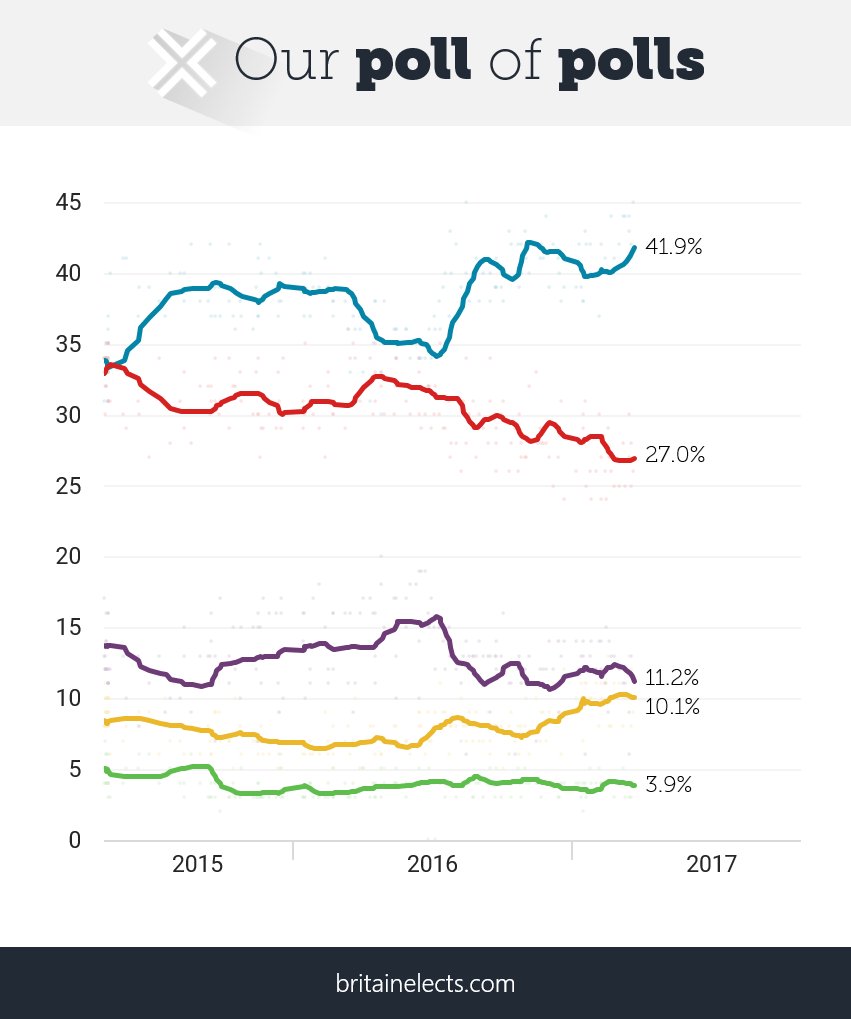
The UKIP polling support is clearly moribund, with the resurgent Liberal Democrats looking set to overtake them shortly. This has been borne out in a large number of by-election results in recent months, mostly council seats but still telling a strong story. UKIP votes have been slashed from the previous election in many of the contested seats, down to between a third and a half of their former vote share.
I watch these closely, and every week (Thursday night & Friday morning) you'll find the results with my comments re-tweeted on my Twitter timeline. The writing is now very clearly on the wall – and perhaps this is indeed the best time to get out and make oneself nominally available to any suitably-positioned new movement that could do with having on board an established political figure to give it some weight.
That could well be the calculation at work here.
Thus UKIP, which has never has had one of its own people elected to the House of Commons, has gone from no MPs to one (defector), and then to two with the second defection by Mark Reckless shortly after, then back to one a mere six months later, and now zero again, less than two years after the last General Election.
The timing of this move is interesting, coming as it does at a slightly odd time. Douglas states his reason as being the completion of the mission to leave the EU – but we haven't yet done so. Article 50 is to be triggered just four days from now, so if that was the reason why didn't he at least wait until then? The Referendum was held months ago, so that wasn't the cause either.
Apparently he has been liaising with senior Conservatives with the apparent aiming of rejoining his former party. I don't think that would go down well among the party's rank and file membership, and is something that I'd recommend be seriously pursued.
ANother ingredient in the mix is the possible imminent launch of UKIP big sponsor Arron Banks' new party, provisionally called the Patriotic Alliance. The feeling I get with that, though, is that he might be even less welcome there than back in the Conservative fold. I could be wrong.
In recent days, though, yet another movement has surfaced: this appears to be some kind of 'New UKIP'. While that is probably a dead-end route (the analogy of stopping digging when you're already in a hole of your own making springs to mind) it might provide a new home for Douglas C. I have no idea if that is even on his radar, but as mere speculation it is worth airing as one of the possibilities.
Behind all of this, though, I suspect is the realisation that UKIP – which I have long stated is a dead end – is dying, as polls and by-elections have been clearly showing. Here's Britain Elects' poll-of-polls graph covering the period since the May 2015 General Election…
The UKIP polling support is clearly moribund, with the resurgent Liberal Democrats looking set to overtake them shortly. This has been borne out in a large number of by-election results in recent months, mostly council seats but still telling a strong story. UKIP votes have been slashed from the previous election in many of the contested seats, down to between a third and a half of their former vote share.
I watch these closely, and every week (Thursday night & Friday morning) you'll find the results with my comments re-tweeted on my Twitter timeline. The writing is now very clearly on the wall – and perhaps this is indeed the best time to get out and make oneself nominally available to any suitably-positioned new movement that could do with having on board an established political figure to give it some weight.
That could well be the calculation at work here.
Tuesday, 14 March 2017
No More Kipping
The creation of a new political party by Arron Banks – long anticipated by some including myself (as I have mentioned before) – seems to have taken a step forward today, with the suspension of Mr Banks from UKIP. This was (he says) because of something he recently said about UKIP.
Now, this is a promising move, if it is handled in the right way. I have been saying (and showing) for some time that UKIP was always a dead end – and it has been proven true. I'd venture to suggest that a considerable majority of the electorate also now realise this.
Despite the boost given to them by certain pundits, movers & shakers, and being gifted votes as a protest party, their core vote was usually in single figures (I estimate 6% to 8% tops) as has been shown consistently in opinion polls and in particular in more recent actual elections, whether council or parliamentary. Note that each party has a core vote that will probably never change, plus other more fluid 'floating' votes, so the core forms just part of the polling/voting figure.
Most notably, the UKIP vote has in the majority of cases dropped hugely since the previous election in that seat, typically down to just a third to a half of the percentage vote they had the last time. I watch this every week, and tweet all the results, so they can be found on my Twitter feed.
So: what about this new party, then? I'd welcome it, because it is about time that the deadwood were to be cleared out from our nation's political scene – and that means Labour and the Greens, along with TUSC, as well as UKIP. None of them offers any real value in twenty-first century politics.
So far there are two problems with what has emerged today: Arron Banks seems to be thinking of it as a Mark Two version of UKIP, which would be the wrong approach. It has to be something new and fresh, not modelled on what has gone before, otherwise it will almost certainly mutate over a few years into being in the same situation as UKIP is today, and will never generate sufficient public confidence to become viable. They'll prefer the devil they already know.
The second issue is the likelihood of Nigel Farage being pushed to be its leader. Again, this will lead to the same kinds of difficulties that UKIP had for years in that it will become the Nigel Show all over again – a 'cult of personality'. That is not what is needed. Hopefully Farage's Trump association will lead to a full-time occupation on that side of the Atlantic, which will thus help save the new venture here if it should go ahead.
I wish such a new party well, especially if it does result in the dross vanishing from the scene. It could (and should) be much healthier for British politics, both nationally and (over a longer period) locally too. It just needs to be done right, from the launch onward, and all should be set fair to raise the bar hugely over the next few years.
Monday, 24 October 2016
Strood South By-election
Edited to correct a misleading part taken from a Medway Labour tweet and scans
It is no secret that I have considerable affection for the Strood South ward of Medway Council, so it will come as no surprise that I took an interest in last Thursday's by-election. That event was caused by the resignation of UKIP councillor Catriona Reckless-Brown who will soon be moving to Wales where her husband (former Rochester & Strood MP Mark Reckless) has been selected to stand for the Welsh Assembly, also for UKIP.
The three Council seats in Strood South were at that time held by UKIP, Conservative (John Avey) and an Independent (Mark Joy, who had been elected as UKIP but then left the party) so very mixed – in fact the only ward of Medway Council's 22 to be a three-way split. There were six candidates in the by-election, including the two (one Conservative, Josie Iles, and one Labour, Isaac Igwe) who had lost their seats to the then two UKIP candidates.
The results of the by-election were thus, in descending order of number of votes cast:
Also note the wide gulf between them and the winner – more than 200 votes. It is to be noted that I predicted this outcome, and told a couple of people my forecast, though forgot to make it public until the morning of last Thursday, i.e. polling day! My exact prediction was "a comfortable Conservative win, with Labour and UKIP close together in second and third place, either way round." (It's on my Facebook page.)
The turnout was low, sadly, at 16·74% – just one in six eligible voters participated. By-elections tend to have significantly lower turnouts than full elections, and last year's council elections here were boosted by coinciding with the General Election. Indeed, back in May 2000, at the full council elections that year Luton (a Labour safe ward) had a turnout of just 17·37% – hardly any higher than this mere by-election.
EDIT: The Council leader, Alan Jarrett (Conservative), has today been reported in the local newspaper (not online, unfortunately) as saying that UKIP lost the seat because their councillors had been "ineffectual" since being elected some 17 months ago; and UKIP group leader Roy Freshwater is also quoted as saying they lost the seat (a) because of the weather and (b) because they don't have the 'party machine' that the two traditional big parties have. Medway Labour has selectively scanned parts of the relevant page from the 'paper. This they misrepresented, but this edit corrects what I wrote here before, having taken the Medway Labour claim as correct. I really must learn that they can NEVER be trusted!
I certainly agree that the UKIP councillors have been, frankly, a waste of space, and have done as little work as their counterparts in (say) the European Parliament, who are known to be 'the laziest party group' throughout the entire Parliament – though very good at taking as much (public) money as they can, including the occasional 'fiddle' that comes to light (Janice Atkinson's restaurant bill that was in the news around a year ago) – and who knows how much there might be as yet unrevealed?
Anyway, keeping to their usual practice, and as their own fellow has now publicly stated, the 'Kippers on our Council really do seem to have done nothing of any consequence to represent those who elected them in what was, after all, just a national 'anti-establishment' mood swing at the time – May 2015. That of course has faded since then, as I predicted it would, and UKIP Cllr Roy Freshwater's own claim of a lack of a big 'machine' would indeed have hampered their chances of holding the seat at this time. The weather affects all parties equally, and no doubt contributed toward the low turn-out.
Even so, the best they could have done would have been to come second, and I think just 150 votes or so behind the winner: it could have been a slightly closer contest, and they'd have been the runners-up rather than Labour. However, the bigger issue for voters was the lack of activity by UKIP in the ward and elsewhere in Medway for that matter. These things are noticed and the word gets around. It was no doubt what lost the three we had before May 2015 their seats (Messrs Irvine, Mason and Rodberg, all of whom re-stood but lost.)
To me it seems obvious that another of my (longer-standing this time) predictions – that there will be no UKIP councillors at Medway after the next all-out elections – will also come to pass.
And whose fault will that be? Theirs alone!
It is no secret that I have considerable affection for the Strood South ward of Medway Council, so it will come as no surprise that I took an interest in last Thursday's by-election. That event was caused by the resignation of UKIP councillor Catriona Reckless-Brown who will soon be moving to Wales where her husband (former Rochester & Strood MP Mark Reckless) has been selected to stand for the Welsh Assembly, also for UKIP.
The three Council seats in Strood South were at that time held by UKIP, Conservative (John Avey) and an Independent (Mark Joy, who had been elected as UKIP but then left the party) so very mixed – in fact the only ward of Medway Council's 22 to be a three-way split. There were six candidates in the by-election, including the two (one Conservative, Josie Iles, and one Labour, Isaac Igwe) who had lost their seats to the then two UKIP candidates.
The results of the by-election were thus, in descending order of number of votes cast:
- Josie Iles (Con) – 724
- Isaac Igwe (Lab) – 521
- Karl Weller (UKIP – 480
- Steve Dyke (Green) – 74
- Isabelle Cherry (LD) – 62
- Mike Russell (Eng Dem) – 23
Also note the wide gulf between them and the winner – more than 200 votes. It is to be noted that I predicted this outcome, and told a couple of people my forecast, though forgot to make it public until the morning of last Thursday, i.e. polling day! My exact prediction was "a comfortable Conservative win, with Labour and UKIP close together in second and third place, either way round." (It's on my Facebook page.)
The turnout was low, sadly, at 16·74% – just one in six eligible voters participated. By-elections tend to have significantly lower turnouts than full elections, and last year's council elections here were boosted by coinciding with the General Election. Indeed, back in May 2000, at the full council elections that year Luton (a Labour safe ward) had a turnout of just 17·37% – hardly any higher than this mere by-election.
EDIT: The Council leader, Alan Jarrett (Conservative), has today been reported in the local newspaper (not online, unfortunately) as saying that UKIP lost the seat because their councillors had been "ineffectual" since being elected some 17 months ago; and UKIP group leader Roy Freshwater is also quoted as saying they lost the seat (a) because of the weather and (b) because they don't have the 'party machine' that the two traditional big parties have. Medway Labour has selectively scanned parts of the relevant page from the 'paper. This they misrepresented, but this edit corrects what I wrote here before, having taken the Medway Labour claim as correct. I really must learn that they can NEVER be trusted!
I certainly agree that the UKIP councillors have been, frankly, a waste of space, and have done as little work as their counterparts in (say) the European Parliament, who are known to be 'the laziest party group' throughout the entire Parliament – though very good at taking as much (public) money as they can, including the occasional 'fiddle' that comes to light (Janice Atkinson's restaurant bill that was in the news around a year ago) – and who knows how much there might be as yet unrevealed?
Anyway, keeping to their usual practice, and as their own fellow has now publicly stated, the 'Kippers on our Council really do seem to have done nothing of any consequence to represent those who elected them in what was, after all, just a national 'anti-establishment' mood swing at the time – May 2015. That of course has faded since then, as I predicted it would, and UKIP Cllr Roy Freshwater's own claim of a lack of a big 'machine' would indeed have hampered their chances of holding the seat at this time. The weather affects all parties equally, and no doubt contributed toward the low turn-out.
Even so, the best they could have done would have been to come second, and I think just 150 votes or so behind the winner: it could have been a slightly closer contest, and they'd have been the runners-up rather than Labour. However, the bigger issue for voters was the lack of activity by UKIP in the ward and elsewhere in Medway for that matter. These things are noticed and the word gets around. It was no doubt what lost the three we had before May 2015 their seats (Messrs Irvine, Mason and Rodberg, all of whom re-stood but lost.)
To me it seems obvious that another of my (longer-standing this time) predictions – that there will be no UKIP councillors at Medway after the next all-out elections – will also come to pass.
And whose fault will that be? Theirs alone!
Tuesday, 18 October 2016
Woolfe at the (Exit) Door
The new UKIP leadership contest, after Diane James' resignation almost immediately after having been elected, is now gearing up.
The party seems to have been running out of eligible potential candidates, so they have felt it necessary to waive (or perhaps permanently change: I don't have that confirmed) their previous rule that candidates must have been UKIP members for at least two years.
Anyway, at least Stephen Woolfe got both his application and deposit in on time on this occasion – but has now pulled out, and is apparently resigning from the party. It is said by some 'Kippers that he had already spoken to the Conservatives, apparently with the intention of preparing the way to join that party later. Others claim that it was the Conservatives who approached him. We might never know which it was...
The party seems to have been running out of eligible potential candidates, so they have felt it necessary to waive (or perhaps permanently change: I don't have that confirmed) their previous rule that candidates must have been UKIP members for at least two years.
Anyway, at least Stephen Woolfe got both his application and deposit in on time on this occasion – but has now pulled out, and is apparently resigning from the party. It is said by some 'Kippers that he had already spoken to the Conservatives, apparently with the intention of preparing the way to join that party later. Others claim that it was the Conservatives who approached him. We might never know which it was...
Here's another twist: the change of rule I mentioned above has allowed Raheem Kassam to
stand, and Suzanne Evans' suspension from the party was lifted recently,
thus allowing her to stand this time too. Both of these are somewhat
divisive individuals, as are others who are also in contention.
Now, you always get an element of that in any leadership contest, with supporters of one being anti at least one of the others – but this has a noticeably different feel from that, which is usually significant only during the contest/election itself.
I have been reading negative comments (quite a lot of them!) about the likes of Evans, Carswell, Hamilton, O'Flynn and others since long before there was even the first leadership change (i.e. the Farage one that wasn't) so this is deep-seated long standing faction-ism within what is and has always been a somewhat 'flaky' party.
As I have been saying for a few years now, UKIP's time is likely to end "in a few years" – i.e. at what would from then have been around 2017 or 2018. Long before the next General Election, I surmised that they would either cease to exist or become just a lobbying movement by now, post-referendum, with no 'sales pitch' beyond being a kind of Brexit Watch until that's all over – then nothing. That of course is expected to be completed before the next election anyway.
With major donors having already withdrawn their support, leaving UKIP with a reported £800,000 deficit which no doubt will grow much worse as time passes, the party is going to have a tough time indeed just trying to survive.
With Woolfe as leader (which was likely) that might have been possible. Now I don't think they can succeed or survive...
Now, you always get an element of that in any leadership contest, with supporters of one being anti at least one of the others – but this has a noticeably different feel from that, which is usually significant only during the contest/election itself.
I have been reading negative comments (quite a lot of them!) about the likes of Evans, Carswell, Hamilton, O'Flynn and others since long before there was even the first leadership change (i.e. the Farage one that wasn't) so this is deep-seated long standing faction-ism within what is and has always been a somewhat 'flaky' party.
As I have been saying for a few years now, UKIP's time is likely to end "in a few years" – i.e. at what would from then have been around 2017 or 2018. Long before the next General Election, I surmised that they would either cease to exist or become just a lobbying movement by now, post-referendum, with no 'sales pitch' beyond being a kind of Brexit Watch until that's all over – then nothing. That of course is expected to be completed before the next election anyway.
With major donors having already withdrawn their support, leaving UKIP with a reported £800,000 deficit which no doubt will grow much worse as time passes, the party is going to have a tough time indeed just trying to survive.
With Woolfe as leader (which was likely) that might have been possible. Now I don't think they can succeed or survive...
Thursday, 28 January 2016
Who Is In Poll Position – January 2016
Indicative of the general trend, here are some interesting polling results from Ipsos MORI that are out today, kindly shared by the 'Britain Elects' Twitter account...
https://twitter.com/britainelects
1.
The party which 'has the best team of leaders to deal with the country's problems':
CON: 43%
LAB: 16%
UKIP: 4%
LDEM: 2%
2.
The party which 'has the best policies for the country as a whole':
CON: 35%
LAB: 25%
UKIP: 6%
LDEM: 4%
3.
The party which 'would be best at looking after the interests of people like you':
CON: 33%
LAB: 29%
UKIP: 8%
LDEM: 5%
The last has Labour closer to the Conservatives than with the other questions, but still behind by several percentage points.
We can also see that (as I predicted) UKIP support has really fallen away, as more and more people see them as (a) not as credible as many once thought, and (b) a dead end, going nowhere. None of this is surprising, of course, and merely continues a trend that became well-established several months ago.
Indeed, UKIP has become irrelevant (as I had predicted for some time) and the Lib Dems still are, leaving us with the very real prospect of no proper opposition party before much longer. As I have indicated before, including recently, that is not a good thing.
The only prospect I foresee is the one I have been anticipating for several years (as some reading this will be aware) which is that the Lib Dems will need to get their act together and be prepared to take on that task within the next three or four years. No-one else is set to do it!
https://twitter.com/britainelects
1.
The party which 'has the best team of leaders to deal with the country's problems':
CON: 43%
LAB: 16%
UKIP: 4%
LDEM: 2%
2.
The party which 'has the best policies for the country as a whole':
CON: 35%
LAB: 25%
UKIP: 6%
LDEM: 4%
3.
The party which 'would be best at looking after the interests of people like you':
CON: 33%
LAB: 29%
UKIP: 8%
LDEM: 5%
The last has Labour closer to the Conservatives than with the other questions, but still behind by several percentage points.
We can also see that (as I predicted) UKIP support has really fallen away, as more and more people see them as (a) not as credible as many once thought, and (b) a dead end, going nowhere. None of this is surprising, of course, and merely continues a trend that became well-established several months ago.
Indeed, UKIP has become irrelevant (as I had predicted for some time) and the Lib Dems still are, leaving us with the very real prospect of no proper opposition party before much longer. As I have indicated before, including recently, that is not a good thing.
The only prospect I foresee is the one I have been anticipating for several years (as some reading this will be aware) which is that the Lib Dems will need to get their act together and be prepared to take on that task within the next three or four years. No-one else is set to do it!
Monday, 11 May 2015
Apportioning Blame – and Votes
The predictable 'votes-to-seats' argument about our supposedly 'broken' (i.e. inconvenient to some) electoral system has started in earnest. Many are again blaming our so-called 'first past the post' system for lots of votes resulting in no seats, yet all went into the elections – both candidates (and their parties) and voters – in full knowledge of how the system worked..
Regular readers here will recall that I took one of my occasional looks at this topic less than three months ago – but what I mooted then, and devised earlier in the decade, wouldn't suit those with vested interests in manipulating our electoral methodology to benefit those they support – which is their real aim.
Firstly, this (now mainly UKIPper) complaint that the party got nearly four million votes but only one parliamentary seat is based on a false premise. All subsequent analysis is undoubtedly pointing toward the following...
The only reasons they had that many votes, and distributed as they were, can be boiled down to (a) they spread themselves too thinly by trying to look impressive and important by fielding too many candidates (running before they could walk); and (b) much of that voting was tactical and was because of the present electoral system. Under a different methodology they'd have gained only a fraction of the number of votes.
This is one power that the electorate has over 'the establishment' (as the in-vogue terminology puts it) – we can vote tactically if we choose. Some are in favour of this in particular circumstances, others advise against it; but we can still decide for ourselves. The north of England results show this very clearly: they aren't interested in having UKIP Members of Parliament (obviously) but they were and are very interested in sending Labour a close shot across the bows to sharpen up its act, and get a decent leader in particular.
They are getting at least part of their wish, probably all of it in time.
This nation of ours already, quite recently, rejected – in a referendum – a change to even a 'half-way house' Alternative Vote system. I was pleased, because it (like other supposedly but not really 'proportional' methodologies) gives the possibility of some electors having two (or more, in other systems) bites of the cherry – those who voted for the losers at that.
Obviously, right from the basics, that is a dishonest way to fiddle a result so that a non-winner can – and often does in places that work with such systems – 'beat' the actual winner. The sales pitch is that this produces an 'overall majority' or words to the same effect; but it's a lie, and often results in an unwanted (by the majority) 'winner'.
If we wish to maintain integrity we either stick with the present method, or we change to something along the lines of what I proposed years ago and revisited back in February in my above-linked post. The latter would be quite a shake-up in how our parliamentary democracy functions in the country, but is a twenty-first century solution to many if not all the most significant issues people have with our present way of doing it.
Nothing that anyone else either does or is proposing comes anywhere near that.
Regular readers here will recall that I took one of my occasional looks at this topic less than three months ago – but what I mooted then, and devised earlier in the decade, wouldn't suit those with vested interests in manipulating our electoral methodology to benefit those they support – which is their real aim.
Firstly, this (now mainly UKIPper) complaint that the party got nearly four million votes but only one parliamentary seat is based on a false premise. All subsequent analysis is undoubtedly pointing toward the following...
The only reasons they had that many votes, and distributed as they were, can be boiled down to (a) they spread themselves too thinly by trying to look impressive and important by fielding too many candidates (running before they could walk); and (b) much of that voting was tactical and was because of the present electoral system. Under a different methodology they'd have gained only a fraction of the number of votes.
This is one power that the electorate has over 'the establishment' (as the in-vogue terminology puts it) – we can vote tactically if we choose. Some are in favour of this in particular circumstances, others advise against it; but we can still decide for ourselves. The north of England results show this very clearly: they aren't interested in having UKIP Members of Parliament (obviously) but they were and are very interested in sending Labour a close shot across the bows to sharpen up its act, and get a decent leader in particular.
They are getting at least part of their wish, probably all of it in time.
This nation of ours already, quite recently, rejected – in a referendum – a change to even a 'half-way house' Alternative Vote system. I was pleased, because it (like other supposedly but not really 'proportional' methodologies) gives the possibility of some electors having two (or more, in other systems) bites of the cherry – those who voted for the losers at that.
Obviously, right from the basics, that is a dishonest way to fiddle a result so that a non-winner can – and often does in places that work with such systems – 'beat' the actual winner. The sales pitch is that this produces an 'overall majority' or words to the same effect; but it's a lie, and often results in an unwanted (by the majority) 'winner'.
If we wish to maintain integrity we either stick with the present method, or we change to something along the lines of what I proposed years ago and revisited back in February in my above-linked post. The latter would be quite a shake-up in how our parliamentary democracy functions in the country, but is a twenty-first century solution to many if not all the most significant issues people have with our present way of doing it.
Nothing that anyone else either does or is proposing comes anywhere near that.
Tuesday, 5 May 2015
UKIP – the ZX Spectrum of British Politics
One of the interesting side-effects of the rise and rise of the so-called United Kingdom Independence Party (UKIP) is that they can longer be the simple cult-of-personality outfit thay had all too comfortably slipped into once Nigel Farage had become their leader again.
Those who are familiar with both current and defunct outfits of similar origins – Robert Kilroy-Silk's Veritas and George Galloway's Respect in particular, though one can include several others including the rump-ends of the old Liberal party and SDP when the Liberal Democrats were formed – will no doubt recall that UKIP was also of this nature until around three years ago.
Then, when anti-Conservative movers and shakers realised that an Ed Miliband-led Labour party was never going to be able to dislodge David Cameron from Number Ten, they began to promote UKIP as they perceived that it was the only feasible alternative, working from the other side of the electoral equation to leech away the Conservative vote, rather than (impossibly) boosting the Labour vote.
How right they have been proven on both counts!
Awkwardly, UKIP was never really structured or even intended to become such a significant force in British politics as it is now having to face up to, and it shows. Quite apart from a number of other issues with the party – which are almost entirely of its own doing and its poor screening of candidates – the whole entity now resembles a Sinclair ZX Spectrum computer with all those add-ons hanging off the sides.
It still has the rubbery keyboard, which is bad enough, but it also has parts of its new self hanging on via electrical connectors alone, and the whole thing is dodgy, unreliable and distinctly intermittent. UKIP has had to bolt things onto its organisation, such as it was, to cope with entering the Big Boys' world. They are not coping very well, and it isn't surprising. It looks from where I sit to have been almost as devastating in practice as the Galactica's last jump in the recent TV series.
They of course will claim that everything is wonderful – just as Sir Clive Sinclair generally maintained about his products (and I have some tales I could tell about this from when we tried selling Sinclair kit for a short period!) which were, frankly, poorly designed, specified and manufactured.
Thus it can be seen that UKIP are in the unusual, perhaps unique, position of having been thrust into their current position, and are therefore not entirely to blame for their inability to handle themselves all that well. Their arrogant attitude, though, is their own doing and has made things a lot worse than they needed to be, it has to be said.
With dwindling support, as evidenced by consistent polling trends during the past six months, they will be lucky to have any seats in the House of Commons this Friday. Even Douglas Carswell could lose his seat in Clacton, though I have consistently said that this is an unlikely scenario. Mark Reckless will probably (and correctly) lose his, and Nigel Farage is unlikely to win the South Thanet seat – though anything could happen, of course!
In the next five years, if Labour change leader to someone at least reasonably competent, those anti-Conservative 'big voices' will then perceive UKIP as a potentially negative influence from their point of view, so will drop tham and they will fade back into obscurity. Perhaps the British electorate might even learn the odd lesson from this period from 2012 to (say) 2016 or so – who knows?
Those who are familiar with both current and defunct outfits of similar origins – Robert Kilroy-Silk's Veritas and George Galloway's Respect in particular, though one can include several others including the rump-ends of the old Liberal party and SDP when the Liberal Democrats were formed – will no doubt recall that UKIP was also of this nature until around three years ago.
Then, when anti-Conservative movers and shakers realised that an Ed Miliband-led Labour party was never going to be able to dislodge David Cameron from Number Ten, they began to promote UKIP as they perceived that it was the only feasible alternative, working from the other side of the electoral equation to leech away the Conservative vote, rather than (impossibly) boosting the Labour vote.
How right they have been proven on both counts!
Awkwardly, UKIP was never really structured or even intended to become such a significant force in British politics as it is now having to face up to, and it shows. Quite apart from a number of other issues with the party – which are almost entirely of its own doing and its poor screening of candidates – the whole entity now resembles a Sinclair ZX Spectrum computer with all those add-ons hanging off the sides.
It still has the rubbery keyboard, which is bad enough, but it also has parts of its new self hanging on via electrical connectors alone, and the whole thing is dodgy, unreliable and distinctly intermittent. UKIP has had to bolt things onto its organisation, such as it was, to cope with entering the Big Boys' world. They are not coping very well, and it isn't surprising. It looks from where I sit to have been almost as devastating in practice as the Galactica's last jump in the recent TV series.
They of course will claim that everything is wonderful – just as Sir Clive Sinclair generally maintained about his products (and I have some tales I could tell about this from when we tried selling Sinclair kit for a short period!) which were, frankly, poorly designed, specified and manufactured.
Thus it can be seen that UKIP are in the unusual, perhaps unique, position of having been thrust into their current position, and are therefore not entirely to blame for their inability to handle themselves all that well. Their arrogant attitude, though, is their own doing and has made things a lot worse than they needed to be, it has to be said.
With dwindling support, as evidenced by consistent polling trends during the past six months, they will be lucky to have any seats in the House of Commons this Friday. Even Douglas Carswell could lose his seat in Clacton, though I have consistently said that this is an unlikely scenario. Mark Reckless will probably (and correctly) lose his, and Nigel Farage is unlikely to win the South Thanet seat – though anything could happen, of course!
In the next five years, if Labour change leader to someone at least reasonably competent, those anti-Conservative 'big voices' will then perceive UKIP as a potentially negative influence from their point of view, so will drop tham and they will fade back into obscurity. Perhaps the British electorate might even learn the odd lesson from this period from 2012 to (say) 2016 or so – who knows?
Monday, 23 February 2015
Smoke Me A Kipper
"Smoke me a kipper – I'll be back for breakfast!"So said 'Ace' Rimmer in the comedy sci-fi programme Red Dwarf, just before setting off on a dangerous mission.
In the British political world, our own 'Kippers (a colloquial term for UKIP members and activists) have just been on their most dangerous mission yet: being featured in a television documentary. After last week's drama that purported to show how UKIP's first hundred days of running the country would go (itself a delusion, as it is extremely unlikely that they'll ever do so) and that just about everyone said was nonsense, this effort did at least hold out the prospect of being authentic, if a little dated as it was recorded a good two months ago.
Okay, the editing was bound to emphasize the programme-makers' intended image of the party, and cut out a lot of material that didn't do so, and must therefore not be taken simply at face value. If one watches such production with unblinkered awareness, then one shouldn't be too easily manipulated.
However, the material itself is of course genuine enough, and it should be easy to deduce whether any of it was presented out of context or edited in a way that tells a story that wasn't the one on the day it was recorded. I didn't watch either of these two programmes myself, preferring to follow Twitter comments from various (and very varied) sources. I might catch them later, though not necessarily.
The drama received just about universal panning, whereas this evening's documentary wasn't quite so broad, and concentrated primarily on the apparent streak of racism that was evident in at least a few party members and seemed to go completely unopposed by any of those members who heard those remarks. The Twitter reporting of all this was mostly from Lefties, but also from a few on the right. Mind you, I didn't get the feeling that many right-wingers were watching this, or if they were then they weren't tweeting about it this time.
This in The Guardian gives a fuller picture, and is interesting to read from the other side, so to speak.
The general conclusion seems to have been that UKIP did themselves no favours by allowing this programme to be made and broadcast, especially as they didn't exercise their right of reply, which I know was offered. One commenter put it as UKIP having done 'a hatchet job on themselves' – which, though technically inaccurate, probably conveys the flavour as well as anything. Whether or not it will significantly impact their electoral results this coming May is a different matter, though.
Meanwhile, I consider that UKIP has done the Conservative Party an actual favour, by (in effect) siphoning-off the more 'dodgy' members who have jumped ship to UKIP. Some of these were no doubt obvious cases, but even around my way there have been a few that I didn't know held views they have since expressed, or their raw attitude that has now come to light. At least two have turned out to be really nasty – very much like typical Labour folk in that respect.
They have now gone from the Conservative Party and their true natures revealed. This I consider to be a good outcome, and potential time bombs – which could have caused difficulties for the party in due course – can no longer do any more than superficial harm. Here, their voting public is mixed in opinion, but I notice a slow but definite trend away from the defectors, and this is likely to be a one-way street.
Thus their time in public office or (for those not currently elected) in even vaguely serious contention is probably severely time-limited, which is as it should be. We should, as a nation and especially in places like Medway, soon be back on track.
Tuesday, 20 January 2015
The Enemy Of My Enemy
There is an old saying that goes the enemy of my enemy is my friend. It's somewhat simplistic, but it does allow for the creation of some 'unholy alliances' – as I personally witnessed during our local elections here in Medway some eight years ago.
Just about everyone and his dog who were involved in that election campaign (and, yes, there really were a few dogs in the mix!) who wasn't a Conservative teamed up with each other to jointly push an anti-us message. There is quite a story behind that, even entertaining in parts – but that is not my subject of attention on this occasion.
It has been interesting (if predictable) to see the launch of an anti-UKIP Twitter account, supposedly fed from across the political spectrum but (as I expected it would turn out to be) essentially, and predominantly, from the Left.
Okay, it doesn't really matter all that much, but it does mean that – despite a wealth of usable material – they all to often pick on things that they think make the case against UKIP, but to most of the British voting public are more likely to be seen as good things. I have encountered a number of such 'ouch!' moments, and suspect they sometimes do their cause more harm than good.
I follow this account, just to see what they are putting out, and even occasionally re-tweet one of their offerings if it makes a valid and important point. It does happen sometimes, though much of their material is too skewed (and, usually, obviously so) to be usable by someone with my (very high) standards.
So, are they my friends? No. Is UKIP truly my 'enemy'? Not really, not to the extent that I'd apply that term to them. In practice, these elements are already out there, and in practice I am doing little more than keeping a weather eye on them. I do not contribute or respond to them, and don't re-tweet much of their output.
I am content that the British electorate will reach their own conclusions and vote whatever way they decide – though I do like to occasionally pull out the rug from under those who seek to deceive us all. If it hurts enough, and often enough, it might just discourage the deceivers – but it is an ongoing situation and will probably never end.
Thus the game is being played in its 2015 form, and I shall keep a watch on it – though I doubt that any of what I have mentioned here is making more than a miniscule impact around the nation anyway!
Just about everyone and his dog who were involved in that election campaign (and, yes, there really were a few dogs in the mix!) who wasn't a Conservative teamed up with each other to jointly push an anti-us message. There is quite a story behind that, even entertaining in parts – but that is not my subject of attention on this occasion.
It has been interesting (if predictable) to see the launch of an anti-UKIP Twitter account, supposedly fed from across the political spectrum but (as I expected it would turn out to be) essentially, and predominantly, from the Left.
Okay, it doesn't really matter all that much, but it does mean that – despite a wealth of usable material – they all to often pick on things that they think make the case against UKIP, but to most of the British voting public are more likely to be seen as good things. I have encountered a number of such 'ouch!' moments, and suspect they sometimes do their cause more harm than good.
I follow this account, just to see what they are putting out, and even occasionally re-tweet one of their offerings if it makes a valid and important point. It does happen sometimes, though much of their material is too skewed (and, usually, obviously so) to be usable by someone with my (very high) standards.
So, are they my friends? No. Is UKIP truly my 'enemy'? Not really, not to the extent that I'd apply that term to them. In practice, these elements are already out there, and in practice I am doing little more than keeping a weather eye on them. I do not contribute or respond to them, and don't re-tweet much of their output.
I am content that the British electorate will reach their own conclusions and vote whatever way they decide – though I do like to occasionally pull out the rug from under those who seek to deceive us all. If it hurts enough, and often enough, it might just discourage the deceivers – but it is an ongoing situation and will probably never end.
Thus the game is being played in its 2015 form, and I shall keep a watch on it – though I doubt that any of what I have mentioned here is making more than a miniscule impact around the nation anyway!
The Debates Debate
I know it sounds silly, but we've had it before: the way the pre-General Election party leaders' televised debates are to be conducted and who is to be invited to participate.
Last time, five years ago, it was comparatively clear-cut – and there were three parties that could reasonably be thought of as being part or all of the new post-May 2010 UK government. They were, unsurprisingly, the Conservatives, Labour, and the Liberal Democrats.
Thus when those three parties' leaders were to be the invited participants, it all made sense and was no great surprise. Indeed, two of those leaders subsequently became Prime Minister (David Cameron) and Deputy PM (Nick Clegg).
This time around, the national situation has changed markedly and the waters are distinctly (or should that be indistinctly?) muddy, with no fewer than five parties now of sufficient significance to warrant consideration.
Realistically, there are only two approaches that the organising broadcasters can take without justifiable accusations of political bias...
However, the Green Party has a larger membership that either UKIP or the Lib Dems, they also have a new MP who took that seat from another party by standing on a Green party platform. UKIP has never done this, merely holding two seats by deploying the same candidates whose positions were essentially secured by a different party, and their holding them primarily as 'the devil we know' in this time of anti-political sentiment.
Of course, the Lefties don't want the Green party leader in the debate(s), as that would tend to level the playing field again – and one thing upon which all Lefty organisations depend heavily is skewing things their way, playing as dirty as they feel is necessary to achieve that goal. They know they cannot win in any fair contest (hence all that postal vote rigging that we have read about in recent years, for example) as their most respected writers have frequently admitted, and as worldwide history during the past century or so clearly illustrates.
The Left's diversionary tactic has been to put it about that David Cameron is scared of facing Nigel Farage.
I am sure he'd face such an encounter with trepidation, but he knows he has little to fear. UKIP has lots of internal problems, many of which reach the public awareness; their policies are often incoherent and nonsensical and get changed on the hoof (as our Mark Reckless recently found) or even scrapped in their entirety; they are essentially one-dimensional in nature so can be easily outflanked by Cameron's broader and more inclusive approach, and insider knowledge, especially on the world stage.
He can handle the gig!
On the opposite side of the political divide, the Lefties know that the Greens are on an upward trend these days, after a couple of years more-or-less in the political wilderness. Their change of party leader seems to be bearing fruit – watermelons in this case, of course: green on the outside but raw Communist red when one looks below the surface.
This means they can 'out-left' Labour easily, and could even (after an all-five debate) lead to the Lib Dems petering out completely within the next couple of years. Thus neither of those parties wants the Greens involved in any of the debates, especially while that party is in the ascendancy. Both are running scared of them.
Thus it is easy to see that it is actually the Miliband and Clegg camps that are 'frit', and David Cameron who is correct in insisting that the Greens be included. Overall, they are now the most significant (especially potentially) of the three 'lesser' parties – and without them, neither of the others (Lib Dems, UKIP) should be included either.
That, folks, is the bottom line!
Last time, five years ago, it was comparatively clear-cut – and there were three parties that could reasonably be thought of as being part or all of the new post-May 2010 UK government. They were, unsurprisingly, the Conservatives, Labour, and the Liberal Democrats.
Thus when those three parties' leaders were to be the invited participants, it all made sense and was no great surprise. Indeed, two of those leaders subsequently became Prime Minister (David Cameron) and Deputy PM (Nick Clegg).
This time around, the national situation has changed markedly and the waters are distinctly (or should that be indistinctly?) muddy, with no fewer than five parties now of sufficient significance to warrant consideration.
Realistically, there are only two approaches that the organising broadcasters can take without justifiable accusations of political bias...
- Have only those party leaders that can sensibly be expected to have a chance of being the next Prime Minister. That means David Cameron and Ed[ward] Miliband – no-one else; or
- All five significant parties. This is the only acceptable way to include the Liberal Democrats again this time, as their support in the country has consistently been so low as to have them in either equal fourth place or even fifth place, behind UKIP and the Green Party.
However, the Green Party has a larger membership that either UKIP or the Lib Dems, they also have a new MP who took that seat from another party by standing on a Green party platform. UKIP has never done this, merely holding two seats by deploying the same candidates whose positions were essentially secured by a different party, and their holding them primarily as 'the devil we know' in this time of anti-political sentiment.
Of course, the Lefties don't want the Green party leader in the debate(s), as that would tend to level the playing field again – and one thing upon which all Lefty organisations depend heavily is skewing things their way, playing as dirty as they feel is necessary to achieve that goal. They know they cannot win in any fair contest (hence all that postal vote rigging that we have read about in recent years, for example) as their most respected writers have frequently admitted, and as worldwide history during the past century or so clearly illustrates.
The Left's diversionary tactic has been to put it about that David Cameron is scared of facing Nigel Farage.
I am sure he'd face such an encounter with trepidation, but he knows he has little to fear. UKIP has lots of internal problems, many of which reach the public awareness; their policies are often incoherent and nonsensical and get changed on the hoof (as our Mark Reckless recently found) or even scrapped in their entirety; they are essentially one-dimensional in nature so can be easily outflanked by Cameron's broader and more inclusive approach, and insider knowledge, especially on the world stage.
He can handle the gig!
On the opposite side of the political divide, the Lefties know that the Greens are on an upward trend these days, after a couple of years more-or-less in the political wilderness. Their change of party leader seems to be bearing fruit – watermelons in this case, of course: green on the outside but raw Communist red when one looks below the surface.
This means they can 'out-left' Labour easily, and could even (after an all-five debate) lead to the Lib Dems petering out completely within the next couple of years. Thus neither of those parties wants the Greens involved in any of the debates, especially while that party is in the ascendancy. Both are running scared of them.
Thus it is easy to see that it is actually the Miliband and Clegg camps that are 'frit', and David Cameron who is correct in insisting that the Greens be included. Overall, they are now the most significant (especially potentially) of the three 'lesser' parties – and without them, neither of the others (Lib Dems, UKIP) should be included either.
That, folks, is the bottom line!
Saturday, 17 January 2015
Still 'Kipping or Waking Up?
Inevitably, and perfectly understandably, there is currently a lot of anti-UKIP activity by other political parties and sources (especially on Twitter) that do not appear, on the surface, to have a party political basis – though it is more than likely that they do.
For me, already knowing much of what lies up ahead, it has been interesting to observe all these manoeuvrings and the effect they have. The latter has tended to be the opposite of what was intended, actually bolstering UKIP's support rather than diminishing that support/ It's all quite predictable, once one appreciates the 'playing field' that exists in Britain (especially England) today.
None of that really matters all that much in practice, as the deception that is UKIP continues to make headway with a disillusioned voting public, trying hard to find a party that can be considered to be 'non-establishment', for whom they feel they can vote. So far, it seems to be working, and it will result in a spoil for other parties, most notably – but not exclusively – their primary target, the Conservatives.
Thus it is possible that, for a second time, there will no overall majority after the May election – which is what the UKIP leadership are, I believe, fervently hoping, if (as seems likely) they cannot achieve their preferred outcome of a Labour overall majority.
If that sounds strange, it is worth learning at least something of the truth about UKIP, some of which I have described before. All the necessary clues to the truth are in the public domain, and have been obvious to any attentive observer for some time. Two simple questions, that most people will answer incorrectly, will when correctly answered point this out quite starkly...
I shall not answer those here, now, as it is much more instructive for readers to work out the truths for themselves. The mere fact that I felt it necessary to ask them, and in that precise form, is in itself a further clue.
I see that the party's most famous founder (there were originally three, one of who has since died), the left-wing Alan Sked, is weighing-in because of fears that the party's current 'Farage effect' will deprive his old party of any seats. Incidentally, it is interesting to remind ourselves of why he left the party he had helped to create in the first place: partly because of Nigel Farage, partly because it was getting 'too right-wing' – which was never the true game plan: that was just deception.
When it really comes down to it (and as some who have made the switch to UKIP have already learned) everyone is going to have to learn the lessons for themselves, as I often say. There is no point my saying anything to any 'Kipper or supporter in person, because they always 'know better' and use the standard Lefty trick of labelling me in a negative fashion.It has been tried many times.
Therefore I now mostly let them be, and wait for them to humiliate themselves as unfolding events prove what is and what isn't. Although it goes against the grain a little, I have had too much of that kind of treatment to bother much any longer. Let them learn the hard way!
For me, already knowing much of what lies up ahead, it has been interesting to observe all these manoeuvrings and the effect they have. The latter has tended to be the opposite of what was intended, actually bolstering UKIP's support rather than diminishing that support/ It's all quite predictable, once one appreciates the 'playing field' that exists in Britain (especially England) today.
None of that really matters all that much in practice, as the deception that is UKIP continues to make headway with a disillusioned voting public, trying hard to find a party that can be considered to be 'non-establishment', for whom they feel they can vote. So far, it seems to be working, and it will result in a spoil for other parties, most notably – but not exclusively – their primary target, the Conservatives.
Thus it is possible that, for a second time, there will no overall majority after the May election – which is what the UKIP leadership are, I believe, fervently hoping, if (as seems likely) they cannot achieve their preferred outcome of a Labour overall majority.
If that sounds strange, it is worth learning at least something of the truth about UKIP, some of which I have described before. All the necessary clues to the truth are in the public domain, and have been obvious to any attentive observer for some time. Two simple questions, that most people will answer incorrectly, will when correctly answered point this out quite starkly...
- Are the UKIP leadership left-wing or right-wing?
- Are the UKIP leadership in favour of Britain's exit from the EU, or greater integration?
I shall not answer those here, now, as it is much more instructive for readers to work out the truths for themselves. The mere fact that I felt it necessary to ask them, and in that precise form, is in itself a further clue.
I see that the party's most famous founder (there were originally three, one of who has since died), the left-wing Alan Sked, is weighing-in because of fears that the party's current 'Farage effect' will deprive his old party of any seats. Incidentally, it is interesting to remind ourselves of why he left the party he had helped to create in the first place: partly because of Nigel Farage, partly because it was getting 'too right-wing' – which was never the true game plan: that was just deception.
When it really comes down to it (and as some who have made the switch to UKIP have already learned) everyone is going to have to learn the lessons for themselves, as I often say. There is no point my saying anything to any 'Kipper or supporter in person, because they always 'know better' and use the standard Lefty trick of labelling me in a negative fashion.It has been tried many times.
Therefore I now mostly let them be, and wait for them to humiliate themselves as unfolding events prove what is and what isn't. Although it goes against the grain a little, I have had too much of that kind of treatment to bother much any longer. Let them learn the hard way!
Saturday, 20 December 2014
Learning the Lesson
As I am fond of saying, there are essentially two ways to learn something: the easy way, and the hard way. I prefer the latter, as it hurts more so gets learned good and hard, rather than lasting only a short time and then the same mistake is repeated.
Despite that, I'd still save people all of that if they'd learn to accept what I write and say (as the majority do), even if it takes them outside their 'comfort zone' and causes them to re-appraise their own thinking. Those with fixed personal and corporate agendas usually cannot do this, or at best are so unwilling to do so that there is no point in pressing the matter, whatever it might be.
If I wanted to show how 'clever' I have seemed to be in recent years, I could easily list a whole range of statements, predictions and other pracle-like pronouncements I have been making consistently, and we could now easily see just how many of them have already panned out and others are obviously heading toward doing the same. Undoubtedly there are a few that didn't (such as the Lib Dem polling recovery after the 2014 Party Conference season – though there are signs, if too late to be very useful, of that now starting to happen) but it all goes to show that anyone with sme insight and a decent brain can work out what is likely to happen next, and why.
But no: the people always know best, and even I have been labelled as 'biased' (waits for everyone to stop laughing) if I dare to suggest anything that doesn't fit their worldview.
Thus I have been working mostly on getting people to think more for themselves, rather than (one might think) spoon-feeding them on this 'blog. What I have done here over the years was necessary, in order to lay down the proper foundation ahead of the period that is so soon to come.
That I did in considerable detail, but – as long-term readers will recall – wasn't with slanted, manipulated or fake materials to push a preferred view, but as openly as I could, so that readers were in a position to evaluate a situation for themselves. I might have guided the style of thinking, but it wasn't my way, by and large, to steer people's thinking in a specific, fixed direction. Occasionally there was a single, important issue that needed to dominate, but not often.
It was thus that, for unrelated reasons, I considered taking down older material. The world had moved on anyway, and some of what was in that huge number of political posts was no doubt by then out of date in some specifics. Ultimately, though, the time had come for my readership to move on too – and, to be fair to them, they have done so. If they ever truly needed me at all, they certainly don't now – not in the way I had been posting. They've grown up...
So, where does that leave us? Should I still post the occasional political post here? I think so; and it is important to keep that option open. Others in this area, and elsewhere, are continuing to provide their own insights and experiences, and that has improved noticeably in my home area over the past two years – which is one reason why I have been happy to take more of a back seat approach over that period.
Folk are going to have to learn their own lessons, as in practice they always have when it comes right down to it, and it is as I have predicted: that those who have tried to fool us with easy and convenient 'sales pitches', when Police and Crime Commissioner candidates or upcoming political parties, these and others are coming unstuck and greater public/media exposure is revealing to the masses what some of us have known all along.
In the final analysis, all will be well...
Despite that, I'd still save people all of that if they'd learn to accept what I write and say (as the majority do), even if it takes them outside their 'comfort zone' and causes them to re-appraise their own thinking. Those with fixed personal and corporate agendas usually cannot do this, or at best are so unwilling to do so that there is no point in pressing the matter, whatever it might be.
If I wanted to show how 'clever' I have seemed to be in recent years, I could easily list a whole range of statements, predictions and other pracle-like pronouncements I have been making consistently, and we could now easily see just how many of them have already panned out and others are obviously heading toward doing the same. Undoubtedly there are a few that didn't (such as the Lib Dem polling recovery after the 2014 Party Conference season – though there are signs, if too late to be very useful, of that now starting to happen) but it all goes to show that anyone with sme insight and a decent brain can work out what is likely to happen next, and why.
But no: the people always know best, and even I have been labelled as 'biased' (waits for everyone to stop laughing) if I dare to suggest anything that doesn't fit their worldview.
Thus I have been working mostly on getting people to think more for themselves, rather than (one might think) spoon-feeding them on this 'blog. What I have done here over the years was necessary, in order to lay down the proper foundation ahead of the period that is so soon to come.
That I did in considerable detail, but – as long-term readers will recall – wasn't with slanted, manipulated or fake materials to push a preferred view, but as openly as I could, so that readers were in a position to evaluate a situation for themselves. I might have guided the style of thinking, but it wasn't my way, by and large, to steer people's thinking in a specific, fixed direction. Occasionally there was a single, important issue that needed to dominate, but not often.
It was thus that, for unrelated reasons, I considered taking down older material. The world had moved on anyway, and some of what was in that huge number of political posts was no doubt by then out of date in some specifics. Ultimately, though, the time had come for my readership to move on too – and, to be fair to them, they have done so. If they ever truly needed me at all, they certainly don't now – not in the way I had been posting. They've grown up...
So, where does that leave us? Should I still post the occasional political post here? I think so; and it is important to keep that option open. Others in this area, and elsewhere, are continuing to provide their own insights and experiences, and that has improved noticeably in my home area over the past two years – which is one reason why I have been happy to take more of a back seat approach over that period.
Folk are going to have to learn their own lessons, as in practice they always have when it comes right down to it, and it is as I have predicted: that those who have tried to fool us with easy and convenient 'sales pitches', when Police and Crime Commissioner candidates or upcoming political parties, these and others are coming unstuck and greater public/media exposure is revealing to the masses what some of us have known all along.
In the final analysis, all will be well...
Saturday, 29 November 2014
UKIP Are Knocking
Yes, that title sounds like an old song...
I don't write about UKIP (the United Kingdom Independence Party) very much, partly because I don't like to give them the oxygen of publicity, but also because I am fairly relaxed about them. I know that their time will pass, as it generally does for cult-of-personality parties (those revolving around, and dominated by, their leader and that leader's personality) such as Robert Kilroy-Silk and his defunct Veritas party, and George Galloway and his vestigial Respect party.
Eventually people wake up to the fact that they have been duped by a clever 'sales pitch' – as has been happening (exactly as I predicted all along) with the Kent Police and Crime Commissioner, and is happening with UKIP converts, such as James Delinpole. He was one of those I expected to wake up to the truth before too long: I gave him two years, but it actually took him less than a year to turn against his new political home, at least for a while.
Here, in Rochester and Strood, it has taken much less time than that for the rot to set in. Just days after being re-elected as MP, this time as a UKIP candidate, Mark Reckless started to learn one of the many truths about UKIP that some of us have known for years. The following was in regard to immigration...
Mark Reckless (Tuesday 18 November 2014)...
Nigel Farage (Wednesday 19 November 2014)...
Mark Reckless (Saturday 22 November 2014)...
Interesting: Nigel Farage's on-the-hoof statements are immediately accepted as the party's policy. Not that this is anything new: Farage is on TV station video stating that the party's previous general election manifesto was "complete drivel", once again demonstrating who serves whom in UKIP because of that one person's dominance. This is the way dictators come into being, as history illustrates all too often.
Inevitably, UKIP turns out, at its core, to be a largely left-wing party. (and was created by a left-winger, Alan Sked) though this is camouflaged to some extent by having oft-changing policies that – if they were at any moment to be plotted on the two-dimensional Political Compass diagram – would produce a 'scattergun' effect all over the chart.
The only party UKIP continually attack is the Conservative Party – only token (and rare) attacks are made on any other parties specifically. They are also especially nasty, particularly their 'agents' (supposedly ordinary party members, though I do wonder sometimes) on social media and comment threads at newspapers and the like. It is all very reminiscent of the paid 'trolls' that Labour employed to do the same thing – and probably still do, though I haven't seen the classic ones such as David Dee and Hazel Tree for a while now.
I have previously discussed how UKIP is essentially a party of 'posturers and deceivers' as I usually put it, giving it all the yakkety-yak but not interested in doing the work. One UKIP MEP has what I suspect is the lowest attendance record in the European Parliament of just nine percent, while even Nigel Farage – who uses it primarily as a personal platform – has just a 37% record. They are, however, very good at just one thing – and that is taking money from the public purse.
Fortunately, attendance and voting records (and UKIPpers, when they do bother to vote – which isn't all that often – tend to vote against Britain's interests) and their allowances/expenses claims are all on the public record, so can be easily checked.
So, why have UKIP been on the rise during the past two or three years? Are people really that gullible?
As history will show, it was the appointment of Ed[ward] Miliband as Labour party leader that indirectly produced UKIP's rise, because when the more influential anti-Conservative sources realised that it meant that Labour now had only a very small hope of winning the next General Election, they came at it from the opposite direction.
They tried to find someone who – with a lot of active promotion and generalised 'bigging up' – could deprive a number of Conservatives of their seats. I could name names here, those I have observed doing just that, completely disproportionately, trying almost desperately hard to create a self-fulfilling prophecy regarding UKIP. Well, they succeeded – for now. It cannot and will not last...
The basis/background of all of what I have written here has been known to me for years. Ever since UKIP came head-hunting me, and I thus had the opportunity to find out more about them than they have ever realised, I knew the truth. Being me, I naturally modelled all future paths I could imagine were feasible, depending upon the likely fortunes of UKIP in the mix, and found that they will converge at a point a number of years in the future.
UKIP's time will pass, and their long-term impact on the British political scene will turn out to have been of no real consequence.
Thus the reality is that old scenario of the two ways to learn a lesson: the easy (and usual much quicker) way, or the hard way. The UKIP by-election win in Rochester & Strood shows that, yet again, the voters have chosen the hard way – but the benefit of this is that, when they finally do wake up to reality, they will learn that lesson good and hard, and won't forget it in a hurry!
I don't write about UKIP (the United Kingdom Independence Party) very much, partly because I don't like to give them the oxygen of publicity, but also because I am fairly relaxed about them. I know that their time will pass, as it generally does for cult-of-personality parties (those revolving around, and dominated by, their leader and that leader's personality) such as Robert Kilroy-Silk and his defunct Veritas party, and George Galloway and his vestigial Respect party.
Eventually people wake up to the fact that they have been duped by a clever 'sales pitch' – as has been happening (exactly as I predicted all along) with the Kent Police and Crime Commissioner, and is happening with UKIP converts, such as James Delinpole. He was one of those I expected to wake up to the truth before too long: I gave him two years, but it actually took him less than a year to turn against his new political home, at least for a while.
Here, in Rochester and Strood, it has taken much less time than that for the rot to set in. Just days after being re-elected as MP, this time as a UKIP candidate, Mark Reckless started to learn one of the many truths about UKIP that some of us have known for years. The following was in regard to immigration...
Mark Reckless (Tuesday 18 November 2014)...
"In the near term we'd have to have a transitional period, and I think we should probably allow people who are currently here to have a work permit at least for a fixed period."
Nigel Farage (Wednesday 19 November 2014)...
"We believe that anyone who has come to Britain legally has the right to remain."
Mark Reckless (Saturday 22 November 2014)...
"Until Nigel changed it on Wednesday, the policy of the party was everyone can stay for the transitional period, no doubt about that, that there would then be a permanent arrangement which would be part of the EU negotiation. The policy changed on Wednesday and I'm a bit sore about how I came out of that."
Interesting: Nigel Farage's on-the-hoof statements are immediately accepted as the party's policy. Not that this is anything new: Farage is on TV station video stating that the party's previous general election manifesto was "complete drivel", once again demonstrating who serves whom in UKIP because of that one person's dominance. This is the way dictators come into being, as history illustrates all too often.
Inevitably, UKIP turns out, at its core, to be a largely left-wing party. (and was created by a left-winger, Alan Sked) though this is camouflaged to some extent by having oft-changing policies that – if they were at any moment to be plotted on the two-dimensional Political Compass diagram – would produce a 'scattergun' effect all over the chart.
The only party UKIP continually attack is the Conservative Party – only token (and rare) attacks are made on any other parties specifically. They are also especially nasty, particularly their 'agents' (supposedly ordinary party members, though I do wonder sometimes) on social media and comment threads at newspapers and the like. It is all very reminiscent of the paid 'trolls' that Labour employed to do the same thing – and probably still do, though I haven't seen the classic ones such as David Dee and Hazel Tree for a while now.
I have previously discussed how UKIP is essentially a party of 'posturers and deceivers' as I usually put it, giving it all the yakkety-yak but not interested in doing the work. One UKIP MEP has what I suspect is the lowest attendance record in the European Parliament of just nine percent, while even Nigel Farage – who uses it primarily as a personal platform – has just a 37% record. They are, however, very good at just one thing – and that is taking money from the public purse.
Fortunately, attendance and voting records (and UKIPpers, when they do bother to vote – which isn't all that often – tend to vote against Britain's interests) and their allowances/expenses claims are all on the public record, so can be easily checked.
So, why have UKIP been on the rise during the past two or three years? Are people really that gullible?
As history will show, it was the appointment of Ed[ward] Miliband as Labour party leader that indirectly produced UKIP's rise, because when the more influential anti-Conservative sources realised that it meant that Labour now had only a very small hope of winning the next General Election, they came at it from the opposite direction.
They tried to find someone who – with a lot of active promotion and generalised 'bigging up' – could deprive a number of Conservatives of their seats. I could name names here, those I have observed doing just that, completely disproportionately, trying almost desperately hard to create a self-fulfilling prophecy regarding UKIP. Well, they succeeded – for now. It cannot and will not last...
The basis/background of all of what I have written here has been known to me for years. Ever since UKIP came head-hunting me, and I thus had the opportunity to find out more about them than they have ever realised, I knew the truth. Being me, I naturally modelled all future paths I could imagine were feasible, depending upon the likely fortunes of UKIP in the mix, and found that they will converge at a point a number of years in the future.
UKIP's time will pass, and their long-term impact on the British political scene will turn out to have been of no real consequence.
Thus the reality is that old scenario of the two ways to learn a lesson: the easy (and usual much quicker) way, or the hard way. The UKIP by-election win in Rochester & Strood shows that, yet again, the voters have chosen the hard way – but the benefit of this is that, when they finally do wake up to reality, they will learn that lesson good and hard, and won't forget it in a hurry!
Wednesday, 12 November 2014
Reckless Abandon
I have deliberately been reserved (though not completely silent) on the matter of Mark Reckless's defection from the Conservatives to the United Kingdom Independence Party (UKIP). With what has happened since, and pressure from a few to put something on the record 'lest I be perceived as fudging it', here is the complete scenario in several parts. It will be quite long, but I hope will make for worthwhile reading. Let's start at the beginning...
Was it a surprise when Mark Reckless jumped ship?
Not really. Once his good buddy of many years, Douglas Carswell, made the jump, I immediately surmised that Mark would follow after Douglas had checked out 'the lie of the land', so to speak. Indeed, I suspect they had been planning all of this for some time.
Thus, when I was out that day to pay a courtesy visit to an event in the Lower Lines Park in Gillingham, and local Labour councillor Adam Price came up to me and announced that Mark's jump was just then being rumoured, I simply said to him 'So there goes another one!" as casually as you like. It was no great surprise to me.
Was he ever a true Conservative?
Probably not. The Spectator realised this back in 2005, when they supported all but one of the then Conservative candidates – the exception being Mark Reckless. They even wrote an open letter to the the Labour incumbent Bob Marsahall-Andrews, saying that he was 'more of a Conservative than Mark Reckless.'
I was never taken in either. Although I didn't know of that letter at the time (in fact, not until a few weeks ago!) when I was involved in the final three rounds of the candidate selection process for the 2010 General Election, I never once voted for him. Too shifty and calculating, his body language and voice spoke volumes to me...
Why was it timed thus?
The crucial factor was calling the by-election; and within six months of a General Election (either anticipated, or now – with fixed Parliamentary terms – a near-certain date) it is not required to hold a by-election, so it had to be at least a little over that time.
Fortunately for him, this fitted in well with the UKIP conference dates, so he was able to sneak off to Doncaster and make his announcement there, while still just over six months before the scheduled General Election date.
Why have a by-election at all?
It costs a six-figure sum and causes disruption and inconvenience.
There has been no real answer provided to this. There has certainly been no compelling reason offered to show why this suddenly became 'necessary' or even desirable. The correct way to have handled it would have been for Mark Reckless to resign the Conservative whip and sat as an Independent MP for the remaining six months, stating his intention to re-stand next May but for UKIP.
That would have been the honourable thing to do.
Failing that, he could have taken the same route as he has, but letting everyone who needed to know in advance. Instead, as several sources have reported (and it is easy to deduce from events) he lied to people's faces, and simply walked away from his constituency business, leaving those with enquiries and other matters with his office completely in the dark as to what was going to happen.
I had a few of those on to me, asking if I could intervene (a lot of people around here don't know that I am no longer active in the party or on the Council) in order that their business could be handled – but Tracey Crouch picked up the pieces and has taken over all that casework. With some advance warning, Tracey might have had a chance to recruit additional staff to help manage this doubled workload for the duration, but that obviously never came into the Reckless consciousness. He had simply abandoned them...
As far as the by-election per se is concerned, Mark could hardly avoid it once he had decided not to just resign the Whip, as Douglas had already gone the resignation/by-election route and it would have been really awkward for Mark not to do the same. The precedent had been set.
Why did he do it?
We might never know the true, full answer to that; but from what has happened, how it was done and his behaviour both before and after, we can deduce far and away the most likely reason. This also fits in with what Douglas Carswell did, and that was probably for exactly the same reason.
When you're out here in the constituency, you are the 'big fish in the pond'.
When you get to the House of Commons and are surrounded by hundreds of others in your own party, you feel much smaller. Now, many of those are getting promotions while you are being left behind.
As well-reputed 'rebels' Messrs Carswell and Reckless will obviously have realised that they were consigned to careers spent entirely on the backbenches while they remain in a party where they are considered to be 'malcontents' or similar, and where there is plenty of choice to fill vacancies on promotion.
As the same-size fish in a tiny pond, they will now have much greater prominence (assuming Mark gets re-elected, which might well happen, at least for this six-month spell) and will be their new party's official spokesmen on this, that and everything else. Even if there should be an influx of UKIP MPs next May (unlikely, but not impossible) they will be entrenched and established. They will keep their positions.
Thus we can see why they took this particular route. If they had not been specifically 'UKIP MPs' until next May, they'd be vying with any other new UKIP electees for position. Thus the bottom line is, and always was, personal ambition. Principles probably never really came into it, apparent from perhaps incidentally, despite the hype. I'd say this scenario is a near-certainty, and the way they handled it shows this very clearly, once one takes a few moments to analyse it all.
Will he get back in?
Possibly. The local electorate still haven't yet fully woken up to the error they made with the Police and Crime Commissioner – though, as I have mentioned before (and confided to several people for more a good two years) that is happening. I suspect they'll make exactly the same mistake again, falling for the easy and oh-so-convenient sales pitch and the (pseudo!) 'non-establishment' line in particular. Of course it's all nonsense, but the public-at-large don't get it – not yet...
So, why are UKIP doing so well in polls and various elections?
This one is easy, but it needs some recent historical knowledge within the punditry to fully understand.
Once Ed[ward] Miliband became the Labour party leader, everyone and his dog immediately realised that Labour were not going to be able to win the next General Election on their own mettle. It was therefore around that time, realising that the Liberal Democrats were now a spent force and seeing their ratings plummet, that those with a specifically anti-Conservative agenda started looking for an alternative approach.
Shortly after, some influential sources started pushing UKIP very, very hard – and some of us noticed this at the time and since. I could name names here, but will merely drop a hint to one such: 'PB'. It is obvious that these pundits and similar were building-up UKIP a long way beyond their actual standing at the time or their unaided future prospects.
The reasoning was simple: they were purportedly right-wing and anti-EU (yet they had, and have, plenty of MEPs blissfully taking all the allowances and expenses they can get their hands on, while putting in little if any effort – one of their MEPs has a 9% attendance record, and even Nigel Farage's figure is just 37%) though much of this is deception. As if to point that up, they are also almost exclusively anti-Conservative: they very rarely have a go at any other specific party.
Thus they were an ideal choice for those with a suitably meshing agenda, especially those sources purporting to be 'non-party supporting', and the rest has become history. It is all very easy to see in retrospect, of course, when one analyses what has been going on under our noses.
And there we have it: there is more (a lot more, in fact) but this is long enough, I think. No doubt I shall get 'Kipper trolls doing what they always do – but they are transparent. I have operated on facts that are in the news and on the record. They are going to have a hard time with this, as they will know that what I have written is either essentially or entirely correct. I shall not be passing any comments that are either diversionary or seek to demean the messenger (i..e. me) as they are the two most common methods of the dishonest. No-one honest ever uses either approach!
Was it a surprise when Mark Reckless jumped ship?
Not really. Once his good buddy of many years, Douglas Carswell, made the jump, I immediately surmised that Mark would follow after Douglas had checked out 'the lie of the land', so to speak. Indeed, I suspect they had been planning all of this for some time.
Thus, when I was out that day to pay a courtesy visit to an event in the Lower Lines Park in Gillingham, and local Labour councillor Adam Price came up to me and announced that Mark's jump was just then being rumoured, I simply said to him 'So there goes another one!" as casually as you like. It was no great surprise to me.
Was he ever a true Conservative?
Probably not. The Spectator realised this back in 2005, when they supported all but one of the then Conservative candidates – the exception being Mark Reckless. They even wrote an open letter to the the Labour incumbent Bob Marsahall-Andrews, saying that he was 'more of a Conservative than Mark Reckless.'
I was never taken in either. Although I didn't know of that letter at the time (in fact, not until a few weeks ago!) when I was involved in the final three rounds of the candidate selection process for the 2010 General Election, I never once voted for him. Too shifty and calculating, his body language and voice spoke volumes to me...
Why was it timed thus?
The crucial factor was calling the by-election; and within six months of a General Election (either anticipated, or now – with fixed Parliamentary terms – a near-certain date) it is not required to hold a by-election, so it had to be at least a little over that time.
Fortunately for him, this fitted in well with the UKIP conference dates, so he was able to sneak off to Doncaster and make his announcement there, while still just over six months before the scheduled General Election date.
Why have a by-election at all?
It costs a six-figure sum and causes disruption and inconvenience.
There has been no real answer provided to this. There has certainly been no compelling reason offered to show why this suddenly became 'necessary' or even desirable. The correct way to have handled it would have been for Mark Reckless to resign the Conservative whip and sat as an Independent MP for the remaining six months, stating his intention to re-stand next May but for UKIP.
That would have been the honourable thing to do.
Failing that, he could have taken the same route as he has, but letting everyone who needed to know in advance. Instead, as several sources have reported (and it is easy to deduce from events) he lied to people's faces, and simply walked away from his constituency business, leaving those with enquiries and other matters with his office completely in the dark as to what was going to happen.
I had a few of those on to me, asking if I could intervene (a lot of people around here don't know that I am no longer active in the party or on the Council) in order that their business could be handled – but Tracey Crouch picked up the pieces and has taken over all that casework. With some advance warning, Tracey might have had a chance to recruit additional staff to help manage this doubled workload for the duration, but that obviously never came into the Reckless consciousness. He had simply abandoned them...
As far as the by-election per se is concerned, Mark could hardly avoid it once he had decided not to just resign the Whip, as Douglas had already gone the resignation/by-election route and it would have been really awkward for Mark not to do the same. The precedent had been set.
Why did he do it?
We might never know the true, full answer to that; but from what has happened, how it was done and his behaviour both before and after, we can deduce far and away the most likely reason. This also fits in with what Douglas Carswell did, and that was probably for exactly the same reason.
When you're out here in the constituency, you are the 'big fish in the pond'.
When you get to the House of Commons and are surrounded by hundreds of others in your own party, you feel much smaller. Now, many of those are getting promotions while you are being left behind.
As well-reputed 'rebels' Messrs Carswell and Reckless will obviously have realised that they were consigned to careers spent entirely on the backbenches while they remain in a party where they are considered to be 'malcontents' or similar, and where there is plenty of choice to fill vacancies on promotion.
As the same-size fish in a tiny pond, they will now have much greater prominence (assuming Mark gets re-elected, which might well happen, at least for this six-month spell) and will be their new party's official spokesmen on this, that and everything else. Even if there should be an influx of UKIP MPs next May (unlikely, but not impossible) they will be entrenched and established. They will keep their positions.
Thus we can see why they took this particular route. If they had not been specifically 'UKIP MPs' until next May, they'd be vying with any other new UKIP electees for position. Thus the bottom line is, and always was, personal ambition. Principles probably never really came into it, apparent from perhaps incidentally, despite the hype. I'd say this scenario is a near-certainty, and the way they handled it shows this very clearly, once one takes a few moments to analyse it all.
Will he get back in?
Possibly. The local electorate still haven't yet fully woken up to the error they made with the Police and Crime Commissioner – though, as I have mentioned before (and confided to several people for more a good two years) that is happening. I suspect they'll make exactly the same mistake again, falling for the easy and oh-so-convenient sales pitch and the (pseudo!) 'non-establishment' line in particular. Of course it's all nonsense, but the public-at-large don't get it – not yet...
So, why are UKIP doing so well in polls and various elections?
This one is easy, but it needs some recent historical knowledge within the punditry to fully understand.
Once Ed[ward] Miliband became the Labour party leader, everyone and his dog immediately realised that Labour were not going to be able to win the next General Election on their own mettle. It was therefore around that time, realising that the Liberal Democrats were now a spent force and seeing their ratings plummet, that those with a specifically anti-Conservative agenda started looking for an alternative approach.
Shortly after, some influential sources started pushing UKIP very, very hard – and some of us noticed this at the time and since. I could name names here, but will merely drop a hint to one such: 'PB'. It is obvious that these pundits and similar were building-up UKIP a long way beyond their actual standing at the time or their unaided future prospects.
The reasoning was simple: they were purportedly right-wing and anti-EU (yet they had, and have, plenty of MEPs blissfully taking all the allowances and expenses they can get their hands on, while putting in little if any effort – one of their MEPs has a 9% attendance record, and even Nigel Farage's figure is just 37%) though much of this is deception. As if to point that up, they are also almost exclusively anti-Conservative: they very rarely have a go at any other specific party.
Thus they were an ideal choice for those with a suitably meshing agenda, especially those sources purporting to be 'non-party supporting', and the rest has become history. It is all very easy to see in retrospect, of course, when one analyses what has been going on under our noses.
And there we have it: there is more (a lot more, in fact) but this is long enough, I think. No doubt I shall get 'Kipper trolls doing what they always do – but they are transparent. I have operated on facts that are in the news and on the record. They are going to have a hard time with this, as they will know that what I have written is either essentially or entirely correct. I shall not be passing any comments that are either diversionary or seek to demean the messenger (i..e. me) as they are the two most common methods of the dishonest. No-one honest ever uses either approach!
Wednesday, 7 May 2014
Political Racism
Readers of this might recall that I have recently listed 'The creation of racist offences' as not only among, but the very first of the Frankfurt School of Cultural Marxism's eleven primary policies for demolishing a nation and its culture. The intention was, all along, to devise a convenient way to easily interpret a wealth of existing material, and much of what was to follow, as being able to be challenged in court – and thus to restrict free speech.
Now, I am not one to encourage atual racist language or behaviour: my history on this stance (though not well known as it wasn't an issue back then) extends a long way into the past, and for complex reasons that would be near-enough impossible for me to explain here. Suffice it to say that I tend to have a better perspective on the real issue(s) than most – and it has nothing to do with legislation.
Since the creation of such offences, though, and other similar-style offences for other specific groups (which, incidentally, shows that they were always devised with the intention to divide us, regardless of how cleverly that was disguised within their wording), they have become very convenient 'tools' for dealing with political groups, specifically those whose underlying emphasis runs counter to that of those (Marxists) promoting this agenda.
Thus we see labels such as 'racist' being applied to those of the political Right and those of indeterminate political placement who are conspicuously opposed to the Left, even if they embrace some of their thinking.
Thus we see the rather too convenient labelling of UKIP as 'a party of racists' (note: not 'a racist party') or something along those lines, based on what a few of its (admittedly often quite prominent) members have betrayed concerning their own views.
In reality, UKIP obviously isn't in and of itself a 'racist' party – but its positioning and public recruitment image are currently bound to attract that type. Picture the scene: if you are one of those who (incessantly!) post comments here, there and everywhere about the so-called 'LibLabCon', equating all those parties as being the same and only the commenter's own (invariably, and blatantly, UKIP) stance being 'different', what does that tell the rest of us?
The only way one can perceive obviously different entities as being 'the same' is to be so far away from them all that they cannot be distinguished one from the other. Yes: you have to be at the extremes. This, though, is what anyone who has been following comment threads on newspaper websites, Guido's site, ConHome or any number of others will have witnessed for a few years now. The back-history of this trend is solidly established, and cannot be denied.
Thus we see that, regardless of intent, UKIP has gathered to itself a horde of extremist activists who give themselves away all the time. I know the (multiple) reasons for this – too lengthy an explanation to go into just now, though I might write a separate post about it sometime – but it isn't directly the fault of the party. I don't know whether there is a lot they could do about it....and for the time being, they probably have little desire to do so anyway.
The bottom line is that UKIP may be many things, most of them undesirable in respect of useful government both nationally and in Europe, but these 'labelled' issues come largely as an unintended side-effect of their posturing (they are essentially a party of posturing, not of action, as their track record clearly shows) rather than as anything they set out to do or to be.
Smearing them with all-too-convenient labels is not helpful – but it is still useful to have a mental 'handle' on from where their members are coming, politically speaking. Learning that lesson can also help calibrate our thinking (as my brother usefully puts it) elsewhere in the political arena as well.
Now, I am not one to encourage atual racist language or behaviour: my history on this stance (though not well known as it wasn't an issue back then) extends a long way into the past, and for complex reasons that would be near-enough impossible for me to explain here. Suffice it to say that I tend to have a better perspective on the real issue(s) than most – and it has nothing to do with legislation.
Since the creation of such offences, though, and other similar-style offences for other specific groups (which, incidentally, shows that they were always devised with the intention to divide us, regardless of how cleverly that was disguised within their wording), they have become very convenient 'tools' for dealing with political groups, specifically those whose underlying emphasis runs counter to that of those (Marxists) promoting this agenda.
Thus we see labels such as 'racist' being applied to those of the political Right and those of indeterminate political placement who are conspicuously opposed to the Left, even if they embrace some of their thinking.
Thus we see the rather too convenient labelling of UKIP as 'a party of racists' (note: not 'a racist party') or something along those lines, based on what a few of its (admittedly often quite prominent) members have betrayed concerning their own views.
In reality, UKIP obviously isn't in and of itself a 'racist' party – but its positioning and public recruitment image are currently bound to attract that type. Picture the scene: if you are one of those who (incessantly!) post comments here, there and everywhere about the so-called 'LibLabCon', equating all those parties as being the same and only the commenter's own (invariably, and blatantly, UKIP) stance being 'different', what does that tell the rest of us?
The only way one can perceive obviously different entities as being 'the same' is to be so far away from them all that they cannot be distinguished one from the other. Yes: you have to be at the extremes. This, though, is what anyone who has been following comment threads on newspaper websites, Guido's site, ConHome or any number of others will have witnessed for a few years now. The back-history of this trend is solidly established, and cannot be denied.
Thus we see that, regardless of intent, UKIP has gathered to itself a horde of extremist activists who give themselves away all the time. I know the (multiple) reasons for this – too lengthy an explanation to go into just now, though I might write a separate post about it sometime – but it isn't directly the fault of the party. I don't know whether there is a lot they could do about it....and for the time being, they probably have little desire to do so anyway.
The bottom line is that UKIP may be many things, most of them undesirable in respect of useful government both nationally and in Europe, but these 'labelled' issues come largely as an unintended side-effect of their posturing (they are essentially a party of posturing, not of action, as their track record clearly shows) rather than as anything they set out to do or to be.
Smearing them with all-too-convenient labels is not helpful – but it is still useful to have a mental 'handle' on from where their members are coming, politically speaking. Learning that lesson can also help calibrate our thinking (as my brother usefully puts it) elsewhere in the political arena as well.
Wednesday, 30 April 2014
Beyond the Big Three Parties
There are many people who dislike (or worse) the three traditionally classed as main national political parties in mainland Britain, and the predictable outcome is that they are switching support to the smaller, minority parties or not voting at all next time. The other side of the latter coin is that previous non-voters are now considering supporting one or another of those smaller parties.
This is, in general terms, a healthy thing – and should also result in the Big Three sharpening-up their own acts, so is to be welcomed in that context. It is, therefore, disappointing that, even after many years of existence, none of them has knocked itself into a professional shape that has genuine credibility – though a relatively small proportion of the electorate will no doubt be misled nonetheless.
Let's look at the best known players alphabetically...
The British National Party (BNP) seems now to be a spent force; and in this case, this is almost certainly a Good Thing as most people would agree. They are still around, and make a little noise here and there, but hardly anyone ever hears anything from them nowadays. Attempts to de-toxify the party's public image have completely failed, despite considerable efforts over a number of years, and for all practical purposes they are now just about completely 'out of it'.
The Greens are still going nowhere; and even their only Member of Parliament looks to have a real battle on her hands to retain that seat at the next General Election (and those pundits who have published their opinions on this seem to concede the point). At council level their presence remains small overall, and it is thought by some is likely to fall, possibly even losing control of the odd council they currently run.
Again, they are not presenting a professional image, and are often (correctly!) seen as posturers and meddlers, more concerned with their ideology than being beneficial to society. Their posturing nature is frequently glaringly obvious. For example, earlier today they posted a photograph to social media of nineteen party activists (I don't know how many were actual candidates) in Bristol – all of then white ethnic Brits with zrto 'diversity', despite the party's claims and (for that matter) its policy demands in that respect. I'd post the image here, but I do not know of its copyright status – but it can be seen here. It's a typical Lefty 'do as I say, not what I do' stance in their policy...
The English Democrats were once a party for whom I had some regard and respect. After all, their basic point was and is essentially valid: when the other parts of the UK have their own devolved governments, at least in some (varying) parts of their governance, why shouldn't England have the same? Sadly, over the years, their position has become more extreme, to the point where the only matters on which they post tend to be about 'England' as the be-all and end-all.
Yes, they have some tick-box policies (probably knocked together in an evening at the pub', just for the sake of having something) but what proportion of their writings, in any forum, discusses any actual policy? Perhaps two percent, if I am being generous, probably less in reality. They are now true 'little Englanders' and are frankly embarrassing. It is small wonder that their former candidates have left the party wholesale – two became Conservtives within a year or so of each other, here in Medway alone, and a third (a former blogger) seems to have gone completely silent in recent years. They are another dead end.
The Socialist Workers Party could one day be a replacement for Labour, and the Communist Union leaders are well aware of this. To date, they have been bubbling away below most people's perceptions – but if the Unions decide to switch their financial and political support to the SWP that could change in a big way. For now, though, they are doing little regarding cultivating a public image, so need just a weather eye kept on them until and unless the situation changes.
Trades Unions and Socialists Coalition (TUSC), the extreme Left outfit that has made no impact whatsoever, is till around but continues to have this blinkered attitude that Brits like their kind of politics. I have known a couple of their candidates, and there is nothing they like better than to devise new schemes where they get to set whole rafts of rules to impose on others. As always with Lefties, they are by nature the totalitarian types who (quite rightly) frighten off voters with their personal attitude, and again with their collective policy stance. Perhaps they'd fare better in North Korea, except that's a one-party State...
Finally, we hve the United Kingdom Independence Party (UKIP or Ukip). This remains a cult of personality; and just like the others (Robert Kilroy-Silk's Veritas, and George Galloway's Respect) who can name any other public figure from any of these? UKIP is riding high at the moment, thanks to huge pushes from certain influential quarters that I could name and some clever posturing – but, as Alex Massie points out, it's phoney.
Many people won't realise this until they have made the mistake of supporting UKIP – but they will learn the lesson better for that, just as many are now doing in the case of Kent's Police and Crime Commissioner. Thus whatever happens in the next year or two will almost certainly be be end of a slightly prolonged flas-in-the-pan phenomenon.
They have a 'front' that makes them look something like a 'real' political party, including (again) a set of tick-box policies – a list of policy topics (probably taken from another party's manifesto) with, in effect, a 'for' or 'against' attached to each, dressed up with a few words. It is not a coherent policy platform, but of course they hope that no-one will challenge them intelligently to show up the flaws. The Alex Massie piece, though, does put some meat on those bones: he isn't being fooled any more than I ever have (as long-term readers of this 'blog will well remember).
The bottom line is that, as matters stand, there is no realistic form of challenge from any of the lesser parties, despite the current UKIP flurry. This is a genuine shame, and needs to be tackled. Sadly, none of the present contenders is fit to do so, though the English Democrats were once, not so many years ago, as I know from my own dealings with their members and activists whom I'd meet occasionally in the course of my own political activity at the time.
One day the situation might well change, but at present I cannot even see it on the horizon, and British politics is thus less than it ought to be in terms of proper and competent variety and choice.
This is, in general terms, a healthy thing – and should also result in the Big Three sharpening-up their own acts, so is to be welcomed in that context. It is, therefore, disappointing that, even after many years of existence, none of them has knocked itself into a professional shape that has genuine credibility – though a relatively small proportion of the electorate will no doubt be misled nonetheless.
Let's look at the best known players alphabetically...
The British National Party (BNP) seems now to be a spent force; and in this case, this is almost certainly a Good Thing as most people would agree. They are still around, and make a little noise here and there, but hardly anyone ever hears anything from them nowadays. Attempts to de-toxify the party's public image have completely failed, despite considerable efforts over a number of years, and for all practical purposes they are now just about completely 'out of it'.
The Greens are still going nowhere; and even their only Member of Parliament looks to have a real battle on her hands to retain that seat at the next General Election (and those pundits who have published their opinions on this seem to concede the point). At council level their presence remains small overall, and it is thought by some is likely to fall, possibly even losing control of the odd council they currently run.
Again, they are not presenting a professional image, and are often (correctly!) seen as posturers and meddlers, more concerned with their ideology than being beneficial to society. Their posturing nature is frequently glaringly obvious. For example, earlier today they posted a photograph to social media of nineteen party activists (I don't know how many were actual candidates) in Bristol – all of then white ethnic Brits with zrto 'diversity', despite the party's claims and (for that matter) its policy demands in that respect. I'd post the image here, but I do not know of its copyright status – but it can be seen here. It's a typical Lefty 'do as I say, not what I do' stance in their policy...
The English Democrats were once a party for whom I had some regard and respect. After all, their basic point was and is essentially valid: when the other parts of the UK have their own devolved governments, at least in some (varying) parts of their governance, why shouldn't England have the same? Sadly, over the years, their position has become more extreme, to the point where the only matters on which they post tend to be about 'England' as the be-all and end-all.
Yes, they have some tick-box policies (probably knocked together in an evening at the pub', just for the sake of having something) but what proportion of their writings, in any forum, discusses any actual policy? Perhaps two percent, if I am being generous, probably less in reality. They are now true 'little Englanders' and are frankly embarrassing. It is small wonder that their former candidates have left the party wholesale – two became Conservtives within a year or so of each other, here in Medway alone, and a third (a former blogger) seems to have gone completely silent in recent years. They are another dead end.
The Socialist Workers Party could one day be a replacement for Labour, and the Communist Union leaders are well aware of this. To date, they have been bubbling away below most people's perceptions – but if the Unions decide to switch their financial and political support to the SWP that could change in a big way. For now, though, they are doing little regarding cultivating a public image, so need just a weather eye kept on them until and unless the situation changes.
Trades Unions and Socialists Coalition (TUSC), the extreme Left outfit that has made no impact whatsoever, is till around but continues to have this blinkered attitude that Brits like their kind of politics. I have known a couple of their candidates, and there is nothing they like better than to devise new schemes where they get to set whole rafts of rules to impose on others. As always with Lefties, they are by nature the totalitarian types who (quite rightly) frighten off voters with their personal attitude, and again with their collective policy stance. Perhaps they'd fare better in North Korea, except that's a one-party State...
Finally, we hve the United Kingdom Independence Party (UKIP or Ukip). This remains a cult of personality; and just like the others (Robert Kilroy-Silk's Veritas, and George Galloway's Respect) who can name any other public figure from any of these? UKIP is riding high at the moment, thanks to huge pushes from certain influential quarters that I could name and some clever posturing – but, as Alex Massie points out, it's phoney.
Many people won't realise this until they have made the mistake of supporting UKIP – but they will learn the lesson better for that, just as many are now doing in the case of Kent's Police and Crime Commissioner. Thus whatever happens in the next year or two will almost certainly be be end of a slightly prolonged flas-in-the-pan phenomenon.
They have a 'front' that makes them look something like a 'real' political party, including (again) a set of tick-box policies – a list of policy topics (probably taken from another party's manifesto) with, in effect, a 'for' or 'against' attached to each, dressed up with a few words. It is not a coherent policy platform, but of course they hope that no-one will challenge them intelligently to show up the flaws. The Alex Massie piece, though, does put some meat on those bones: he isn't being fooled any more than I ever have (as long-term readers of this 'blog will well remember).
The bottom line is that, as matters stand, there is no realistic form of challenge from any of the lesser parties, despite the current UKIP flurry. This is a genuine shame, and needs to be tackled. Sadly, none of the present contenders is fit to do so, though the English Democrats were once, not so many years ago, as I know from my own dealings with their members and activists whom I'd meet occasionally in the course of my own political activity at the time.
One day the situation might well change, but at present I cannot even see it on the horizon, and British politics is thus less than it ought to be in terms of proper and competent variety and choice.
Tuesday, 31 December 2013
Kipping On The Job
Long-term visitors to my 'blog might recall that I have mentioned in the past that UKIP Members of the European Parliament (MEPs) take their duties and obligations so lightly that they don't bother to put in the attendance or make any other effort to do the job for which they were elected. I don't think it's universal, but it is reputed to be the norm. Of course, they have plenty of excuses – but what it always boils down to is that they are pursuing their own (generally quite lazy) agenda rather than doing the job of an MEP.
If they prefer to do that other thing, then that's fine – but not as a make-believe MEP. If they can't hack it and do the job they are supposed to do, then they should resign so that someone who will make the effort can take their place. I recall when I was elected that there were some aspects of the work I had to do that didn't sit easily with me – but I always put my duty first and my own preferences or comfort very much in last place...so it can be done by those with competence and an honest approach.
All of this extends right to the top of the party, as pointed out here by Guy Verhofstadt...
John Redwood has recently blogged on the same topic. Yes, this is indeed a genuine case of the British electorate being hoodwinked into paying out nice fat amounts and a comfortable existence to those who are even less worthy of it than a lot of the less good MEPs from all over the EU.
The English Democrats, whose very public writings give a strong impression that they are the most fervent enemies of UKIP, do occasionally have their uses despite the now-endemic monomania that makes them one-dimensional and unsuited ever for office. An example of the benefit in keeping an eye on what they are putting out is today's detailing of the outcome of an Ipsos MORI poll and its predecessors showing how the UKIP leader in particular has seemingly fallen out of favour with the British electorate.
This post is very revealing, although it has to be said that it merely confirms what I have been predicting all along – that UKIP are, in effect, a flash in the pan and their support will fade. Indeed, I know I predicted (in one of my now-deleted posts) that we should see this effect kick-in by or around the end of this calendar year. It is why I have always been so relaxed about them, content to point out a few things from time to time, but not being vehemently 'anti' as the Eng Dems seems always to be.
In particular, it shows that UKIP leader Nigel Farage's personal ratings have turned around during 2013. Now, as the party is essentially a one-man publicity machine, with the public-at-large knowing of no other UKIP elected member or party official, and with it now being fairly wide public knowledge that the leader controls and dictates just about everything within the party, this produces a nexus-style 'big swing' in UKIP's prospects. It all hangs on him.
Although the party is still likely to do well at the EU elections this coming May – near-enough by default, as a protest vote, rather than through earning it – after that (and a few months for the headlines and follow-ups to die down) I can see their support waning quite markedly, as the voting public see where the real battle is to be fought for the vastly more important (to most people) General Election the following year.
It will be Cameron-vs-Miliband, with Clegg as a sideshow, and all others will if anything be consigned even more than usual to the sidelines. This will be too big, and at a crucial time, for more than a few percent of voters – and a minority of commentators – to pay more than merely perfunctory attention to anyone else. What is covered outside of that will comprise mostly tokenism dressed up to look more significant than even a basic analysis would disclose.
UKIP had their short period of fame, threw it away in their Farage mania and embarrassingly poor work record, and their time will pass. The boys will be pushed aside when the men come out to do electoral battle...
If they prefer to do that other thing, then that's fine – but not as a make-believe MEP. If they can't hack it and do the job they are supposed to do, then they should resign so that someone who will make the effort can take their place. I recall when I was elected that there were some aspects of the work I had to do that didn't sit easily with me – but I always put my duty first and my own preferences or comfort very much in last place...so it can be done by those with competence and an honest approach.
All of this extends right to the top of the party, as pointed out here by Guy Verhofstadt...
John Redwood has recently blogged on the same topic. Yes, this is indeed a genuine case of the British electorate being hoodwinked into paying out nice fat amounts and a comfortable existence to those who are even less worthy of it than a lot of the less good MEPs from all over the EU.
The English Democrats, whose very public writings give a strong impression that they are the most fervent enemies of UKIP, do occasionally have their uses despite the now-endemic monomania that makes them one-dimensional and unsuited ever for office. An example of the benefit in keeping an eye on what they are putting out is today's detailing of the outcome of an Ipsos MORI poll and its predecessors showing how the UKIP leader in particular has seemingly fallen out of favour with the British electorate.
This post is very revealing, although it has to be said that it merely confirms what I have been predicting all along – that UKIP are, in effect, a flash in the pan and their support will fade. Indeed, I know I predicted (in one of my now-deleted posts) that we should see this effect kick-in by or around the end of this calendar year. It is why I have always been so relaxed about them, content to point out a few things from time to time, but not being vehemently 'anti' as the Eng Dems seems always to be.
In particular, it shows that UKIP leader Nigel Farage's personal ratings have turned around during 2013. Now, as the party is essentially a one-man publicity machine, with the public-at-large knowing of no other UKIP elected member or party official, and with it now being fairly wide public knowledge that the leader controls and dictates just about everything within the party, this produces a nexus-style 'big swing' in UKIP's prospects. It all hangs on him.
Although the party is still likely to do well at the EU elections this coming May – near-enough by default, as a protest vote, rather than through earning it – after that (and a few months for the headlines and follow-ups to die down) I can see their support waning quite markedly, as the voting public see where the real battle is to be fought for the vastly more important (to most people) General Election the following year.
It will be Cameron-vs-Miliband, with Clegg as a sideshow, and all others will if anything be consigned even more than usual to the sidelines. This will be too big, and at a crucial time, for more than a few percent of voters – and a minority of commentators – to pay more than merely perfunctory attention to anyone else. What is covered outside of that will comprise mostly tokenism dressed up to look more significant than even a basic analysis would disclose.
UKIP had their short period of fame, threw it away in their Farage mania and embarrassingly poor work record, and their time will pass. The boys will be pushed aside when the men come out to do electoral battle...
Subscribe to:
Posts (Atom)